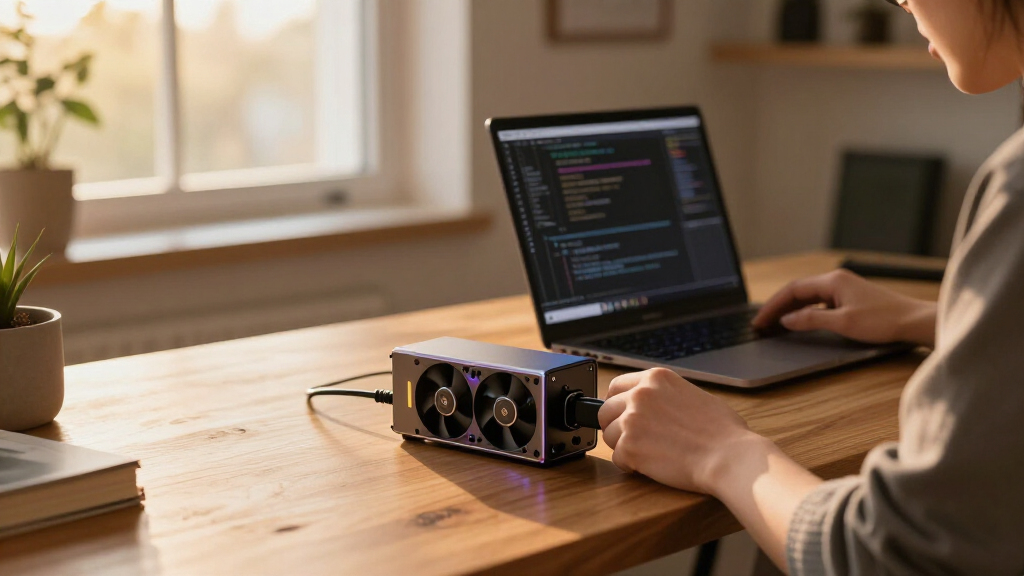

🔍 Read the full analysis: External GPU Innovations Powering AI In 2026 on ThorstenMeyerAI.com

Get hardware and tech essentials delivered free with Prime
- Fast, free delivery on millions of items
- Prime Video, Amazon Music and more included
- Member-only deals all year
TL;DR
In 2026, advancements in external GPU (eGPU) technology are significantly enhancing AI processing power. New enclosures and improved connectivity standards like Thunderbolt 4 and USB4 are enabling faster, more efficient AI workloads. The developments matter for AI researchers, tech companies, and consumers seeking high-performance computing without replacing hardware.
In 2026, the external GPU (eGPU) market has seen a wave of innovations that are significantly boosting AI processing capabilities. Leading manufacturers have introduced new high-performance enclosures featuring advanced connectivity standards and enhanced power delivery, enabling AI developers and enterprises to accelerate workloads without the need for full hardware upgrades. This development is reshaping the landscape of AI research and deployment, making powerful computing more accessible and flexible.
Major players like Razer, ASUS, and MINISFORUM have launched new eGPU models optimized for AI workloads, supporting the latest graphics cards and connectivity standards such as Thunderbolt 4 and USB4. The Razer Core X V2 remains popular for its reliability and robust power management, while ASUS’s ROG XG Mobile caters to high-end AI tasks requiring maximum GPU performance. These enclosures now support full-sized GPUs with power supplies exceeding 600W, facilitating complex AI models and large data processing.
Connectivity improvements are central to these innovations. Thunderbolt 4 and USB4 standards have become the norm, offering data transfer rates up to 40Gbps, which reduces latency and enhances real-time AI processing. Manufacturers emphasize thermal management and cooling solutions to sustain prolonged high-performance operation, critical for AI training and inference tasks. Pricing varies, but investments in higher-end models promise better future-proofing and compatibility with upcoming hardware upgrades.
Experts note that these advancements are enabling AI applications across industries, from autonomous vehicles to healthcare diagnostics, by providing scalable, portable, and cost-effective GPU power. The trend toward modular AI infrastructure is accelerating, with more users able to deploy sophisticated models without extensive hardware overhauls.
The 10 picks
- 1
 ASUS ROG XG Mobile (2025) External Graphics Card with NVIDIA GeForce RTX 5090View on Amazon →
 - 2ASUS ROG XG Mobile (2025) External Graphics Card with NVIDIA GeForce RTX 5070 TiView on Amazon →
- 3
 Razer Core X V2 External Graphics Enclosure (eGPU)View on Amazon →
 - 4
 AOOSTAR AG02 OCuLink eGPU Dock with 800W PSU and USB4 Port, External GPU Dock…View on Amazon →
 - 5
 External GPU Dock Station, Mini eGPU Enclosure Compatible with Thunderbolt 3/…View on Amazon →
 - 6
 MINISFORUM DEG1 eGPU Dock, External GPU Docking Station for RTX 4090, AMD RX…View on Amazon →
 - 7
 OwlTree PCIe 5.0 x4 128Gbps eGPU Dock for 50 Series Graphics Cards, M.2 NVMe…View on Amazon →
 - 8
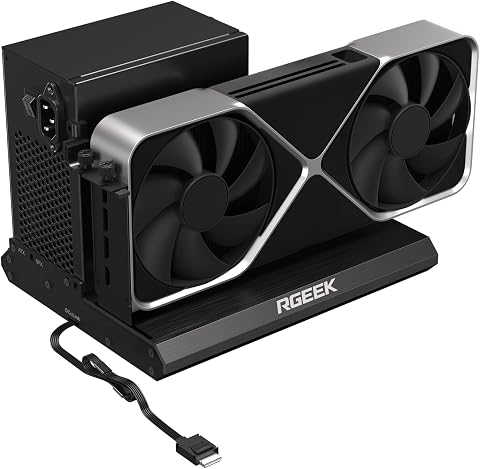 RGEEK OCuLink eGPU Dock PCIe 5.0 x4 for External Graphics CardView on Amazon →
 - 9
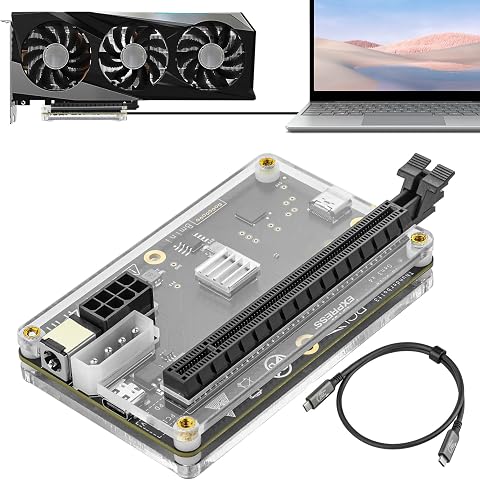 PCIe 3.0 x16 22Gbps eGPU Dock with Thunderbolt 4 Cable for Windows/LinuxView on Amazon →
 - 10
 OCuLink eGPU Dock, PCIe 4.0 x4 64Gbps, 19.7-inch SFF-8611 Cable, External GPU…View on Amazon →
How External GPU Advances Impact AI Development
The innovations in external GPU technology in 2026 are transforming AI development by making high-performance computing more accessible and flexible. Researchers and companies can now leverage portable enclosures with high wattage support and cutting-edge connectivity to run complex models faster and more efficiently. This reduces costs, accelerates research timelines, and broadens the user base for AI applications, potentially leading to breakthroughs in various fields. Additionally, these developments support a shift toward more modular and scalable AI infrastructure, enabling organizations to upgrade incrementally rather than overhaul entire systems.
Evolution of External GPU Tech and AI Needs
Over the past few years, external GPUs have transitioned from niche accessories to essential tools for AI and high-performance computing. Early models supported basic graphics tasks, but recent innovations focus on supporting the latest graphics cards and high bandwidth standards. The rise of AI workloads, which demand massive parallel processing and high data throughput, has driven this evolution. Manufacturers have responded by developing enclosures with higher wattage support, improved thermal management, and compatibility with the fastest connectivity standards like Thunderbolt 4 and USB4. This progression aligns with the increasing complexity and size of AI models, which require scalable and portable GPU solutions.
Prior to 2026, most eGPUs were limited in power and bandwidth, restricting their use to gaming or basic graphics tasks. The current wave of innovations addresses these limitations, supporting full-sized GPUs capable of handling demanding AI workloads. The market is also seeing a diversification of offerings tailored to different user needs—from portable solutions for field researchers to high-end enclosures for data centers.
Remaining Challenges and Unanswered Questions in eGPU Tech
While advancements are promising, several uncertainties remain. It is not yet clear how widespread adoption of the latest enclosures will be, especially in enterprise environments. Compatibility issues with older laptops and mini PCs persist, potentially limiting accessibility. Additionally, the long-term durability of high-wattage power supplies and thermal solutions under continuous AI workloads requires further observation. The impact of upcoming standards or potential hardware bottlenecks in data transfer speeds also remains to be seen.
Future Developments and Market Trends in AI-Optimized eGPUs
Looking ahead, manufacturers are expected to release more compact, energy-efficient enclosures that support even higher GPU wattages and faster connectivity standards. Software optimization for eGPU systems will also improve, reducing latency and enhancing AI training speeds. Industry analysts predict increased integration of AI-specific hardware accelerators within eGPU enclosures, further boosting performance. Market adoption will likely expand beyond early adopters to broader enterprise and consumer segments, driven by decreasing costs and greater performance gains. Monitoring these trends will be key to understanding how AI development continues to evolve with external GPU innovations.
Key Questions
How do external GPUs enhance AI processing capabilities?
External GPUs provide additional graphics processing power, enabling faster AI training and inference. They support high-performance graphics cards with advanced connectivity, which accelerates complex computations and large data handling outside traditional data centers.
Are current eGPU enclosures compatible with all laptops?
No, compatibility depends on the laptop’s ports—primarily Thunderbolt 4 or USB4—and hardware support. Users should verify their device specifications before purchasing an eGPU enclosure to ensure seamless integration.
What are the main advantages of Thunderbolt 4 over earlier standards?
Thunderbolt 4 offers higher data transfer speeds up to 40Gbps, improved thermal management, and broader compatibility, making it ideal for demanding AI workloads and high-performance GPU connections.
Will eGPU technology continue to evolve rapidly?
Yes, ongoing innovations in connectivity, power delivery, and thermal management suggest that eGPU technology will keep advancing, supporting even more powerful AI hardware and applications in the near future.
Source: ThorstenMeyerAI.com
Halloween Picks
halloween
As an affiliate, we earn on qualifying purchases.