
🔍 Read the full analysis: Can AI Follow Noctilucent Clouds Using A Twilight Dial? on ThorstenMeyerAI.com

Get hardware and tech essentials delivered free with Prime
- Fast, free delivery on millions of items
- Prime Video, Amazon Music and more included
- Member-only deals all year
TL;DR
ThorstenMeyerAI.com describes “Noctilucent — NLC Watch at 83 km,” an AI-built exhibition page about real high-altitude ice clouds. Its solar-depression dial changes the page’s lighting and cloud effects; the fictional observing project is not a live scientific service.
ThorstenMeyerAI.com has presented “Noctilucent — NLC Watch at 83 km,” an AI-built exhibition page that uses an interactive twilight dial to illustrate how high-altitude clouds can remain sunlit after darkness reaches the ground. The page is a fictional field journal, not a live observing service or scientific project; its subject, noctilucent clouds, is real.
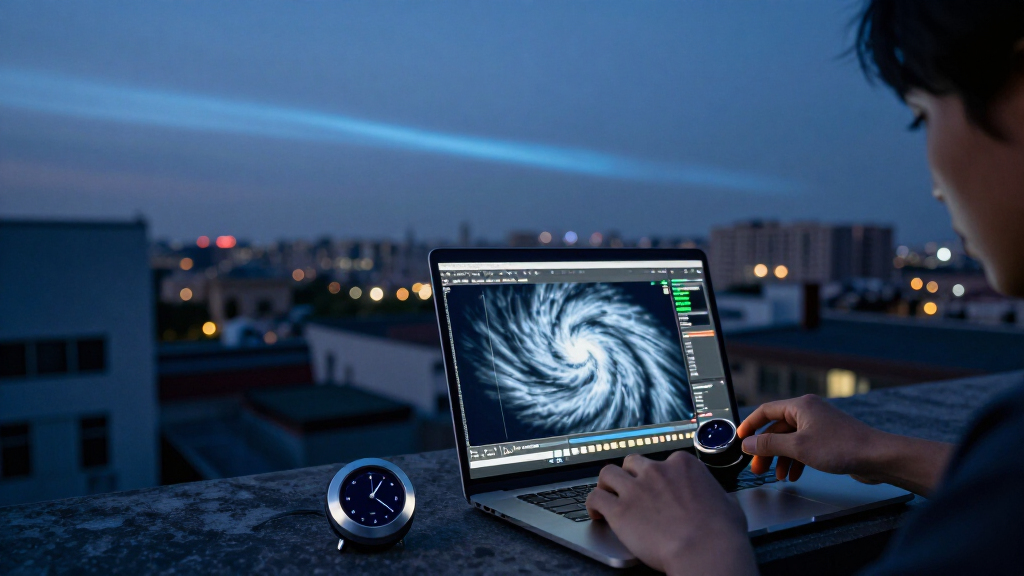
The dial represents the Sun’s position from 6 to 16 degrees below the horizon. As a visitor changes that setting, the page adjusts related visual elements, including sky brightness, shadow depth, cloud glow, ambient color, grain and horizon flare. The source says the most expressive point is near 11 degrees below the horizon. These are interactive visualizations, not measurements from a live sky or observing network.
The page’s cloud illustrations use different forms for billows, whirls and bands, while diagrams and supporting text follow the same lighting state. In a later exercise, visitors hold a control as simulated ground-level haze fades and a cloud band at 83 kilometres altitude becomes clearer. Releasing early lets the simulated sighting fade. The interaction supports pointer, keyboard and touch-like input, according to the project description.
ThorstenMeyerAI.com says the graphics are generated in the browser with Canvas, inline SVG and CSS, without image assets. Its description also says animation pauses when the page is hidden and that a reduced-motion setting provides a still version. The page moves from horizon and cloud explanations to ice-crystal formation, seasonal observation and a fictional field log.
Interactive exhibition · Twilight geometry
Can AI Follow Noctilucent Clouds Using a Twilight Dial?
A browser based exhibition uses a simulated solar depression dial to show how high altitude ice clouds can remain sunlit after darkness reaches the ground. The clouds are real; the observing project is fictional.
01 / What the dial changes
One setting, many visual effects
Moving the dial links the page’s lighting model to several visual details. This helps explain the twilight idea, but the changing scene is an illustration rather than evidence of current cloud activity.
Sky & horizon
Brightness shifts
Sky brightness, ambient color, shadow depth, and horizon flare respond together as the simulated Sun moves farther below the horizon.
Cloud appearance
Ice catches the light
Cloud glow changes with the dial. Billows, whirls, and bands use different illustrated forms to give the scene texture.
Page atmosphere
Details stay in sync
Grain, diagrams, and supporting text follow the same lighting state, keeping the interface centered on one visual variable.
02 / The learning idea
From dark ground to sunlit ice
Noctilucent clouds are real, high altitude ice clouds. They can remain illuminated when the observer below is already in darkness, as sunlight grazes the shadowed Earth and reaches higher layers of the atmosphere.
Ground enters darkness
The observer’s horizon is already past sunset.
Sun drops below horizon
The dial represents this angle from 6° to 16°.
Higher ice still catches light
Clouds near the title’s 83 km altitude can remain sunlit.
Contrast becomes visible
The page visualizes the difference between ground and sky.
Hold to reveal
A later exercise asks visitors to hold a control as simulated ground haze fades and a cloud band becomes clearer. Releasing early lets the simulated sighting fade.
Designed for access
The project description says the interaction supports pointer, keyboard, and touch input. Animation pauses when the page is hidden, with a still version for reduced motion.
03 / What it is—and is not
A fictional journal about real clouds
“A fictional field journal for a fictional observing project, not a real company or live scientific service.”ThorstenMeyerAI.com project description
Evidence boundary
The supplied description reports no live observations, data sources, forecast accuracy, scientific validation, or connection to monitoring stations. The dial’s range and effects describe the page design, not an instrument reading or AI tracking clouds in the atmosphere.
04 / How to read the project
Creative process, not field validation
The exhibition’s design guide describes a three pass process: build the page, critique its clarity and interaction, then review its art direction. Those notes document the design approach; they do not establish operational cloud monitoring or independent scientific testing.
Is NLC Watch a real observation service?
No. It is described as a fictional field journal and observing project, not a live scientific service.
Are the displayed clouds live observations?
The description presents them as browser generated illustrations, with no identified live feed or observing network.
What does the twilight dial control?
A simulated solar depression from 6° to 16° below the horizon, updating visual elements such as sky brightness, cloud glow, and shadow depth.
Are noctilucent clouds real?
Yes. They are high altitude ice clouds that can stay sunlit after the ground below has entered darkness.
Source: ThorstenMeyerAI.com project description. The supplied material does not establish the page’s current availability or whether its implementation has changed. Consult the exhibition and design guide for its exact interaction and any additional scientific references.
Turning Twilight Geometry Into an Interaction
The dial gives visitors a way to explore the central visual idea behind noctilucent clouds: the observer is in darkness while ice higher in the atmosphere can still catch sunlight. Rather than changing only a background color, the control links several parts of the page to one setting. That design may help visitors connect the changing appearance of the sky with the Sun’s position below the horizon.
The project is best understood as an educational and visual demonstration, not evidence that AI is tracking clouds in the real atmosphere. The supplied material describes an authored interactive experience and a fictional observing network. It does not report field observations, validated predictions, scientific results or a functioning monitoring system. That distinction matters for readers deciding whether they can use the page to locate clouds or contribute observations: the source does not establish that they can.
night sky telescope for noctilucent clouds
As an affiliate, we earn on qualifying purchases.
As an affiliate, we earn on qualifying purchases.
A Fictional Journal, Real Clouds
Noctilucent clouds are real, high-altitude ice clouds that can remain illuminated after the ground below has entered darkness. The page’s title refers to an altitude of 83 kilometres, and its design brief frames the display around twilight geometry: sunlight grazing the shadowed Earth and reaching ice above it. The source presents this as the scientific idea the interface is meant to communicate.
The exhibition is identified as room 162 of 175 in a series. Its observing stations and journal entries are invented, and the source explicitly describes the network as fictional. The accompanying design guide documents a three-pass process: building the page, critiquing it for clarity and interaction, and reviewing its art direction. Those notes explain the design approach; they are not independent scientific testing or a report of operational cloud monitoring.
““a fictional field journal for a fictional observing project, not a real company or live scientific service.””
— ThorstenMeyerAI.com project description
high-altitude cloud observation binoculars
As an affiliate, we earn on qualifying purchases.
As an affiliate, we earn on qualifying purchases.
No Live Tracking or Validation Reported
The supplied source does not give a publication date, link to independent testing or information showing that the page has been evaluated by atmospheric scientists. It also does not report live observations, data sources, forecast accuracy or a connection to real monitoring stations. The stated dial range and its visual effects describe the page’s design; they should not be read as a live instrument reading.
The source refers readers to the live page and a construction guide, but the material provided here does not establish the page’s current availability or whether its implementation has changed. It is also unclear whether the exhibition includes citations or additional scientific material beyond the descriptions summarized in the source.
astronomy binoculars for astrophotography
As an affiliate, we earn on qualifying purchases.
As an affiliate, we earn on qualifying purchases.
Check the Page and Its Design Notes
The source invites readers to open the exhibition in a browser and consult its design guide for details on the lighting model, procedural graphics and animation behavior. Those materials are the next places to check for the exact interaction and any additional scientific references. Until such material establishes otherwise, the project should be treated as a browser-based illustration of noctilucent-cloud viewing, not a tool for tracking current sightings.
solar depression dial astronomy tool
As an affiliate, we earn on qualifying purchases.
As an affiliate, we earn on qualifying purchases.
Key Questions
Is NLC Watch a real cloud-observation service?
No. ThorstenMeyerAI.com describes it as a fictional field journal and observing project, not a live scientific service.
What does the twilight dial control?
It moves through a simulated solar-depression range of 6 to 16 degrees below the horizon and updates visual elements such as sky brightness, cloud glow and shadow depth.
Are the clouds shown on the page live observations?
The supplied description presents them as browser-generated illustrations. It does not identify a live feed, real observations or a connection to an observing network.
Are noctilucent clouds real?
Yes. The project describes them as real, high-altitude ice clouds that can remain sunlit after the ground below is dark.
Source: ThorstenMeyerAI.com
Halloween Picks
halloween
As an affiliate, we earn on qualifying purchases.