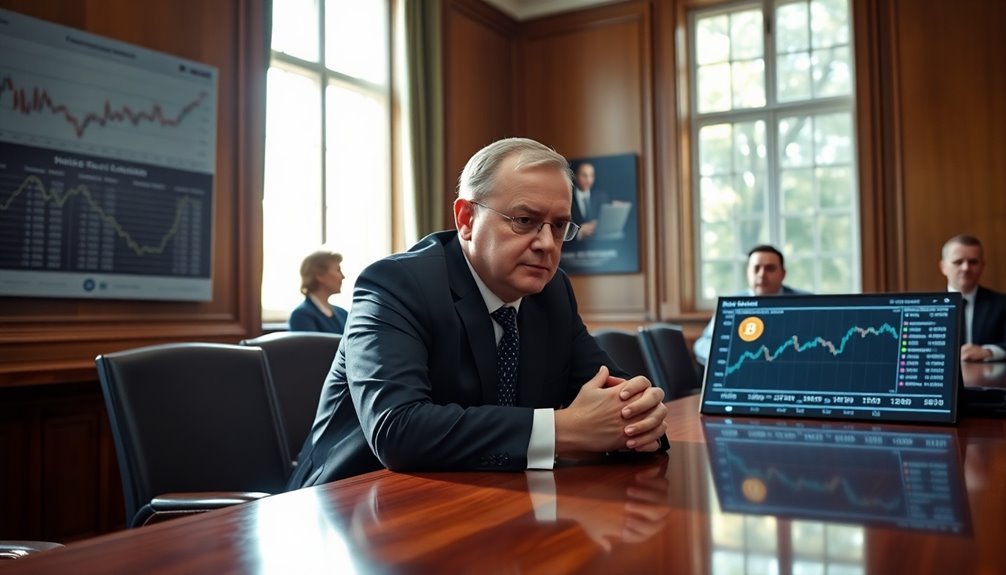

You might find it intriguing that the Governor of the Czech National Bank is advocating for a measured approach to Bitcoin. Instead of panicking, he suggests a careful study of its potential benefits. This perspective highlights a shift in how institutions view cryptocurrencies amid uncertainty. What could this mean for the future of digital assets and traditional banking? The implications are worth considering as we navigate this evolving landscape.

As the Czech National Bank explores the potential of Bitcoin for its foreign exchange reserves, it's stirring up conversations about the cryptocurrency's role in modern finance. You might find it intriguing that the bank is considering allocating up to 5% of its substantial €140 billion reserves to Bitcoin. This move reflects a broader trend among central banks worldwide as they look to diversify their asset portfolios beyond traditional equities and bonds.
However, you shouldn't overlook the volatility concerns that accompany Bitcoin. Its unpredictable price fluctuations have made it a high-risk asset, and that's a big deal for investors and financial institutions. The Czech National Bank is well aware of this volatility and is conducting a thorough analysis to weigh Bitcoin against other asset classes like corporate bonds and real estate funds. This careful assessment will help them understand Bitcoin's potential benefits for portfolio diversification and its overall market impact. Moreover, global uncertainty influences market behavior significantly, compelling institutions to consider alternative assets like Bitcoin.
Economic uncertainty and geopolitical risks are also influencing the Czech National Bank's interest in Bitcoin. In times of instability, alternative assets like Bitcoin often gain traction. While some view Bitcoin as an inflation hedge, its effectiveness remains up for debate. The ongoing discussions about its role as a safe haven during economic downturns highlight the skepticism surrounding its reliability compared to traditional assets like gold.
You should note that the Czech National Bank's approach includes regulatory oversight of the cryptocurrency market under new legislation. This step reflects a growing awareness among central banks of the need to adapt to technological changes in financial markets. The bank's exploration of Bitcoin indicates a willingness to embrace this evolution while managing associated risks.
The European Central Bank has expressed skepticism about investing in Bitcoin, showcasing the mixed perspectives among central banks. Nonetheless, the Czech National Bank's focus on a diverse asset strategy signals a shift toward modern financial tools. With growing interest from institutional investors and the public, the cryptocurrency world is capturing attention like never before.

Cryptocurrency QuickStart Guide: The Simplified Beginner’s Guide to Digital Currencies, Bitcoin, and the Future of Decentralized Finance (Trading & Investing – QuickStart Guides)
As an affiliate, we earn on qualifying purchases.
As an affiliate, we earn on qualifying purchases.

Crypto Seed Cold Storage Wallet with Engraver Pen Kit – Metal Plate and Etching Tool for Cryptocurrency Password Phrase Backup and Recovery
All Inclusive Kit for Crypto Seed Key Storage – Comes a Stainless Steel Plate & Tungsten Steel Engraving…
As an affiliate, we earn on qualifying purchases.
As an affiliate, we earn on qualifying purchases.

Bitkey Bitcoin Hardware Wallet – Secure Wallet for Self Custody, No Seed Phrase, 2-of-3 Multisig Security, NFC Device, iOS and Android Compatible
BITCOIN HARDWARE WALLET FOR TRUE SELF CUSTODY: Secure your bitcoin with a dedicated hardware wallet designed for self…
As an affiliate, we earn on qualifying purchases.
As an affiliate, we earn on qualifying purchases.

Blockchain Fundamental Analysis for Digital Asset Investors: A Guide to Minimizing Risk and Maximizing Returns
As an affiliate, we earn on qualifying purchases.
As an affiliate, we earn on qualifying purchases.