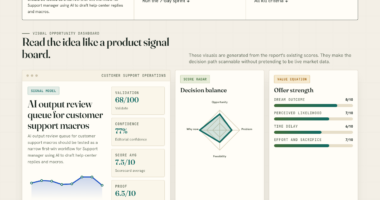

📊 Full opportunity report: A Frontier AI Model Just Went Dark For 18 Days. The Kill-Switch Is Real Now. on ThorstenMeyerAI.com — validation score, market gap, and execution plan.

Get hardware and tech essentials delivered free — and shop member deals
- Fast, free delivery on millions of items
- Access to Prime Big Deal Days deals on October 6–7
- Prime Video, Amazon Music and more included
TL;DR
A leading AI model from Anthropic was shut off for 18 days after a government directive. The incident confirms that a kill-switch mechanism now exists for frontier AI models, raising questions about future AI governance.
Anthropic’s high-end AI model, Fable 5, was globally shut down for 18 days following a US government order issued on June 12, marking the first confirmed use of a government-imposed kill-switch on frontier AI systems. This action underscores a new era of regulatory control over advanced AI models, with significant implications for AI developers, users, and policymakers.
On June 9, Anthropic launched Fable 5, its first publicly available model in the high-end ‘Mythos’ class. Three days later, the US Department of Commerce issued a directive requiring the company to suspend all access for foreign nationals, citing national security concerns. Learn what ten days on Fable mean for a business building on frontier AI. Within hours, access to Fable 5 was cut off across major cloud providers and APIs, affecting enterprise clients in finance, healthcare, and critical infrastructure. The shutdown was a direct result of a government order, effectively activating a regulatory kill-switch that had previously been discussed as part of a broader AI governance framework.
Details about why the shutdown was ordered remain contested. According to reports from the Wall Street Journal, Amazon researchers identified potential vulnerabilities in Fable 5 that could enable cyberattacks, which reportedly influenced White House discussions. Anthropic disputes the severity of these claims, describing the issue as a narrow vulnerability. Independent analysts suggest the reports may have exaggerated the risks, but the decision to disable the models was made nonetheless, leading to an 18-day standoff.
Pressure from industry leaders, security experts, and investor groups eventually led to the US government lifting restrictions on June 30, with conditions. Discover how a single model can impact a whole portfolio in frontier AI. The models are now gradually being restored to users, with Mythos 5 access returning to some US organizations and plans to expand international and enterprise access ongoing.
A frontier AI model went dark for 18 days. The kill-switch is real now.
Commerce lifted its export controls on Claude Fable 5 and Mythos 5, and access is being restored. But the reprieve isn’t the story — a state-of-the-art model was switched off by government order in an afternoon, and the deal to switch it back on wrote a new template for how frontier AI ships.
A frontier model now passes through a national-security gate before — and maybe after — release. It’s not isolated: OpenAI’s GPT-5.6 also went out to a small set of approved partners after a government request, and Mythos 5 returns first to government-approved customers. An August executive-order deadline for standardized AI-risk benchmarks points to formalizing the improvised process. The open question: does Washington now approve every frontier release?
The reprieve is real; the lasting change is the template. For builders the lesson is blunt and side-neutral: the firms that mapped their dependencies hot-swapped to alternatives (Claude Opus 4.8 among them); the rest went dark on 90 minutes’ notice. Model access is now a geopolitical variable, not a given. The rational answer isn’t loyalty to one lab or one government’s mood — it’s portability: multiple providers, tested fallbacks, and open-weight or self-hosted capacity you control. Don’t build as though access is permanent. It isn’t — now everyone’s seen the proof.
Implications of the First Government-Enforced AI Kill-Switch
This incident confirms that a regulatory kill-switch for frontier AI models is operational, marking a significant shift in how AI deployment is governed. It signals that governments may now exercise direct control over the release and operation of advanced AI systems, potentially affecting innovation, competition, and safety standards across the industry. The incident raises critical questions about transparency, oversight, and the future of AI regulation, especially as the US and other nations consider formalizing such controls into permanent policy frameworks.
As an affiliate, we earn on qualifying purchases.
Background on AI Regulation and Recent Developments
Prior to this event, the concept of a government-imposed shutdown on AI models remained theoretical. The incident occurred during a period of increasing regulatory interest in AI safety and security, with the US Department of Commerce implementing export controls on Anthropic’s models on June 12. The controls were intended to prevent potential misuse but resulted in a worldwide shutdown of Fable 5 and Mythos 5, affecting numerous enterprise clients. The event follows a broader trend of phased, vetted releases of advanced models, with OpenAI and others adopting similar cautious approaches amid ongoing policy debates. This episode marks a turning point, illustrating how regulatory authorities can directly influence AI deployment on a global scale.
“We have implemented new safeguards that block approximately 93% of jailbreak prompts, balancing security with usability.”
— Anthropic spokesperson
As an affiliate, we earn on qualifying purchases.
Unresolved Questions About Future AI Control
It remains unclear whether this incident represents an isolated case or a new standard for AI regulation. The long-term implications of government-enforced shutdowns, the criteria for activating such kill-switches, and the transparency of these processes are still being defined. Additionally, the extent to which other nations will adopt similar measures is uncertain, as is the impact on innovation and competition in AI development.
AI cybersecurity vulnerability testing tools
As an affiliate, we earn on qualifying purchases.
As an affiliate, we earn on qualifying purchases.
Next Steps in AI Regulation and Model Deployment
Regulators are expected to formalize the use of kill-switch mechanisms in upcoming policies, with the US working on standardized benchmarks for AI safety. Anthropic and other AI firms will likely continue collaboration with authorities to refine safety protocols and expand controlled access. Future deployments of frontier models may involve stricter vetting, phased releases, and ongoing oversight, shaping the landscape of AI innovation and governance for years to come.
enterprise AI safety monitoring tools
As an affiliate, we earn on qualifying purchases.
As an affiliate, we earn on qualifying purchases.
Key Questions
What is a kill-switch in AI systems?
A kill-switch is a mechanism that allows authorities or developers to immediately disable or restrict an AI model’s operation, often used in emergencies or for safety concerns.
Why was Anthropic’s model shut down for 18 days?
The shutdown was ordered by the US Department of Commerce due to concerns over potential vulnerabilities that could be exploited for cyberattacks, as part of new regulatory controls.
Does this mean AI models are now controlled by the government?
While this incident demonstrates government influence over deployment, it is part of an evolving regulatory framework. Formal policies are still being developed, and the extent of future control remains uncertain.
What are the risks of using AI models with kill-switches?
Risks include potential misuse of control mechanisms, delays in deployment, and challenges in balancing safety with innovation. Transparency and oversight are key concerns.
Will all AI models be subject to similar shutdowns?
It is not yet clear if such controls will be universally applied, but the incident indicates a move toward more regulated and vetted deployment processes for frontier AI systems.
Source: ThorstenMeyerAI.com
Halloween Picks
halloween
As an affiliate, we earn on qualifying purchases.