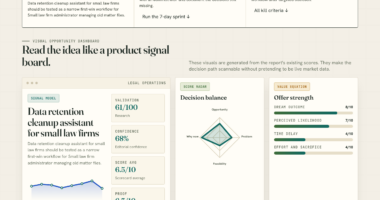

📊 Full opportunity report: AI output review queue for customer support macros on IdeaNavigator AI — validation score, market gap, and execution plan.

Get hardware and tech essentials delivered free — and shop member deals
- Fast, free delivery on millions of items
- Access to Prime Big Deal Days deals on October 6–7
- Prime Video, Amazon Music and more included
TL;DR
Support managers are trialing a new AI output review system for support macros to catch policy and tone issues. This development aims to improve quality control in AI-assisted customer support. The initiative is in early testing stages with a focus on manual validation.
Support teams are beginning to test a new AI output review queue for customer support macros, aiming to ensure compliance with policies and tone before macros are published. This development addresses the challenge of maintaining quality in AI-generated support content, which can drift from established guidelines without human oversight.
The new review queue is designed as a workflow tool for support managers using AI to draft help-center replies and macros. Its primary function is to score drafts based on criteria such as policy adherence, tone, source support, and risk of making misleading promises. The system aims to identify issues before macros are published, reducing the risk of policy violations or tone inconsistencies.
According to sources familiar with the initiative, the review process involves manual validation of twenty AI-drafted macros, with metrics focused on how many issues are caught during review. The goal is to establish a reliable first-pass filter that supports faster, safer deployment of AI-generated support content. The project is currently in early testing phases, with support teams evaluating the tool’s effectiveness and refining its scoring algorithms.
Support organizations interested in the system will be able to subscribe on a team basis, integrating it into their existing support workflows. The system’s success depends on its ability to reduce manual review time while improving macro quality and compliance.
Potential Impact on Customer Support Quality Control
This initiative is significant because it addresses a key challenge in adopting AI for customer support: ensuring that automatically generated macros do not violate policies or misrepresent information. By implementing an AI output review queue, support organizations can better control the quality of AI assistance, potentially reducing compliance risks and maintaining brand reputation.
For support managers, this system offers a way to balance automation with oversight, enabling faster response times without sacrificing accuracy or tone. If successful, it could become a standard part of AI-assisted support workflows, influencing how companies deploy AI in customer service environments.
As an affiliate, we earn on qualifying purchases.
Rise of AI in Customer Support and Need for Oversight
As AI adoption accelerates in customer support, many organizations are using AI to draft macros and responses to improve efficiency. However, without proper review processes, there is a risk that these macros may drift from company policies, contain inaccuracies, or fail to match the desired tone. Currently, many support teams review AI-generated content manually, which can be time-consuming and inconsistent.
The development of a dedicated review queue aims to formalize this oversight process, providing an automated scoring system to flag potential issues. This approach reflects broader industry trends toward balancing automation with quality control, especially as AI tools become more integrated into support workflows.
Initial validation involves manually reviewing twenty macros to measure how many issues are identified before publication, serving as a benchmark for the system’s effectiveness. The initiative is part of ongoing efforts to scale AI support while maintaining high standards of compliance and customer experience.
“The review queue is designed to catch policy violations and tone issues early, supporting support managers in maintaining quality.”
— an anonymous researcher
customer support macro validation software
As an affiliate, we earn on qualifying purchases.
As an affiliate, we earn on qualifying purchases.
Unclear How Effectiveness Will Be Measured
It is not yet clear how the success of the review queue will be quantified beyond initial manual validation. Details on long-term performance metrics, integration with existing support systems, and scalability remain to be seen.
It is also uncertain whether support teams will fully adopt the system or how it will perform across different industries and company sizes. Further testing and real-world deployment will clarify these aspects over time.
As an affiliate, we earn on qualifying purchases.
Next Steps in Testing and Deployment
Support organizations will continue testing the review queue with a focus on refining scoring algorithms and reducing false positives. The system is expected to undergo broader pilot programs before potential wider rollout.
Further validation will involve tracking how many macros are flagged and corrected during review, as well as gathering feedback from support managers on usability. Industry observers will watch for how this tool influences overall support quality and compliance standards.
AI-generated support response review
As an affiliate, we earn on qualifying purchases.
As an affiliate, we earn on qualifying purchases.
Key Questions
How does the review queue improve AI support macros?
The review queue scores AI-drafted macros based on policy adherence, tone, and risk factors, helping support managers catch issues before publication.
Is this system available for all support teams now?
Currently, the review queue is in early testing phases and not yet widely available. Support organizations can participate in pilot programs.
Will this reduce manual review time?
Yes, the goal is to automate initial quality checks, reducing the manual effort needed to vet AI-generated macros.
What are the main challenges expected in deploying this system?
Challenges include refining the scoring algorithms to minimize false positives, ensuring integration with existing workflows, and gaining support team acceptance.
Could this system prevent policy violations?
It aims to catch potential violations early, but human oversight will still be necessary to ensure complete compliance and context understanding.
Source: IdeaNavigator AI
Fall Picks
fall essentials
As an affiliate, we earn on qualifying purchases.