
📊 Full opportunity report: Benefit Check Bots And Their Role In Advancing Social Determinants Of Health on IdeaNavigator AI — validation score, market gap, and execution plan.

Get hardware and tech essentials delivered free with Prime
- Fast, free delivery on millions of items
- Prime Video, Amazon Music and more included
- Member-only deals all year
TL;DR
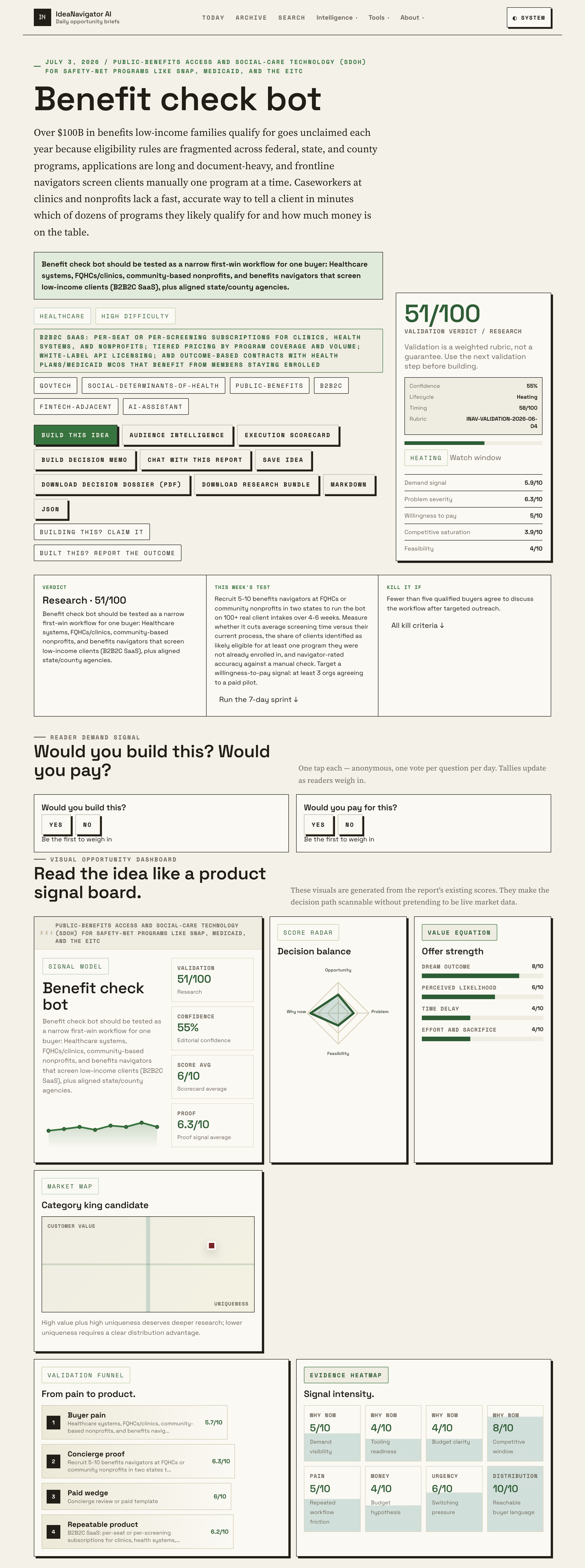
Benefit check bots are being tested as tools for healthcare providers and nonprofits to quickly identify low-income clients’ eligibility for social programs. This innovation could improve access, reduce manual screening time, and help recover billions in unclaimed benefits.
Benefit check bots are being tested as a new tool to help healthcare systems, clinics, and nonprofits quickly identify low-income clients’ eligibility for multiple social benefit programs. This development aims to address the longstanding challenge of unclaimed benefits worth over $100 billion annually, by providing a fast, accurate, and multilingual screening process that can be embedded into existing workflows.
The benefit check bot is a white-label conversational AI tool designed for use by benefits navigators at clinics, community organizations, and state agencies. It asks clients a series of yes/no and multiple-choice questions, then generates a list of likely-eligible programs such as SNAP, Medicaid, EITC/CTC, WIC, and LIHEAP, along with estimated benefits and application links. The tool is initially being tested in two states with 5-10 navigators, aiming to evaluate its impact on screening efficiency and accuracy.
This initiative follows the recent shutdown of Benefits Data Trust, a nonprofit that had been screening and enrolling clients across seven states for two decades. Its absence has created a capacity gap as health systems and state agencies face increased demand for eligibility redeterminations, especially after the pandemic-era Medicaid unwinding. The AI-powered bots leverage conversational technology to perform screening at near-zero marginal cost, potentially transforming benefits access workflows.
Developers plan to log anonymized screening data for dashboards, allowing organizations to track outcomes and improve accuracy over time. The revenue model includes tiered SaaS subscriptions, API licensing, and outcome-based contracts with Medicaid managed care organizations, aiming for scalability across public-benefits programs.
This innovation could significantly improve the efficiency of benefits screening, enabling frontline workers to identify eligible clients faster and with greater accuracy. By reducing manual effort and streamlining eligibility checks, benefit check bots may recover billions in unclaimed benefits annually, directly supporting low-income families. Additionally, the multilingual capability of the AI can help reach diverse populations often underserved by traditional processes, addressing disparities in social determinants of health (SDOH).
Moreover, as health systems and social service agencies seek to adapt to post-pandemic challenges, these tools could become critical infrastructure for social care delivery. The potential to embed such bots into existing workflows offers a scalable solution that aligns with broader efforts to incorporate social determinants into health management and payment models.
Products Worth Considering

Apple MacBook Pro 2023 14 with M3 Pro Chip, 18 GB RAM, 2 TB SSD, Space Black

Logitech MX Brio Ultra HD 4K Webcam, Graphite

Logitech MX Keypad Programmable Macro Pad, Graphite
As an affiliate, we earn on qualifying purchases.
Background on Benefits Screening Challenges and AI Solutions
For decades, low-income families have left over $100 billion in benefits unclaimed each year due to complex eligibility rules, lengthy application processes, and manual screening by caseworkers. The shutdown of Benefits Data Trust in 2024 removed a key capacity for outsourced benefits enrollment, intensifying the workload for health systems and state agencies during Medicaid redeterminations. Meanwhile, advances in conversational AI have made it feasible to develop automated, multilingual screening tools that can operate at minimal cost, promising to address longstanding access gaps.
Early pilots of similar AI tools have shown promise in reducing screening times and increasing the identification of eligible clients. The current effort builds on these developments, with a focus on testing in real-world settings to validate effectiveness and scalability.
What Aspects of Effectiveness and Adoption Remain Unclear
It is not yet confirmed how accurately the benefit check bots will perform across diverse populations and program rules at scale. The pilot phase will provide initial data, but long-term effectiveness, user acceptance, and integration into existing workflows remain to be fully evaluated. Additionally, questions about funding, privacy, and data security are still under discussion, and broader regulatory considerations could influence deployment.
Next Steps for Validation and Broader Implementation
Over the coming weeks, the participating organizations will conduct pilot testing with 100+ client screenings. The focus will be on measuring reductions in screening time, increases in benefits identified, and accuracy compared to manual checks. Success in these pilots could lead to wider adoption, with plans to expand the tool to additional states and programs, and to refine features based on user feedback.
Further research and development will explore integration with existing health and social service platforms, as well as potential policy support for automated benefits screening as part of broader social determinants of health initiatives.
Key Questions
How does the benefit check bot work?
The bot uses conversational AI to ask clients a series of yes/no and multiple-choice questions about their circumstances, then outputs a list of programs they likely qualify for, along with estimated benefits and application links.
Who is developing and testing these benefit check bots?
The initiative is led by developers working with healthcare providers, community nonprofits, and state agencies, with pilot testing planned in two states involving 5-10 navigators.
What benefits could this technology bring?
If successful, the bots could reduce screening time, increase benefits recovery, and improve access for underserved populations, supporting social determinants of health efforts.
Are there any privacy concerns?
While privacy measures are being considered, the pilots will include anonymized data collection to ensure compliance with data security standards. Broader privacy implications are still under review.
When might this technology be available at scale?
Wider deployment depends on pilot results, but if successful, broader adoption could occur within the next 1-2 years as organizations refine the tool and expand its use.
Source: IdeaNavigator AI