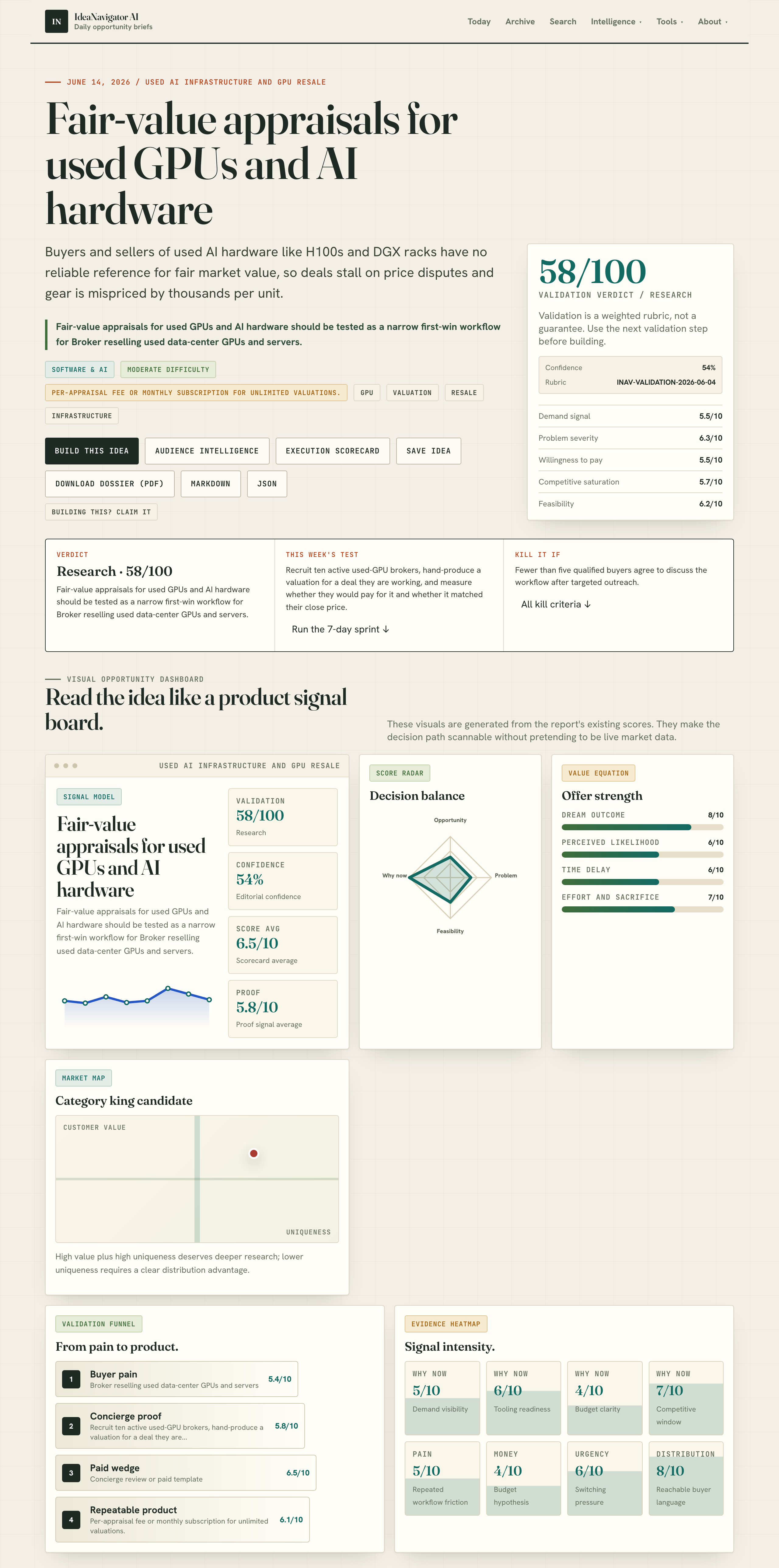
📊 Full opportunity report: Fair-value appraisals for used GPUs and AI hardware on IdeaNavigator AI — validation score, market gap, and execution plan.

Get hardware and tech essentials delivered free — and shop member deals
- Fast, free delivery on millions of items
- Access to Prime Big Deal Days deals on October 6–7
- Prime Video, Amazon Music and more included
TL;DR
A new manual valuation method for used GPUs and AI hardware is being tested to provide brokers with fair market value estimates. This aims to reduce pricing disputes and improve transparency in the resale of data-center equipment.
Efforts are underway to develop a manual fair-value appraisal system for used data-center GPUs and AI hardware, aiming to provide brokers with reliable pricing benchmarks amid a rapidly expanding secondary market.
The initiative targets brokers reselling used AI hardware such as H100 GPUs and DGX racks, which currently face challenges due to a lack of transparent, standardized pricing references. The proposed system involves a manual valuation sheet where brokers input hardware details—model, condition, quantity—and receive a curated fair-value range based on recent comparable sales from public listings.
This approach is designed as a first step to establish a reliable, quick reference for fair market value, potentially reducing deal stalls caused by price disagreements. The valuation tool is expected to generate revenue through per-appraisal fees or subscriptions offering unlimited valuations. Validation involves testing the system with ten active used-GPU brokers, comparing the appraisals with actual closing prices to assess accuracy and willingness to pay for the service.
Impact of Standardized Fair-Value Appraisals on GPU Resale
This development could significantly streamline the secondary market for AI hardware, reducing pricing disputes and increasing market transparency. Reliable fair-value estimates may encourage more trading activity, improve pricing efficiency, and help brokers and buyers make better-informed decisions. As hyperscalers and labs continue to refresh their GPU fleets rapidly, a standardized valuation tool could become a critical component in facilitating smoother transactions and reducing the risk of mispricing, which currently can amount to thousands of dollars per unit.
As an affiliate, we earn on qualifying purchases.
Rapid Hardware Refreshes Drive Secondary Market Growth
Recently, hyperscalers and research labs have been aggressively upgrading their GPU fleets, often replacing hardware with recent-generation models. This has flooded the secondary market with large volumes of used AI hardware, including high-end GPUs like the H100 and complex servers such as DGX racks. Despite the market’s growth, pricing remains opaque, with no widely accepted benchmarks, leading to frequent deal stalls and mispricing by thousands of dollars per unit. Currently, brokers lack a standardized method to assess fair value, which hampers efficient trading and liquidity in this niche market.
“A manual valuation tool based on recent comparable sales could provide the transparency needed to stabilize the used AI hardware market.”
— an anonymous researcher
As an affiliate, we earn on qualifying purchases.
Uncertainties in Adoption and Accuracy of Valuation System
It is not yet clear how widely brokers will adopt the manual valuation tool or how accurate the fair-value ranges will be compared to actual market prices. The validation process with ten brokers will determine its practical effectiveness, but broader industry acceptance remains uncertain. Additionally, the system’s ability to adapt to rapidly changing hardware prices and conditions is still under development.
As an affiliate, we earn on qualifying purchases.
Next Steps in Testing and Market Integration
The next phase involves deploying the valuation sheet with ten active used-GPU brokers, measuring its accuracy against actual deal prices, and assessing whether brokers are willing to pay for such a service. If successful, the team plans to refine the tool, expand testing, and potentially launch a commercial platform offering subscription-based or per-appraisal pricing. Broader industry feedback will be crucial in shaping its future adoption.
As an affiliate, we earn on qualifying purchases.
Key Questions
How will the fair-value appraisal system improve GPU resale transactions?
It will provide brokers with a standardized, transparent estimate of fair market value based on recent comparable sales, reducing pricing disputes and speeding up deal closures.
What hardware models will the valuation tool cover initially?
The initial focus will be on high-demand data-center GPUs like the H100 and servers such as DGX racks, which are most actively traded in the secondary market.
Is this valuation method expected to be fully automated?
No, the current approach is manual, involving a curated valuation sheet. Automation may be considered in future iterations based on initial testing outcomes.
When could this system be available for widespread use?
The testing phase is ongoing; if validation proves successful, a broader rollout could occur within the next year, but timelines depend on industry feedback and refinement.
Will this system address all types of used AI hardware?
Initially, it will target high-value GPUs and servers, with potential expansion to other hardware types as the model matures and demand grows.
Source: IdeaNavigator AI
Evergreen bestsellers Picks
bestsellers
As an affiliate, we earn on qualifying purchases.