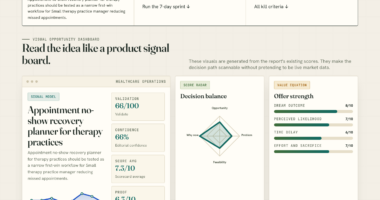

📊 Full opportunity report: Q3 2026 SaaS Earnings Pre-Brief: The Litmus Test for the Agentic-Disruption Thesis on ThorstenMeyerAI.com — validation score, market gap, and execution plan.

Get hardware and tech essentials delivered free — and shop member deals
- Fast, free delivery on millions of items
- Access to Prime Big Deal Days deals on October 6–7
- Prime Video, Amazon Music and more included
TL;DR
The upcoming Q3 2026 SaaS earnings reports will serve as a key test for the agentic-disruption thesis, revealing whether SaaS companies are accelerating or stalling their shift to consumption-based models. Major firms like ServiceNow and Salesforce have already signaled a structural transition, but uncertainties remain about the pace and market acceptance.
The Q3 2026 SaaS earnings season will serve as a decisive test for the agentic-disruption thesis, with key companies reporting their latest financials to confirm whether the industry is accelerating its shift toward consumption-based, AI-driven models or facing a stall.
Major SaaS firms like ServiceNow and Salesforce have signaled a significant shift in their business models, emphasizing consumption-based revenue streams and AI-driven metrics. ServiceNow reported in April that over 50% of net new business now derives from non-seat, consumption-based models, and raised its AI annual contract value (ACV) guidance from $1 billion to $1.5 billion. Despite beating revenue and profitability expectations, its stock declined 18% the following day, reflecting market skepticism about the durability of this transition. Similarly, Salesforce’s Q4 FY26 report revealed that its Agentforce ARR grew 169% YoY to $800 million, with 29,000 deals closed, and introduced the metric of Agentic Work Units (AWUs), which measure tasks accomplished by AI agents. Salesforce also restated its fiscal 2026 numbers, segmenting its revenue into ‘Agentforce Apps’ and ‘Data 360, Platform & Other,’ signaling a strategic shift toward agentic, AI-enabled offerings. The combined ARR for these segments exceeds $2.9 billion, up 200% YoY. Market participants are closely watching whether these signals indicate a broader industry trend or are isolated to these giants. The upcoming earnings reports from other leading SaaS providers will be pivotal in confirming if the agentic-disruption thesis is gaining momentum or if the transition is stalling, which could lead to a reevaluation of SaaS valuations and growth assumptions.Six companies. Four metrics.
The litmus test for the agentic-disruption thesis at scale. July-August 2026.
Q1 baseline: ServiceNow beat earnings, raised AI ACV 50%, lost 18% in a day. Salesforce restated segments to separate Agentforce Apps from Data 360. Both stocks repriced lower despite beats. The Q3 cycle either confirms the consumption pivot is durable or accelerates the cohort selloff.
Four metrics. Four watch thresholds.
Investor focus has consolidated around four metrics that determine Q3 reactions. Each beats or misses produces asymmetric stock reactions: small misses produce large drops, small beats produce muted reactions.
Six companies. July-August 2026.
Six major SaaS companies report Q3 2026 calendar reports across July-August 2026. Each needs to prove specific elements of the four-metric scorecard.
July
name
August
name
August
exposed
July
exposed
July
exposure
August
exposure
Three outcomes. One cohort.
25/50/25 probability allocation reflects genuine uncertainty in the data. Q1 was already mixed (beats produced selloffs); Q3 follows the same pattern unless metrics move decisively.
- Non-seat 50%+ sustainsNOW pivot durable.
- AWU >50% Q/QCRM Agentforce traction holds.
- $1M+ ACV >120% Y/YEnterprise concentration accretive.
- RDR >108%Switching costs real.
- Outcome: NOW recovers 18% drop. Multiple expands.
- Non-seat 50%NOW pivot equilibrium.
- AWU 35-45% Q/QCRM deceleration visible.
- $1M+ ACV 80-100%Saturation early signals.
- RDR 105-110%Durability uncertain.
- Outcome: Multiples compressed through Q4 next litmus test.
- Non-seat <45%NOW pivot stalled.
- AWU <30% Q/QCRM Agentforce deceleration confirmed.
- $1M+ ACV <80%Enterprise saturation visible.
- RDR <105%Consumption customers churning faster than seats.
- Outcome: 10-20% cohort compression. Recovery extends mid-2027.
SaaS as a category is in active structural transformation. Each quarterly cycle through 2026-2027 produces incremental data on whether the per-seat-to-consumption transition is durable or destructive. Q3 2026 is one data point in a longer arc.
Four assignments. By role.
Update positioning ahead of Q3.
Long ServiceNow / Salesforce on non-seat-share + AWU-growth thesis if you believe consumption pivot is durable. Underweight if structurally worse than per-seat. Use four-metric scorecard to update each quarterly cycle through 2027. Asymmetric setup means small misses produce large reactions.
Time the Q3 cycle precisely.
If incumbents miss → accelerate customer-acquisition + fundraising. If incumbents beat → prioritize retention + unit economics over top-line. 25/50/25 probability suggests cautious-optimistic positioning is default. The customer-acquisition window opens or closes based on Q3 prints.
Negotiate multi-year protections.
AWU rate caps, renewal-term commitments, exit provisions. Incumbents that commit are pricing for durable equilibrium; incumbents that resist are extracting transitional premium. Q3 reveals which is which. Time multi-year commitments to incumbent transparency on consumption pricing.
Engage on structured-financing.
Anthropic-Blackstone JV template applies to SaaS facing same scaling challenge. Engagements through July-September; SaaS companies missing on four metrics become more receptive. Window for advantaged structuring is open through Q4 2026; thereafter pricing advantage compresses as template replicates.
Implications of Q3 SaaS Earnings for Industry Disruption
The upcoming earnings season is critical because it will reveal whether SaaS companies are successfully transitioning to consumption models driven by AI and agentic metrics or if the shift is stalling. Confirmed acceleration would reinforce the structural change thesis, potentially leading to a reevaluation of SaaS valuations and investment strategies. Conversely, signs of deceleration or stagnation could cause the market to reprice SaaS stocks higher, questioning the durability of the disruption.
enterprise SaaS analytics software
As an affiliate, we earn on qualifying purchases.
As an affiliate, we earn on qualifying purchases.
Recent Industry Signals and Market Reactions
In April-May 2026, ServiceNow’s strong performance—beating all top-line and profitability metrics and raising AI ACV guidance—was countered by a sharp stock decline, illustrating market skepticism about the sustainability of its transition. Salesforce’s restated segments and growth in Agentforce ARR, along with the introduction of AWUs, underscored a strategic pivot towards AI-driven, consumption-based revenue streams. These moves reflect broader industry trends, as investors and companies grapple with the implications of a consumption-pricing transition, accelerated by the rise of frontier labs and Chinese low-cost APIs that challenge traditional SaaS licensing models.
“Fifty percent of net new business now comes from non-seat, consumption models—tokens, infrastructure, connector usage—half of our revenue is consumption-based.”
— Bill McDermott, ServiceNow CEO
As an affiliate, we earn on qualifying purchases.
Uncertainties Surrounding the Industry Transition
It remains unclear whether the acceleration in consumption-based SaaS revenue and AI adoption observed in early 2026 will sustain through Q3 and beyond. Market skepticism persists about the durability of these models, especially given the stock reactions to ServiceNow and Salesforce’s results. Additionally, it is uncertain if other SaaS providers will follow suit in segmenting their offerings or if the industry will see a broader adoption of JV-style AI partnerships similar to the Anthropic-Blackstone-Goldman model.
subscription revenue tracking software
As an affiliate, we earn on qualifying purchases.
As an affiliate, we earn on qualifying purchases.
Next Steps and Key Earnings Reports to Watch
The primary focus will be on the Q3 2026 earnings reports from leading SaaS companies such as ServiceNow, Salesforce, and others like Adobe, SAP, and Oracle. Investors will scrutinize revenue growth, segment disclosures, and new AI or consumption-based metrics. The results will determine whether the industry is accelerating its structural shift or facing headwinds. Additionally, market analysts will monitor guidance updates and any new strategic initiatives, including JV-style AI collaborations, that could shape the SaaS landscape in the coming months.
As an affiliate, we earn on qualifying purchases.
Key Questions
What is the agentic-disruption thesis?
The agentic-disruption thesis suggests that SaaS companies are shifting from traditional per-seat licensing to consumption-based, AI-driven models, fundamentally changing the industry’s economics and growth dynamics.
Why are ServiceNow and Salesforce’s recent moves significant?
Both companies’ signals—ServiceNow’s high non-seat revenue and Salesforce’s segment restatements and Agentforce growth—indicate a strategic pivot toward AI and consumption models, testing the industry’s broader adoption of these changes.
What could cause the industry to stall or accelerate this transition?
Market acceptance, customer adoption, and operational scalability will influence whether the transition accelerates or stalls. Guidance from earnings reports and strategic initiatives like JV-style partnerships will be key indicators.
How might this impact SaaS valuations?
If acceleration continues, valuations may be re-rated higher based on growth potential in AI and consumption models. Conversely, signs of stagnation could lead to a reevaluation of SaaS stocks, possibly lowering their valuations.
Are there risks that traditional SaaS models will persist?
Yes, if consumption-based models face challenges such as customer resistance, margin compression, or operational hurdles, traditional per-seat licensing may continue to play a significant role in the industry.
Source: ThorstenMeyerAI.com
Fall Picks
fall essentials
As an affiliate, we earn on qualifying purchases.