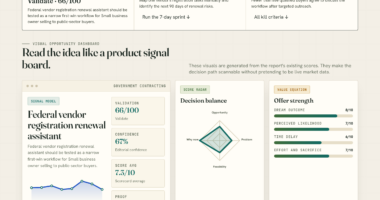

📊 Full opportunity report: The Local-First Agentic Operator on ThorstenMeyerAI.com — validation score, market gap, and execution plan.
TL;DR
A series of 18 diverse products illustrates that a single operator, empowered by agentic AI, can now develop and run complex software portfolios traditionally requiring large teams. This shift challenges organizational norms in software development.
A portfolio of 18 diverse software products demonstrates that a single operator, working with agentic AI, can now build and manage complex systems across multiple domains, a task once reserved for large organizations. This development signifies a shift in software production, emphasizing individual capability over organizational scale. For more on how individual developers are transforming the industry, see The rails. Why European agentic commerce is co-defined by two converging regimes.
The series, laid out over eighteen days, features products spanning content engines, validation councils, prediction markets, and satellite ISR platforms, among others. All share four core principles: they are local-first, provider-agnostic, built by a non-developer using agentic AI, and are edited by subtraction. This demonstrates that one person, leveraging AI, can produce a diverse portfolio that previously required a team or company.
These products are not just isolated tools but evidence that a new operational stance is emerging: that a single individual, with the right tools, can handle what was once organizationally complex. This shift is part of the broader trend discussed in The pyramid cracks. What agentic AI does to the consulting leverage model.. The portfolio’s diversity across domains illustrates the breadth of this approach, from content management to satellite data analysis. Learn more about the underlying architecture in Disk Is the Contract: Inside Threlmark’s Local-First Architecture.
The Local-First Agentic Operator
Eighteen products that looked like a sprawl were never eighteen things. They were one thing, built eighteen times. This is the thesis underneath all of them — named.
- Not “solo beats funded team.” Depth still wins most single contests. The narrower, truer claim: the floor moved — one person can now do what recently took many.
- Breadth is strength and risk. Eighteen products is resilience and a focus problem; several are seeds, not trees.
- The AI part is assisted, not autonomous. Strip away human judgment and subtraction and you get faster mediocrity, not a portfolio.
- A pattern, not a prescription. This fit one operator, one skill set, one moment. The honest version of any manifesto includes “this worked for me.”
A synthesis and a statement of one operator’s working philosophy — independent commentary, produced with AI assistance under human editorial oversight. The views are the author’s own and may change. This is not business, financial, legal, or technical advice, and the four-facet framing is a personal operating pattern, not a prescription or a claim of results. Individual products carry their own terms, disclaimers, and limitations in their respective articles; several are early- or positioning-stage. Product, model, and company names are trademarks of their respective owners; mention does not imply endorsement.
Implications of a Solo Operator Managing Complex Portfolios
This development challenges traditional notions of organizational scale in software creation. It suggests that individuals can now produce and manage complex, multi-domain systems, potentially decentralizing innovation and reducing reliance on large teams. For industries relying on specialized software, this shift could alter competitive dynamics and operational models.
Furthermore, the principles of local-first and provider-agnostic design enhance resilience and flexibility, critical in environments where data security and vendor dependency are concerns. The use of agentic AI as a power tool democratizes software development, making it accessible beyond traditional engineering roles.

Building MCP Servers: A Practical Python Guide to Model Context Protocol — From First Tool to Real-World Workflows (The Practical Tech Guide Series)
As an affiliate, we earn on qualifying purchases.
As an affiliate, we earn on qualifying purchases.
How this Portfolio Reflects Evolving Software Practices
Historically, building and maintaining diverse software systems required organizational resources: teams, infrastructure, and coordination. Recent advancements in agentic AI have shifted this paradigm, enabling a single individual to produce complex systems. The portfolio exemplifies a trend where software craftsmanship and domain versatility are no longer exclusive to large organizations.
The series’ structure, covering domains from content to defense, underscores that this approach is applicable across a wide range of fields. Prior to this, such breadth would have been impractical for a solo operator, but AI-powered tools now make it feasible.
“The unit isn’t the startup. It’s the person, amplified. A single operator working with agentic AI can now build and run what used to require an entire organization.”
— Thorsten Meyer
![WavePad Audio Editing Software - Professional Audio and Music Editor for Anyone [Download]](https://m.media-amazon.com/images/I/B1fcLEGCs6S._SL500_.png)
WavePad Audio Editing Software – Professional Audio and Music Editor for Anyone [Download]
- Professional audio editing: Record and edit music, voice, audio
- Audio effects: Echo, noise reduction, reverb, more
- Wide format support: WAV, MP3, FLAC, OGG, and more
As an affiliate, we earn on qualifying purchases.
As an affiliate, we earn on qualifying purchases.
Unanswered Questions About Solo Software Management
It is not yet clear how scalable or sustainable this approach is over the long term. Questions remain about the ability of a single operator to maintain such diverse systems at scale, handle evolving security challenges, and adapt to rapid technological changes. The series is a demonstration, not a proven model for widespread deployment.

Agentic Spec-Driven Development: A Practical Method for Using AI to Build Complete Specifications for Software, Products, and Knowledge Work
As an affiliate, we earn on qualifying purchases.
As an affiliate, we earn on qualifying purchases.
Next Steps for Individual Operators and Industry Adoption
Further exploration and testing are expected to determine whether this approach can be adopted broadly. Industry observers will watch for case studies, performance metrics, and potential limitations as more individuals experiment with agentic AI for portfolio management. The evolution of AI tools will likely influence how this model develops.

Build Smart Systems with Raspberry Pi and Claude Code: Practical Projects for Home Automation and IoT Using AI-Guided Development (The Smart Developer’s Toolkit Series)
As an affiliate, we earn on qualifying purchases.
As an affiliate, we earn on qualifying purchases.
Key Questions
Can a single person truly replace a large development team?
While the portfolio demonstrates individual capability, it is context-dependent. Large, complex projects may still require teams, but for many applications, AI-enabled individuals could handle significant workloads.
What are the risks of relying on agentic AI for software development?
Risks include security vulnerabilities, vendor dependency, and the challenge of maintaining quality and coherence across diverse systems. Ongoing oversight and validation remain essential.
Is this approach applicable across all industries?
It is most promising in domains where software can be modular and where individual expertise is sufficient. Highly regulated or large-scale enterprise systems may still require organizational resources.
How does this change the role of traditional software developers?
It shifts the focus from coding to managing AI tools and domain expertise. Developers may become more like AI facilitators or supervisors rather than traditional programmers.
Source: ThorstenMeyerAI.com