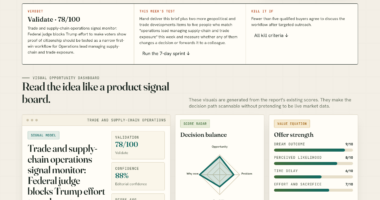

📊 Full opportunity report: Your Coding Agent Is an Attack Surface: The Claude Code Security Reckoning on ThorstenMeyerAI.com — validation score, market gap, and execution plan.

Get hardware and tech essentials delivered free — and shop member deals
- Fast, free delivery on millions of items
- Access to Prime Big Deal Days deals on October 6–7
- Prime Video, Amazon Music and more included
TL;DR
Security researchers uncovered three major flaws in Claude Code, a developer agent tool, allowing token theft and code execution. Anthropic patched some issues, but vulnerabilities remain, highlighting risks in agent-based development tools.
Security researchers have disclosed three critical vulnerabilities in Claude Code, an AI-powered developer agent, which create silent attack paths for token theft and remote code execution. These flaws, documented by Mitiga Labs and Check Point Research, pose significant security risks for organizations integrating Claude Code into their development workflows. Although Anthropic has patched some of these issues, at least one remains unpatched by design, raising broader concerns about the security of agent-based developer tools.
Researchers identified three key vulnerabilities in Claude Code. First, Mitiga Labs demonstrated that a malicious npm package could silently rewrite the tool’s local configuration file (~/.claude.json), enabling an attacker to reroute OAuth tokens and intercept credentials without detection. This attack relies on executing a malicious post-install hook during package installation, which is a common supply chain risk.
Second, Check Point Research disclosed two flaws—CVE-2025-59536 and CVE-2026-21852—that allowed remote code execution and API key extraction. These vulnerabilities could be triggered simply by cloning untrusted repositories, enabling attackers to run malicious code before user prompts or redirect traffic to attacker-controlled infrastructure.
Additionally, a separate security leak exposed unencrypted TypeScript source code from Claude Code’s online repository, which has been exploited to craft social-engineering campaigns targeting developers. This leak, combined with the other flaws, underscores how configuration files and repository artifacts serve as active execution paths rather than passive metadata, increasing attack surfaces.
Anthropic responded to disclosures by patching the vulnerabilities they acknowledged, but the Mitiga Labs attack chain remains unpatched by design, emphasizing the ongoing risk. Experts warn that these issues are not unique to Claude Code but reflect a broader pattern of security challenges in agent-based development tools.
Your Coding Agent Is an Attack Surface
● SecurityThree disclosed flaws turned Claude Code’s local config and MCP integrations into silent paths for token theft and code execution. Some fixes are yours to make — and the lesson applies to every agentic dev tool, not one.
The config files most teams treat as passive metadata are, in practice, active execution paths.
~/.claude.json, reroutes MCP traffic, and intercepts long-lived OAuth tokens for GitHub, Jira, Confluence.How the unpatched Mitiga path works — at the level its researchers published. (Defensive overview, no exploit detail.)
~/.claude.json.For teams running Claude Code — or any coding agent — in production.
~/.claude.json/permissions; disconnect what you don’t use.Anthropic patched the Check Point CVEs fast — responsible disclosure worked. The npm post-install hook is an industry-wide supply-chain risk class, not Anthropic’s invention.
Anthropic calls the Mitiga chain “out of scope.” But consenting to install a package isn’t consenting to having your SaaS credentials intercepted — and plaintext tokens in the router file turn a generic risk into a specific one.
Independent commentary, produced with AI assistance under human editorial oversight; the views are the author’s own and may change. This is security analysis and opinion, not professional security, legal, or financial advice; verify specifics against vendor advisories and the primary research before acting. It describes publicly disclosed vulnerabilities at the level reported by their researchers and is for defensive purposes only — no exploit code or attack instructions. Sources: Computerwoche (Anjali Gopinadhan Nair), Mitiga Labs, Check Point Research, SecurityWeek, all-about-security, and Anthropic’s documentation, read as of June 2026. References to companies, researchers, and CVEs are factual and analytical and imply no affiliation or endorsement.
Implications for Developer Tool Security
The vulnerabilities in Claude Code highlight critical security concerns for organizations relying on AI-powered developer agents. Silent token theft and remote code execution can lead to data breaches, credential compromise, and potential supply chain attacks. As these tools become more integrated into development pipelines, their attack surfaces expand, making security controls and rigorous vetting essential. The fact that some vulnerabilities remain unpatched by design raises questions about the security assumptions underlying agent-based tools and the need for industry-wide standards to prevent such risks from becoming systemic.
As an affiliate, we earn on qualifying purchases.
Broader Risks in AI-Driven Developer Tools
Claude Code is among a growing number of agentic developer tools that connect to cloud services, repositories, and internal APIs. Over recent months, security researchers have documented multiple vulnerabilities across similar platforms, often involving configuration files, repository hooks, and integration points that are treated as passive but are actively exploitable. The vulnerabilities follow a pattern where configuration files and repository artifacts serve as live execution paths, creating silent attack surfaces that can be exploited for credential theft, code execution, or data exfiltration.
In February 2026, disclosures from Check Point Research revealed flaws allowing remote code execution and API key theft, which Anthropic patched promptly. However, the recent findings by Mitiga Labs expose a more insidious vector—silent rewrites of local config files during package installation—highlighting the evolving complexity of securing developer agents. Industry experts warn that as these tools become more powerful and integrated, their attack surfaces will continue to grow if security is not prioritized from the outset.
“The fact that configuration files and repository hooks can be weaponized to silently reroute tokens and execute code is a wake-up call for the entire developer ecosystem.”
— Thorsten Meyer, security researcher
code security vulnerability scanners
As an affiliate, we earn on qualifying purchases.
As an affiliate, we earn on qualifying purchases.
Remaining Risks and Unpatched Vulnerabilities
While Anthropic has patched several issues, the Mitiga Labs attack chain remains unpatched by design, and the full scope of potential exploits in other agent integrations is not yet fully understood. It is unclear whether additional vulnerabilities exist in other configurations or future updates, and how widespread these risks might become across different developer environments.
software supply chain security tools
As an affiliate, we earn on qualifying purchases.
As an affiliate, we earn on qualifying purchases.
Security Improvements and Industry Response
Developers and organizations using Claude Code should review their configurations, monitor for suspicious activity, and apply available patches. Industry experts recommend that security standards be established for agent-based developer tools, emphasizing secure configuration management and supply chain safeguards. Further research and disclosures are expected as attackers continue to explore these attack surfaces, prompting ongoing vigilance and potential new patches from vendors.
As an affiliate, we earn on qualifying purchases.
Key Questions
What are the main security risks in using Claude Code?
The primary risks include silent token theft via configuration file rewrites, remote code execution through malicious repository hooks, and credential exfiltration. These vulnerabilities can lead to data breaches and compromise of connected cloud services.
Has Anthropic fixed all the vulnerabilities?
Anthropic has patched several disclosed vulnerabilities, including those reported by Check Point Research. However, the Mitiga Labs attack chain remains unpatched by design, and ongoing risks persist.
Are these vulnerabilities unique to Claude Code?
No, similar issues have been observed in other agent-based developer tools, indicating a broader pattern of active execution paths and supply chain risks in AI-driven development environments.
What should organizations do now?
Organizations should review their configurations, monitor for unusual activity, and stay updated on security patches. Implementing strict supply chain controls and security best practices is essential to mitigate these risks.
Source: ThorstenMeyerAI.com
Halloween Picks
halloween
As an affiliate, we earn on qualifying purchases.