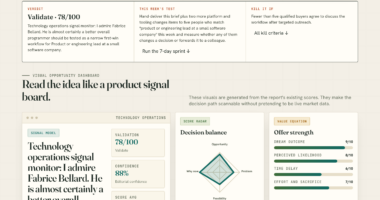

📊 Full opportunity report: A Skill Is A Folder, Not A Prompt: What Anthropic Learned Running Hundreds Of Them on ThorstenMeyerAI.com — validation score, market gap, and execution plan.

Get hardware and tech essentials delivered free with Prime
- Fast, free delivery on millions of items
- Prime Video, Amazon Music and more included
- Member-only deals all year
TL;DR
Anthropic has shifted from viewing AI Skills as prompts to treating them as folders—comprehensive containers for instructions, code, and knowledge—aiming to improve consistency, onboarding, and organizational learning. This approach emphasizes building reusable, versioned assets over ad-hoc prompting.
Anthropic has announced a new approach to developing AI Skills, defining them as folders that contain instructions, code, reference documents, and configurations—rather than mere prompts. This shift aims to create durable, reusable organizational assets that improve the consistency and efficiency of AI deployment across teams, marking a significant change in how AI capabilities are structured and maintained.
In a detailed write-up from a Claude Code engineer, Anthropic explained that its internal practice involves packaging knowledge into Skills as folders, not prompts. Each folder can include instructions, scripts, templates, data, and hooks that activate during use, enabling agents to discover and execute complex workflows. This conceptual reframe moves away from the idea of saving prompts as text snippets, instead emphasizing structured containers that reflect actual business processes.
Anthropic identified nine core categories of Skills, ranging from library and API reference to infrastructure operations. The most impactful are those for verification—ensuring output quality—and business-process automation. The company reports that its best Skills started small but improved iteratively as they captured edge cases and institutional knowledge, turning Skills into assets that appreciate in value over time.
This methodology aims to standardize outputs, streamline onboarding, and build a knowledge base that evolves. Anthropic advocates dedicating engineer time to perfecting a single Skill category, viewing these as investments that compound in organizational value.
A Skill is a folder, not a prompt
Anthropic published what it learned running hundreds of Skills across its own engineering org. Read as a business memo, the point is bigger than a coding trick: this is how ad-hoc prompting becomes durable institutional capability — the SOPs your agents actually follow, versioned and shared.
“A Skill is just a clever markdown prompt you save in a file.”
A folder the agent can discover, read & run — instructions, scripts, references, templates, config & on-demand hooks.
The knowledge of how your organization actually operates can be captured, versioned, shared & executed — and the thing capturing it is a humble folder with a script and a gotchas list inside. For the builder, that’s context engineering with real tools attached. For whoever owns the budget, it’s the difference between AI that starts from zero every morning and an asset that compounds. Caveats: best practices are still evolving, checked-in Skills cost context, and curation beats accumulation. Start with one Skill, one gotcha, and the category that catches your mistakes.
Transforming AI Capabilities into Organizational Assets
This approach matters because it shifts AI development from ad-hoc prompt engineering to structured, maintainable assets that embed tribal knowledge and guardrails. Treating Skills as folders enhances consistency, reduces onboarding time, and creates a scalable way to improve AI behavior over time. For organizations relying on AI, this could lead to more reliable, transparent, and efficient deployment, especially in complex operational environments.
As an affiliate, we earn on qualifying purchases.
From Prompting to Structured Asset Management
Historically, many teams have relied on prompt engineering—crafting specific instructions for each task—to control AI outputs. Anthropic’s internal experience, shared publicly in March 2024, reveals a shift toward building reusable, versioned containers of knowledge called Skills. The company’s internal experiments show that Skills, when properly constructed, can serve as durable assets that evolve and improve, contrasting with the ephemeral nature of prompts.
This development builds on broader trends in AI deployment, emphasizing reliability, repeatability, and institutional memory, moving beyond simple prompt tuning to more sophisticated organizational practices.
“A Skill is not a prompt saved in a text file. It’s a folder—containing instructions, scripts, and reference documents—that the agent can discover and execute.”
— Thorsten Meyer, AI engineer at Anthropic
AI instruction and script management tools
As an affiliate, we earn on qualifying purchases.
As an affiliate, we earn on qualifying purchases.
Unclear Aspects of Implementation and Adoption
It remains uncertain how widely this approach will be adopted outside Anthropic or how easily other organizations can implement similar folder-based Skills systems. Details about the tooling, integration with existing workflows, and scalability across different industries are still emerging. Additionally, the long-term impact on AI performance and maintenance costs has not yet been fully evaluated.
As an affiliate, we earn on qualifying purchases.
Next Steps for Broader Adoption and Validation
Organizations interested in this approach should assess their current Knowledge Management practices and consider developing prototype Skills as folders. Future developments may include standardized tools for creating, versioning, and sharing Skills across teams. Anthropic is likely to continue refining its methodology and share best practices to encourage wider industry adoption.
As an affiliate, we earn on qualifying purchases.
Key Questions
How does treating Skills as folders improve AI consistency?
Folders can contain comprehensive instructions, scripts, and configurations, enabling AI agents to follow standardized workflows and guardrails, leading to more predictable outputs.
Can this approach be applied outside of Anthropic?
Potentially, yes. However, implementation requires a structured knowledge management system and discipline in creating and maintaining Skills as reusable assets. Adoption may vary based on organizational resources and technical maturity.
What are the main benefits of this folder-based Skills system?
It enhances output consistency, reduces onboarding time, captures institutional knowledge, and allows Skills to improve iteratively, turning them into valuable organizational assets.
What challenges might organizations face in adopting this model?
Challenges include developing the tooling for managing Skills as folders, integrating with existing workflows, and maintaining the quality and relevance of Skills over time.
Will this change how AI models are trained or just how they are used?
This approach primarily affects how AI is used and maintained, not the core training of models. It emphasizes building structured, reusable assets for deployment and operational consistency.
Source: ThorstenMeyerAI.com
Columbus Day / Indigenous Peoples' Day Picks
long weekend sales
As an affiliate, we earn on qualifying purchases.