
📊 Full opportunity report: Best Quiet Case Fans + the Airflow Setup That Actually Works on ThorstenMeyerAI.com — validation score, market gap, and execution plan.

Get hardware and tech essentials delivered free — and shop member deals
- Fast, free delivery on millions of items
- Access to Prime Big Deal Days deals on October 6–7
- Prime Video, Amazon Music and more included
TL;DR
This article identifies the best quiet case fans for 2026 and explains the airflow setup that maximizes cooling while minimizing noise. It emphasizes large, slow-moving fans and proper placement for optimal results.
In 2026, the most effective way to achieve quiet yet efficient cooling in high-performance AI workstations is by using large, slow-moving fans combined with a carefully planned airflow setup, according to industry experts and recent testing.
Recent testing and expert consensus highlight that larger fans, such as 140mm models, running at lower RPMs produce significantly less noise while maintaining excellent airflow. The Noctua NF-A12x25 and NF-A14 are considered the top-performing fans for quiet operation and durability, though they come at a premium price. Arctic P12 Pro and P14 fans offer nearly comparable performance at a fraction of the cost, making them popular budget options. For absolute silence, be quiet! Silent Wings 4 fans excel, maintaining low noise levels even at higher speeds. When using liquid cooling, static-pressure fans like Arctic P12 Pro and Noctua NF-F12 are recommended for radiators and dense heatsinks, as they push air through restrictive fin stacks efficiently. Proper placement and tuning—favoring intake at the front and exhaust at the rear—are critical to creating a gentle, continuous airflow that keeps temperatures low without generating noise.Best quiet case fans
+ the airflow that works.
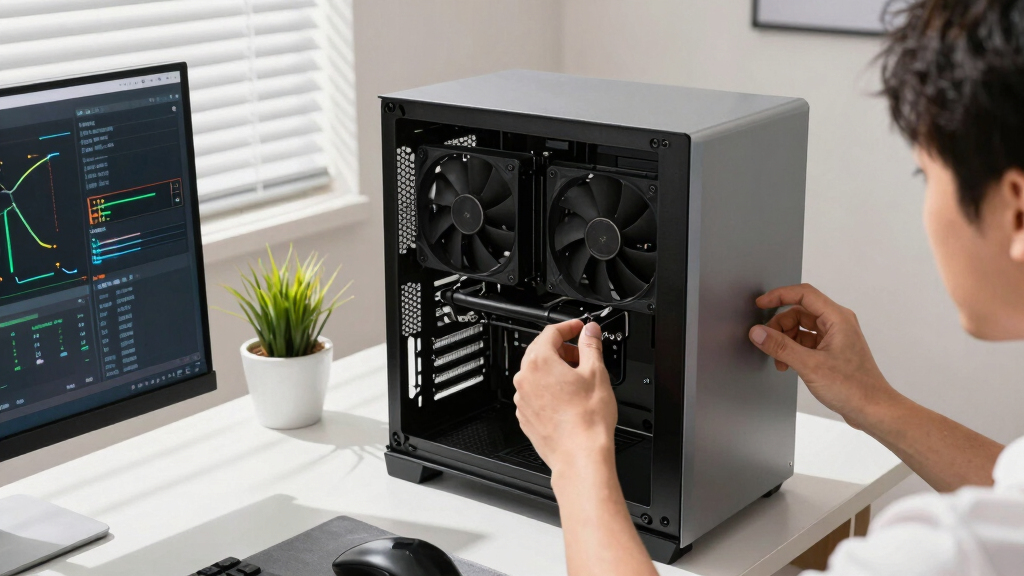
The best fan won’t help if it’s pointed the wrong way. The whole recipe: big fans, running slowly, in a clean front-to-back path, with slightly more intake than exhaust. Build a config in Part 2 and watch the pressure balance respond.
Why Choosing the Right Fans and Setup Matters
Selecting the appropriate fans and airflow configuration directly impacts the noise level and thermal performance of high-power AI workstations. Quiet operation enables better working environments, especially in shared or office spaces, while effective cooling prolongs component lifespan and maintains system stability. The emphasis on large, slow fans challenges traditional notions that higher RPM fans are necessary for good cooling, highlighting a shift toward more efficient, noise-conscious designs that benefit both hobbyists and professionals.As an affiliate, we earn on qualifying purchases.
Recent Trends in Quiet PC Cooling for AI Workstations
Over the past few years, advancements in fan engineering and a better understanding of airflow dynamics have led to a focus on larger fans that operate at lower speeds. Brands like Noctua, Arctic, and be quiet! have introduced models that prioritize silent operation without sacrificing cooling performance. This shift is driven by the needs of AI researchers and content creators who require powerful, always-on systems that operate quietly in office or home environments. Proper airflow setup—using intake at the front and exhaust at the rear—has become a standard practice to optimize the gentle flow of air through the case, reducing turbulence and noise."Large, slow-moving fans move the same amount of air as smaller, faster fans but produce far less noise, which is essential for quiet high-performance systems."
— Thorsten Meyer, cooling expert
best airflow setup for high-performance PC
As an affiliate, we earn on qualifying purchases.
As an affiliate, we earn on qualifying purchases.
Unclear Aspects of Long-Term Fan Performance
While current testing shows promising results, long-term durability and performance under continuous high loads remain to be fully validated for some budget fans like Arctic P12 Pro. Additionally, the optimal airflow configuration can vary depending on case design and component layout, and more real-world testing is needed to establish best practices universally.As an affiliate, we earn on qualifying purchases.
Future Developments in Quiet Cooling Technologies
Manufacturers are expected to introduce even larger fans and more advanced blade designs aimed at further reducing noise without compromising airflow. Software tools for dynamic fan tuning and airflow management are also likely to improve, allowing users to optimize their setups more precisely. Ongoing research will continue to refine best practices for quiet, high-performance cooling in AI and other demanding workloads.static pressure radiator fans for liquid cooling
As an affiliate, we earn on qualifying purchases.
As an affiliate, we earn on qualifying purchases.
Key Questions
Why are larger fans quieter than smaller ones?
Larger fans move the same amount of air at lower RPMs, which reduces the noise generated by fan blades and motor vibrations, resulting in quieter operation.
Should I use airflow fans or static-pressure fans for my case?
Use airflow fans for case intake and exhaust to promote gentle, continuous airflow. Reserve static-pressure fans for radiators and dense heatsinks where air must be pushed through restrictive fins.
Can I achieve both silence and good cooling with budget fans?
Yes, models like Arctic P12 Pro and P14 offer near-premium performance at a lower cost, especially when used in larger sizes and tuned properly.
What is the most important factor in creating a quiet PC setup?
Choosing large, slow fans combined with a well-planned airflow path—front intake, rear/exhaust—ensures effective cooling with minimal noise.
Source: ThorstenMeyerAI.com
Fall Picks
fall essentials
As an affiliate, we earn on qualifying purchases.