
📊 Full opportunity report: Mac vs GPU Tower for Local LLMs: The Heat-and-Noise Tradeoff on ThorstenMeyerAI.com — validation score, market gap, and execution plan.

Get hardware and tech essentials delivered free — and shop member deals
- Fast, free delivery on millions of items
- Access to Prime Big Deal Days deals on October 6–7
- Prime Video, Amazon Music and more included
TL;DR
This article compares Mac Studio and GPU tower setups for running local large language models, focusing on heat, noise, capacity, and performance tradeoffs. The choice hinges on model size, speed needs, and thermal management.
Recent comparisons between Mac Studio with M3 Ultra and high-end GPU towers reveal fundamental tradeoffs in heat, noise, and capacity for running local large language models (LLMs). The choice between these architectures impacts performance, thermal management, and user experience, making it a critical decision for AI practitioners and enthusiasts.
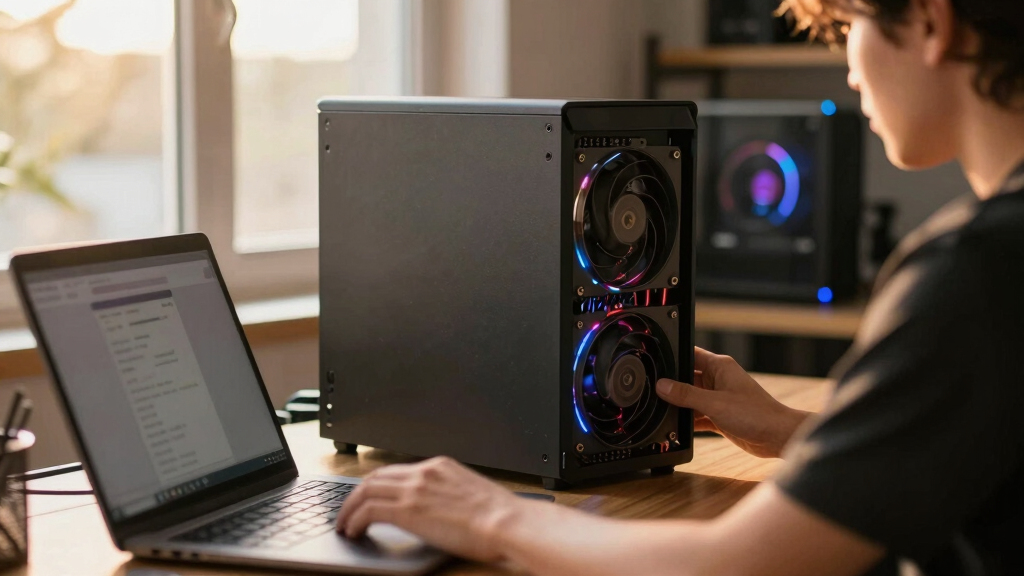
The core difference lies in architecture: GPU towers prioritize memory bandwidth, with RTX 5090 cards delivering roughly 1,792 GB/s, enabling faster token processing for models that fit within their VRAM (24–32GB). However, they generate significant heat and noise, requiring complex thermal management and noise mitigation strategies.
In contrast, Apple Silicon chips like the M3 Ultra optimize for memory capacity, offering up to 512GB of unified memory shared across CPU, GPU, and Neural Engine. While this results in slower inference speeds—particularly for models that exceed GPU VRAM—these machines operate near silently and consume far less power, making them suitable for continuous, noise-sensitive environments.
Confirmed facts include the power consumption figures: GPU towers draw 575W to over 800W, producing substantial heat, whereas Mac Studios draw a fraction of that power, remaining near silent under load. The performance gap is clear: towers excel in throughput for models fitting in VRAM, while Macs excel at running larger models that surpass GPU memory limits.
Mac vs GPU tower
for local LLMs.
What if you sidestep the heat entirely with a different kind of machine? A tower is a high-bandwidth furnace you spend five levers quieting. Apple Silicon is near-silent by design — but asks for different tradeoffs. Match your priority in Part 2.
Put the loud, hot machine where its noise doesn’t matter, and the quiet one where you do. SSH into the tower when you need raw power; let the Mac handle everything else, silently.
Implications for AI Hardware Selection
This comparison highlights a fundamental decision point for AI practitioners: whether to prioritize raw throughput and upgradeability with GPU towers or to opt for silent, power-efficient operation with Macs. For workloads constrained by model size, Macs offer a practical, low-maintenance solution. For latency-sensitive or high-throughput tasks with smaller models, GPU towers remain superior.
The choice impacts not only performance but also operational costs, thermal management complexity, and workspace environment. As AI models grow larger and hardware options evolve, understanding these tradeoffs becomes increasingly crucial for effective deployment and development.
GPU tower for large language models
As an affiliate, we earn on qualifying purchases.
As an affiliate, we earn on qualifying purchases.
Hardware Architectures and Performance Factors
The debate stems from two contrasting hardware philosophies. GPU towers leverage high bandwidth to accelerate inference for models that fit in VRAM, with native CUDA ecosystem support enabling advanced training and fine-tuning. They require significant thermal management, often involving elaborate cooling solutions and noise control efforts.
Apple Silicon, with its unified memory architecture, can load larger models directly into RAM, bypassing VRAM limitations. While inference speeds are generally slower, the design inherently minimizes heat and noise, making it ideal for continuous, low-maintenance operation. The tradeoff is a reduced maximum throughput and less mature ecosystem for model training.
"The heat and noise profile of GPU towers is a space heater you manage, while Macs are near-silent by design—this fundamental difference shapes the entire decision process."
— Thorsten Meyer
As an affiliate, we earn on qualifying purchases.
Unresolved Questions in Hardware Tradeoffs
It remains unclear how upcoming hardware updates will shift these tradeoffs, particularly whether future GPUs will improve capacity or whether Apple Silicon will enhance inference speeds for large models. Additionally, ecosystem maturity and software support for Mac-based AI workflows are still evolving, affecting adoption decisions.
As an affiliate, we earn on qualifying purchases.
Future Developments in AI Hardware Choices
Next steps include monitoring hardware updates from NVIDIA and Apple, as well as user experiences with large-scale deployments. Advances in GPU memory capacity and cooling solutions, along with improvements in Apple Silicon's inference performance, will influence the ongoing balance between heat, noise, capacity, and speed.
Practitioners should stay informed about new hardware releases and software ecosystem progress to make optimal choices aligned with their workload requirements.
noise-reducing thermal management for GPU
As an affiliate, we earn on qualifying purchases.
As an affiliate, we earn on qualifying purchases.
Key Questions
Can a Mac Studio run large language models as effectively as a GPU tower?
Mac Studios can run larger models that exceed GPU VRAM capacity thanks to their high unified memory, but inference speeds are generally slower. For models that fit in VRAM, GPU towers outperform in speed and throughput.
How significant is the heat and noise difference between these setups?
GPU towers produce substantial heat and noise, often requiring elaborate cooling and noise mitigation. Macs operate near silently with minimal heat, making them ideal for noise-sensitive environments.
Will future hardware updates change this comparison?
Potential improvements in GPU memory capacity and cooling, as well as advancements in Apple Silicon inference speeds, could shift the balance. The landscape remains dynamic.
Which setup is better for training large models?
GPU towers with native CUDA support and upgradeability are currently better suited for training large models, while Macs are primarily optimized for inference of large models that fit into their memory pool.
Is the power consumption difference worth considering?
Yes. GPU towers consume hundreds of watts and generate significant heat, increasing operational costs and cooling needs. Macs consume far less power, making them more suitable for continuous, low-cost operation.
Source: ThorstenMeyerAI.com
Fall Picks
fall essentials
As an affiliate, we earn on qualifying purchases.




![Consumer Trends And Innovations In Tying Gym Shorts [Video]](https://dailycoinfeed.com/wp-content/uploads/2026/09/consumer-trends-and-innovations-in-tying-gym-shorts-video-featured-260x140.jpg)