📊 Full opportunity report: What Belongs In A Trust And Estate Administration Tracker? on IdeaNavigator AI — validation score, market gap, and execution plan.

Get hardware and tech essentials delivered free — and shop member deals
- Fast, free delivery on millions of items
- Access to Prime Big Deal Days deals on October 6–7
- Prime Video, Amazon Music and more included
TL;DR
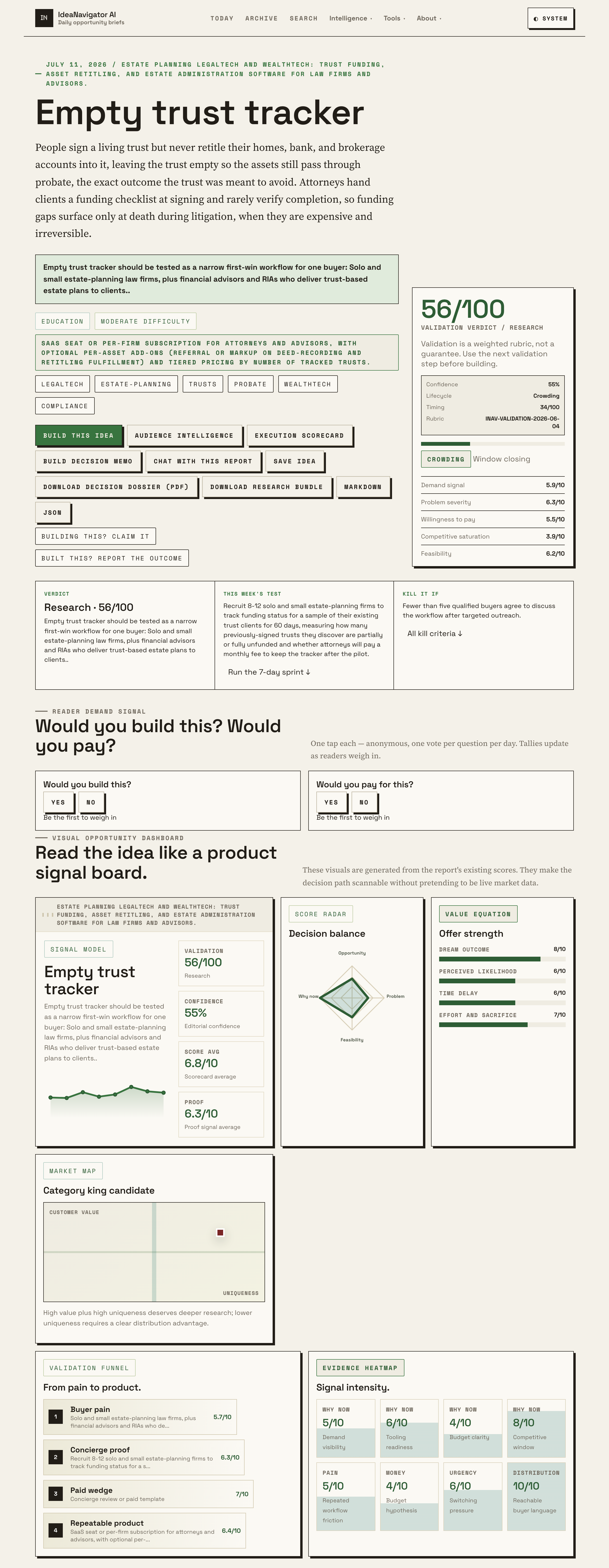
IdeaNavigator AI has outlined a proposed tracker to help law firms and financial advisers check whether clients have moved assets into their living trusts. The idea remains untested: a proposed 60-day pilot would measure how often firms find unfunded trusts and whether they would pay for the service.
IdeaNavigator AI has proposed a trust funding tracker for small estate-planning law firms and financial advisers, aimed at documenting whether clients move assets into their living trusts after signing the documents. The proposal describes a product concept and a possible pilot, not a launched service or a completed test; it gives no results showing how many trusts are left unfunded.
The proposed service would let an attorney or adviser create a funding checklist for each trust. Categories could include real estate, bank and brokerage accounts, business interests, retirement assets and beneficiary designations. Each item would be marked pending, in progress or confirmed funded, with supporting records such as a recorded deed or a statement showing retitling attached to the entry.
Automated reminders would prompt clients to complete outstanding steps, while a firm dashboard would show the share of tracked assets marked funded for each trust. The idea is to help staff follow up after signing and give partners a way to identify files that appear incomplete. The proposal does not specify how the tracker would verify records, connect to financial institutions or handle sensitive client documents.
IdeaNavigator AI suggests selling subscriptions by firm or user seat, with tiers based on the number of trusts tracked. It also identifies optional fees tied to deed recording or retitling services. No pricing for the proposed software, customer commitments or service partners are identified.
Following Up After Trust Signing
A living trust may not control assets that were never transferred into it. The proposal centers on a gap between signing estate-planning documents and completing the separate administrative work of changing ownership records. If a home or account remains outside the trust, it may not receive the intended treatment under the plan; the exact outcome depends on the asset, its ownership and applicable law.
For firms, a shared tracker could make follow-up visible across a client book instead of leaving reminders in individual files or relying on clients to remember a checklist. That could help staff identify unfinished tasks while a client can still act. The proposal does not show that a dashboard alone would prevent probate, litigation or other disputes, and it offers no measured evidence of reduced costs or improved outcomes.
The idea may also matter to advisers who want to include estate-planning support in broader client services. However, the brief does not establish how common such offerings are or how much demand exists for a tracking product. Those questions are part of what the proposed pilot is meant to test.
Top picks for "belong trust estate"
As an affiliate, we earn on qualifying purchases.
The Asset-Funding Gap
The concept brief says clients can sign a living trust without retitling homes or accounts in its name. It describes attorneys handing over a funding checklist at signing and says firms may not routinely confirm that clients completed it. The brief argues that missed steps can come to light only after death, when correcting ownership or resolving disputes may be harder. It does not provide case records or data to quantify how often this happens.
IdeaNavigator AI says about 11% of Americans hold a trust, but the brief does not give a survey date, definition of “hold a trust,” or a cited source for that figure. It also describes estate-planning adoption and digital tools as growing in 2026, without supplying a comparison period or supporting figures. These points should be treated as claims in the proposal, not independently established market measurements.
The brief positions the tracker alongside document-drafting tools and deed or retitling services, which it says can cost from $250 per deed. That price is presented without a provider, location or date range. The proposed tracker would sit around the administrative steps after documents are signed; no integration with existing legal or financial software is specified.
Demand and Verification Remain Untested
No pilot findings, working product, customer interviews or paying customers are reported. It is unknown how many previously signed trusts a trial would find to be partly or fully unfunded, whether firms would keep using the tracker, or what subscription price they would accept. The proposal also does not explain how firms would distinguish a completed transfer from a document that merely appears to confirm one.
Other open questions include who would be responsible for checking attached records, how often funding status would need to be reviewed, and how the product would protect confidential financial and estate-planning information. Asset transfers can involve different institutions and legal requirements, and the brief does not describe how the checklist would account for those differences. It provides no legal analysis of how the service would fit into a firm’s professional duties.
A Proposed 60-Day Firm Pilot
IdeaNavigator AI proposes recruiting 8 to 12 solo and small estate-planning firms to track the funding status of a sample of existing trust clients for 60 days. The stated measures are how many partially or fully unfunded trusts the firms identify and whether attorneys would pay a monthly fee to continue using the tracker.
The brief does not say that recruitment has begun, name participating firms or set a start date. Any next assessment would depend on the pilot’s findings, including whether firms can maintain accurate records and whether clients respond to reminders. Until those results are available, the tracker remains a product hypothesis rather than a demonstrated solution.
Source: IdeaNavigator AI
Key Questions
Has the trust tracker launched?
No launch is reported. IdeaNavigator AI describes a proposed product and a possible pilot.
What would the tracker record?
It would list trust-related assets, mark each as pending, in progress or confirmed funded, and allow firms to attach supporting records such as deeds or account statements.
What is the proposed pilot?
The proposal calls for 8 to 12 small estate-planning firms to track a sample of existing clients’ trust funding for 60 days. Recruitment or results are not reported.
Does the proposal show that the product prevents probate?
No. It describes a tool for tracking follow-up, but provides no outcome data showing that it prevents probate or disputes.
Source: IdeaNavigator AI
Fall Picks
fall essentials
As an affiliate, we earn on qualifying purchases.