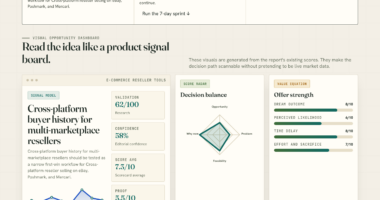

📊 Full opportunity report: World Model Readiness: Are You Ready for AI That Acts? on ThorstenMeyerAI.com — validation score, market gap, and execution plan.

Get hardware and tech essentials delivered free — and shop member deals
- Fast, free delivery on millions of items
- Access to Prime Big Deal Days deals on October 6–7
- Prime Video, Amazon Music and more included
TL;DR
AI is shifting from models that describe to models that predict and act. A new diagnostic tool helps organizations evaluate their preparedness for this transition, which could redefine AI application and safety.
Major AI research and industry efforts are increasingly focused on world models, AI systems that can predict environmental changes and take actions accordingly. A new diagnostic tool has been introduced to help organizations determine their readiness for this shift, which could significantly impact how AI is integrated into operational environments.
Over the past three years, AI development has primarily centered on large language models (LLMs) that excel at describing, summarizing, and generating text. However, the emerging focus is now on world models, which build internal representations of environments to forecast future states and inform actions. Companies like Meta, Google DeepMind, Nvidia, and startups like AMI Labs are investing heavily in this technology, with recent advancements such as DeepMind’s Genie 3, capable of generating real-time interactive 3D worlds, demonstrating that world models are moving toward production readiness.
The shift from descriptive models to predictive, action-oriented models raises critical questions for organizations. These include whether they possess adequate world data (telemetry, video, simulations), if their processes are representable as modelable states, and whether they can supervise and control systems that act based on predictions. The new diagnostic tool aims to evaluate these factors, providing a structured assessment of an organization’s preparedness for deploying such systems.
World Model Readiness — are you ready for AI that acts?
LLMs describe. World models predict and act. The next AI shift isn’t “have we adopted a chatbot” — it’s whether you’d know what to do with a model that anticipates consequences.
Independent commentary, produced with AI assistance under human editorial oversight. The views are the author’s own and may change. World Model Readiness is an early, positioning-stage diagnostic — an assessment framework, not a prediction, guarantee, or technical advice; its conclusions depend on the framework’s assumptions. “World models” are an emerging, rapidly-evolving area of AI; statements about the field reflect publicly reported developments as of mid-2026 and may quickly date. References to companies, labs, and products describe public reporting and imply no affiliation, endorsement, or verification. Product, model, and company names are trademarks of their respective owners.
Implications of Transitioning to Action-Oriented AI
This shift toward world models signifies a fundamental change in AI capabilities, moving from suggestion to autonomous action. Organizations that are unprepared risk deploying systems that act unpredictably or cause unintended harm, especially as these models become more integrated into real-world operations. The diagnostic helps prevent premature adoption and highlights areas needing development, making it a vital tool for managing the risks and opportunities of this new AI era.
As an affiliate, we earn on qualifying purchases.
Recent Advances and Industry Momentum in World Models
In late 2025 and early 2026, the AI field has seen rapid progress in world model research. Yann LeCun’s departure from Meta to focus on building world models with AMI Labs, along with breakthroughs like DeepMind’s Genie 3, showcase the industry’s push toward systems capable of understanding and acting within environments. Major companies like Google, Nvidia, and Waymo are developing their own models, signaling that this is no longer purely research but a move toward practical deployment. Despite this momentum, current systems still face significant challenges, such as the reality gap—the difference between simulation and real-world performance—and limitations in physical reasoning.
While progress is undeniable, experts caution that today’s models are resource-intensive and often perform poorly on elementary physical tasks, underscoring the need for careful assessment before large-scale adoption.
“The move from describe to act changes what you have to be ready for, because action is dangerous without prediction.”
— Thorsten Meyer, AI researcher
organizational AI readiness assessment kit
As an affiliate, we earn on qualifying purchases.
As an affiliate, we earn on qualifying purchases.
Current Limitations and Challenges of World Models
While progress is rapid, current systems still face significant limitations. The reality gap—the disparity between simulated predictions and real-world outcomes—remains a major obstacle. Most models are data- and compute-hungry, and their success is primarily in constrained environments like games or simulations, not messy real-world settings. Their physical reasoning abilities are still rudimentary, and the risk of confidently wrong predictions persists. It is not yet clear how quickly these challenges will be overcome or how reliable current models will be in diverse operational contexts.
As an affiliate, we earn on qualifying purchases.
Next Steps for Organizations Preparing for World Models
Organizations should begin assessing their data infrastructure and processes to determine their readiness for integrating world models. The new diagnostic tool provides a structured way to identify gaps in data, supervision, and calibration. As research continues to advance, companies need to stay informed about emerging capabilities and limitations, and develop safety protocols for deploying autonomous systems. The next milestones include improved physical reasoning, reduced reality gap, and scalable supervision methods, which will influence how quickly organizations can adopt these AI systems safely.
environmental data collection devices for AI
As an affiliate, we earn on qualifying purchases.
As an affiliate, we earn on qualifying purchases.
Key Questions
What is a world model in AI?
A world model is an AI system that builds an internal representation of an environment to predict future states and inform actions, moving beyond simple description to anticipatory behavior.
Why is readiness assessment important now?
As world models approach practical deployment, organizations must evaluate whether they have the necessary data, supervision, and safety measures to manage autonomous actions responsibly.
What are the main challenges with current world models?
The primary challenges include the reality gap between simulation and real-world performance, high resource requirements, and limited physical reasoning capabilities.
How can organizations prepare for this shift?
Organizations should use readiness diagnostics to assess data infrastructure, supervision processes, and calibration practices, and stay informed about ongoing research developments.
Source: ThorstenMeyerAI.com
Fall Picks
fall essentials
As an affiliate, we earn on qualifying purchases.