
📊 Full opportunity report: AI Changelog Digest For Open-source Maintainers on IdeaNavigator AI — validation score, market gap, and execution plan.
TL;DR
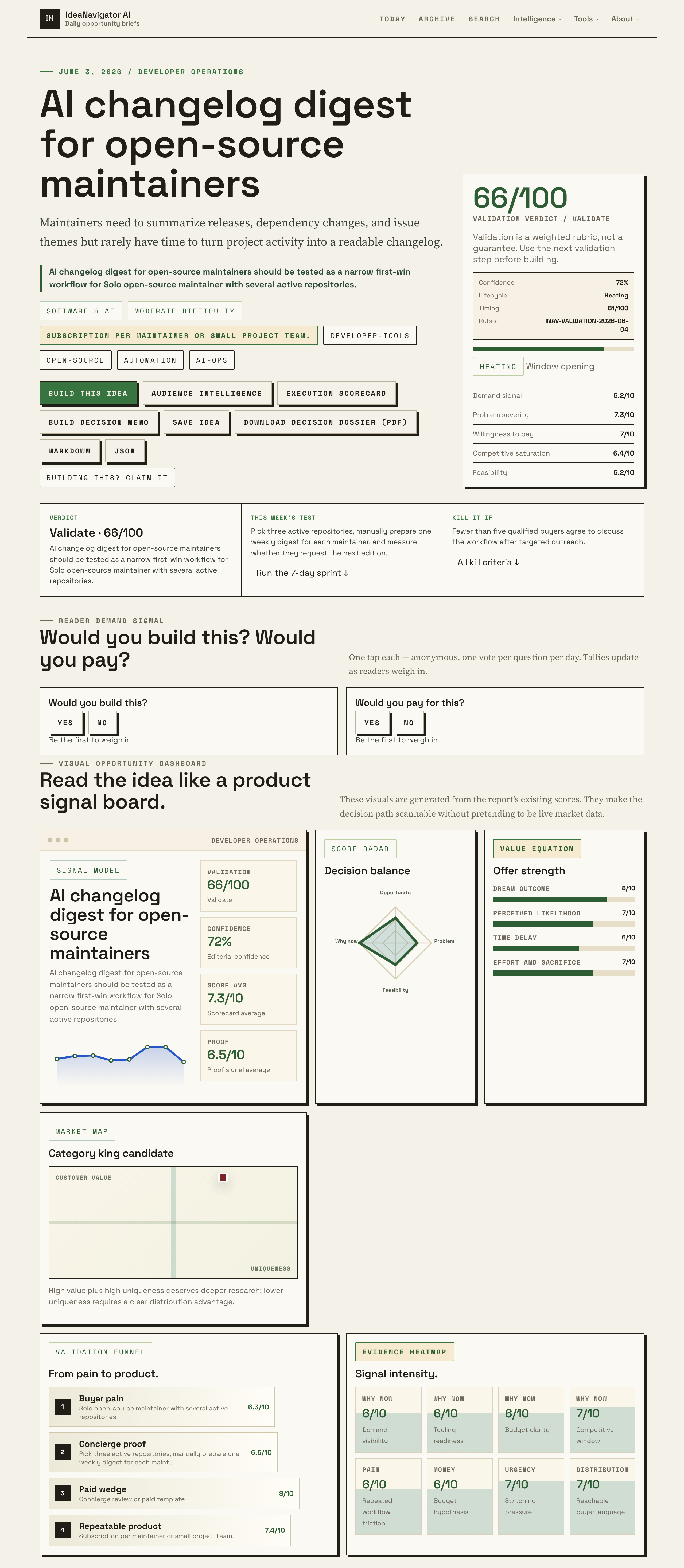
A proposed AI changelog digest for open-source maintainers is being tested as a workflow to automate release summaries. It targets solo maintainers managing multiple repositories and could streamline project updates.
AI changelog digest tools for open-source maintainers are being tested as a targeted workflow to assist solo maintainers managing multiple repositories. This development addresses the challenge of summarizing releases, dependency changes, and issues without a dedicated developer relations team, leveraging AI to automate these updates.
The proposed solution involves a weekly digest generator that reads data from one repository’s releases, merged pull requests, and top issues, then drafts a project update email for the maintainer’s approval. This approach aims to streamline the process of keeping project stakeholders informed, especially for maintainers managing several active repositories.
According to the concept outlined by IdeaNavigator AI, this workflow is designed as a minimal viable product (MVP), with subscription-based pricing targeting individual maintainers or small teams. The validation method involves selecting three repositories, manually creating weekly digests, and measuring whether maintainers request subsequent editions.
While the idea is in early testing, it reflects a broader market trend toward automating developer operations and reducing manual effort in project management, especially for solo maintainers with limited resources.
Potential Impact on Solo Open-Source Maintainers
This development could significantly reduce the time and effort required for solo maintainers to produce comprehensive project updates, enabling better communication with users and contributors. Automating changelog summaries may improve project transparency and responsiveness, particularly as open-source ecosystems grow more complex.
By providing a low-cost, automated solution, it could also lower barriers for individual developers to sustain active projects, potentially increasing open-source contributions and project longevity.
AI-powered changelog generator for open-source projects
As an affiliate, we earn on qualifying purchases.
As an affiliate, we earn on qualifying purchases.
Growing Need for Automated Project Summaries
Maintainers often struggle to keep their project documentation up-to-date due to limited time and resources. Traditionally, they manually compile release notes, dependency updates, and issue summaries, which can be time-consuming. Recent advances in AI and repository metadata, along with the proliferation of release feeds, have made it feasible to automate parts of this process.
This initiative by IdeaNavigator AI builds on existing tools that parse repository data, aiming to create a lightweight, weekly digest tailored for solo maintainers managing multiple repositories. The concept aligns with broader trends in developer operations toward automation and efficiency.
“This AI-driven digest could help maintainers focus more on development rather than administrative updates.”
— an anonymous researcher
automated release note software for developers
As an affiliate, we earn on qualifying purchases.
As an affiliate, we earn on qualifying purchases.
Unconfirmed Effectiveness and Adoption Challenges
It is not yet clear how well the AI digest will perform in real-world scenarios, including its accuracy, usability, and acceptance by maintainers. The testing phase is ongoing, and user feedback will determine whether the tool can be scaled or integrated into existing workflows.
Additional uncertainties include the pricing model’s attractiveness and whether the automation can reliably handle diverse project types and sizes.
project update email automation tools
As an affiliate, we earn on qualifying purchases.
As an affiliate, we earn on qualifying purchases.
Next Steps for Validation and Development
The immediate next step is to complete pilot testing with selected repositories and gather feedback from maintainers. Based on this, developers will refine the tool’s features, accuracy, and user interface. If successful, a broader rollout or integration with popular repository hosting platforms could follow.
Further validation will focus on measuring whether maintainers request continued use and how much time the digest saves them, ultimately shaping the product’s future development and market strategy.

GitHub for Beginners Made Simple: A Step-by-Step Guide to Version Control, Collaboration, Open-Source Projects, and Building a Professional Developer Portfolio
As an affiliate, we earn on qualifying purchases.
As an affiliate, we earn on qualifying purchases.
Key Questions
How will the AI generate the changelog digest?
The AI will analyze repository metadata, including releases, pull requests, and top issues, then compile a summary draft for the maintainer’s review.
Is this tool suitable for large open-source projects?
The current focus is on solo maintainers managing multiple repositories. Its suitability for large, complex projects remains unconfirmed and may require additional features.
Will this replace manual updates entirely?
The goal is to assist, not replace, maintainers by automating the initial draft, which they can then review and customize.
What are the costs involved?
The proposed subscription model targets individual maintainers or small teams, but exact pricing details are still being developed.
When will this tool be generally available?
It is currently in testing, with no official release date announced. Broader deployment depends on pilot feedback and further development.
Source: IdeaNavigator AI