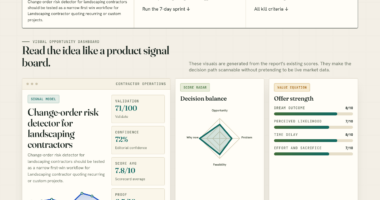

📊 Full opportunity report: Why The Future Of AI Is Full Ownership, Not API Leasing on ThorstenMeyerAI.com — validation score, market gap, and execution plan.

Get hardware and tech essentials delivered free with Prime
- Fast, free delivery on millions of items
- Prime Video, Amazon Music and more included
- Member-only deals all year
TL;DR
Mistral’s Forge introduces a new approach to enterprise AI, focusing on building and owning custom models rather than relying on API-based services. This shift is significant for organizations with sensitive or specialized data.
Mistral’s Forge, announced at Nvidia’s GTC in March 2026, is a new platform that enables organizations to build and operate their own AI models, emphasizing ownership over API leasing. This approach targets organizations with proprietary, sensitive, or highly specialized data, marking a shift from the common practice of using third-party APIs for enterprise AI.
Forge offers a comprehensive lifecycle platform for developing, training, and deploying custom AI models within an organization’s own infrastructure. Unlike retrieval-augmented generation (RAG) or fine-tuning, Forge creates models that fundamentally alter how the AI reasons, making it suitable for entities with complex, proprietary knowledge bases.
The platform includes stages such as data preparation, training, alignment, evaluation, lifecycle management, and deployment, supported by Mistral’s own engineers embedded directly with client teams. The base models are open-weight checkpoints from Mistral, which can be further specialized through techniques like reinforcement learning and distillation.
Early adopters include organizations like ASML, the European Space Agency, and Singapore’s DSO and HTX, all of which handle sensitive or highly technical data. Mistral argues that Forge is most beneficial when proprietary knowledge influences the model’s reasoning, such as in industrial, government, or security contexts. For most organizations, simpler methods like RAG or light fine-tuning remain more cost-effective and easier to update.
Mistral Forge: owning the model, not just renting the API
Europe’s most valuable AI company is betting the next sovereignty fight isn’t which API you call — it’s whether you own the model at all. Forge builds a model adapted to your data, terminology & rules, run inside your own walls. A leap for the right buyer; overkill for most.
Your proprietary knowledge changes how the model reasons — engineering/code, industrial constraints, government language & law, security telemetry, agentic tool-use by your rules. High-consequence, data-mature, sovereignty-bound.
You want a knowledge assistant, doc search or support bot — RAG or light fine-tuning wins on cost, speed & updatability. Analysts warn most enterprises lack the clean, governed data Forge assumes.
Train on your data, in your jurisdiction, on infrastructure you control, with a non-US vendor — air-gapped if needed, keeping the models, infra & knowledge. In a year when model access proved to be a geopolitical variable, owning the model stops being philosophy and becomes a hedge. (US labs offer custom models too; Forge’s moat is the combination — full pre-training + EU residency + on-prem, one platform.)
Forge packages what used to require an in-house AI research team — deep adaptation, sovereign deployment, full lifecycle, with embedded engineers. For big, regulated, data-rich orgs with high-consequence use cases, that’s a real leap, and the European framing is a feature. For everyone else it’s a heavier commitment than the problem needs — climb the ladder (RAG → fine-tune → Forge) and demand proof, not marketing. The deeper signal: enterprise sovereignty is shifting from “which API?” to “do I own the model?”
Implications for Data Security and Model Sovereignty
This development signifies a potential shift towards greater data sovereignty and control over AI models, especially for organizations in regulated or sensitive sectors. Building and owning models reduces reliance on external API providers, mitigating risks related to data privacy, security, and compliance. It also allows organizations to tailor AI reasoning to their specific needs, which is critical for specialized industries like aerospace, defense, or government services.
However, this approach requires significant technical capacity, infrastructure, and data maturity, limiting its immediate applicability to large, well-resourced organizations. For the broader market, the cost and complexity of full ownership may outweigh the benefits, reinforcing a divide between early adopters and typical enterprise users.
enterprise AI model development platform
As an affiliate, we earn on qualifying purchases.
As an affiliate, we earn on qualifying purchases.
Current Enterprise AI Practices and Market Limitations
Until now, most enterprise AI has relied on API leasing, where companies access large pre-trained models via cloud services and customize responses through prompt engineering, retrieval systems, or fine-tuning. This model is flexible, scalable, and suitable for organizations lacking extensive AI infrastructure.
Recent industry analysis, including a survey by Futurum, indicates that many companies spend over half their data management efforts on organizing and maintaining data, not on AI deployment. This suggests that most organizations are unprepared for the technical demands of full model ownership, which requires structured data, ongoing training, and maintenance capabilities.
Mistral’s Forge targets a niche of organizations with high data maturity, such as aerospace and government agencies, where the benefits of full ownership outweigh the costs. For the majority, lighter approaches like RAG or fine-tuning remain the preferred options due to lower complexity and cost.
“Forge is designed for organizations that need to embed proprietary knowledge deeply into their AI reasoning, not just retrieve information.”
— Mistral spokesperson
private AI model training hardware
As an affiliate, we earn on qualifying purchases.
As an affiliate, we earn on qualifying purchases.
Market Readiness and Adoption Challenges for Forge
It remains unclear how quickly and broadly organizations will adopt full ownership models like Forge, given the high technical and data requirements. The actual market size may be smaller than Mistral suggests, as many enterprises lack the necessary data maturity and infrastructure to effectively implement such solutions.
Additionally, the long-term cost-effectiveness and flexibility of full ownership versus API leasing are still under debate, especially as API providers continue to improve their models and fine-tuning techniques.
on-premise AI model deployment solutions
As an affiliate, we earn on qualifying purchases.
As an affiliate, we earn on qualifying purchases.
Next Steps for Adoption and Market Expansion
In the coming months, Mistral will likely focus on onboarding early adopters and demonstrating the ROI of Forge in high-stakes sectors. Monitoring how organizations with different data maturity levels respond will be key to understanding broader market potential. Further technical developments and simplified deployment options could also expand Forge’s appeal beyond its initial niche.
Additionally, industry analysts and competitors will watch how Forge influences the balance between model ownership and API leasing, possibly prompting other providers to develop similar full-ownership solutions.
As an affiliate, we earn on qualifying purchases.
Key Questions
What are the main advantages of full ownership over API leasing?
Full ownership allows organizations to control their AI models completely, customize reasoning deeply, ensure data privacy, and tailor models to specific needs, especially in sensitive sectors.
Who are the ideal candidates for Forge?
Organizations with high data maturity, technical capacity, and a need for proprietary, sensitive, or highly specialized AI models, such as aerospace, government agencies, and security-focused companies.
What are the main challenges of adopting Forge?
The primary challenges include high costs, complex technical requirements, need for ongoing data management, and the organizational capacity to support full model lifecycle management.
Will Forge replace API-based models for most companies?
Most likely not in the near term. API leasing remains more practical for organizations with less mature data infrastructure or smaller budgets, while Forge targets a niche with specific needs for ownership and control.
Source: ThorstenMeyerAI.com
Halloween Picks
halloween
As an affiliate, we earn on qualifying purchases.