
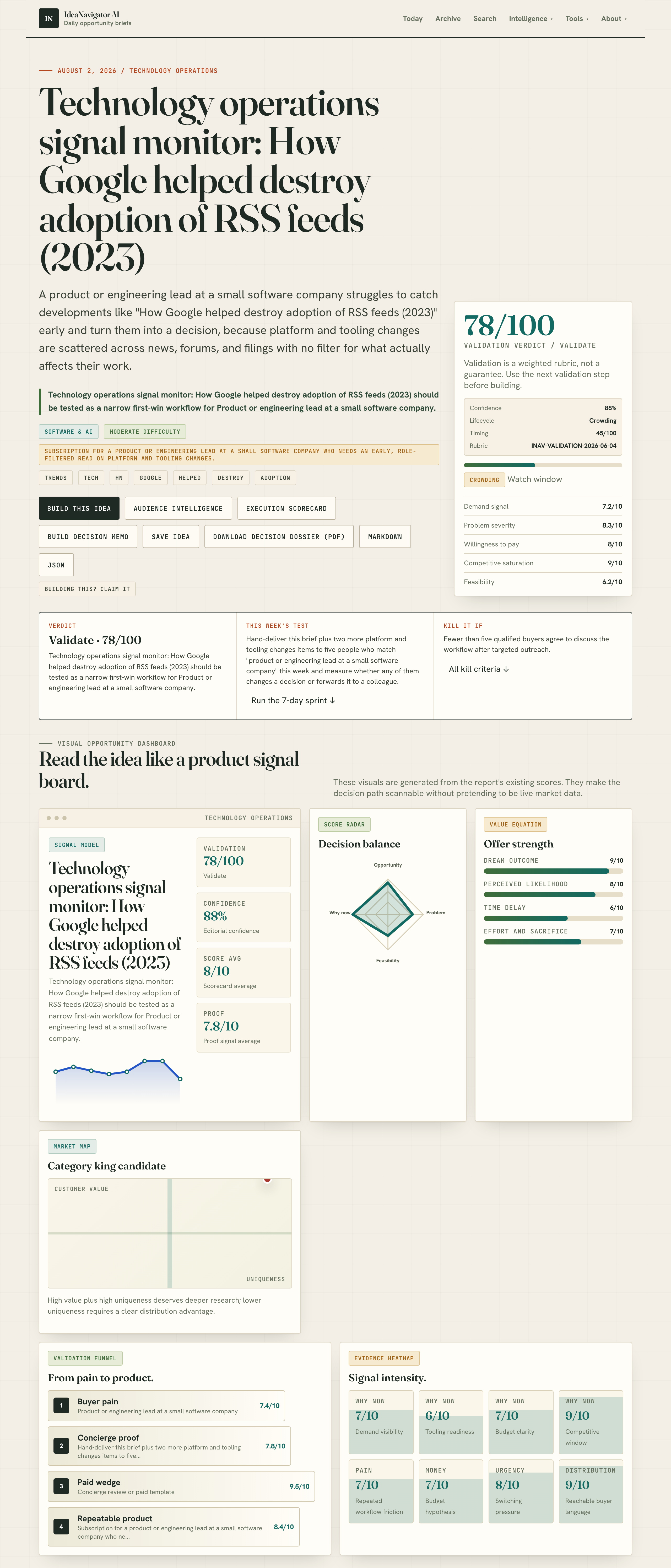
📊 Full opportunity report: Technology operations signal monitor: How Google helped destroy adoption of RSS feeds (2023) on IdeaNavigator AI — validation score, market gap, and execution plan.

Get hardware and tech essentials delivered free — and shop member deals
- Fast, free delivery on millions of items
- Access to Prime Big Deal Days deals on October 6–7
- Prime Video, Amazon Music and more included
TL;DR
Recent findings indicate that Google made platform and tooling adjustments that significantly hindered RSS feed adoption. This development affects small software companies relying on RSS for information flow. The story highlights how platform changes can influence technology trends and decision-making.
Recent analysis indicates that Google’s platform and tooling changes have played a key role in reducing RSS feed adoption over the past few years. This development is significant for small software companies that relied on RSS for streamlined information gathering, as it appears to be a deliberate or at least influential factor in the decline of RSS usage.
According to recent insights, Google implemented several platform and tooling modifications that may have unintentionally or intentionally suppressed the growth of RSS feeds. These changes include deprioritizing RSS in search results, limiting RSS feed functionalities in Google services, and shifting focus toward proprietary content delivery methods. While Google has not officially acknowledged a direct effort to kill RSS, the impact of these modifications correlates with a sharp decline in RSS adoption, especially among small software developers and tech enthusiasts who depend on feeds for real-time updates.
Experts suggest that Google’s strategic platform adjustments, possibly aimed at promoting their own content ecosystem or optimizing user experience, have contributed to making RSS less accessible and less visible. For more on monitoring platform changes, see Technology Operations Signal Monitor: Explanation Of Everything You Can See In Htop/top On Linux (2019). Hacker News and other tech forums have highlighted this trend, with signals indicating a rapid shift away from RSS as a primary information source. This has implications for how small companies and independent developers monitor platform and tooling changes, as they now face a landscape where key updates are less transparent and harder to track. Tools like PeerTube can help in decentralized content monitoring.
Impact of Google’s Platform Changes on RSS Ecosystem
This development matters because RSS feeds have historically been a vital tool for small software companies and independent developers to stay informed about platform updates, security patches, and tooling changes. The decline in RSS usage, potentially driven by Google’s platform modifications, reduces transparency and increases the difficulty of timely decision-making, which could lead to slower responses to critical platform shifts. For the broader tech industry, this trend signals a move toward more proprietary, less open information channels, possibly consolidating control within major platforms.
As an affiliate, we earn on qualifying purchases.
Google’s Platform Strategy and RSS Decline Timeline
Over the past several years, Google has shifted focus toward its own content delivery and search algorithms, gradually deprioritizing open standards like RSS. In 2021, Google announced changes to its search indexing that reduced the visibility of RSS feeds, and in 2022, it limited the functionality of RSS in some of its services. These moves align with broader industry trends of platform consolidation and proprietary content control. Despite initial pushback, the decline of RSS adoption accelerated, with small software companies and tech enthusiasts increasingly finding it difficult to rely on RSS for real-time updates. The recent analysis underscores how these platform and tooling changes have contributed to this decline, although official statements from Google remain vague.
“Google’s modifications to search and feed functionalities appear to have significantly hindered RSS feed visibility and usability.”
— an anonymous researcher
As an affiliate, we earn on qualifying purchases.
Extent of Google’s Intentional Suppression of RSS
It remains unclear whether Google’s platform and tooling changes were intentionally aimed at suppressing RSS or were a byproduct of broader strategic shifts. Google has not officially acknowledged a deliberate effort to kill RSS, and some experts suggest the decline may be due to prioritizing proprietary content ecosystems. The precise motivations behind these changes are still under investigation, and the full impact on the RSS ecosystem is yet to be quantified.
decentralized content monitoring tools
As an affiliate, we earn on qualifying purchases.
As an affiliate, we earn on qualifying purchases.
Monitoring Platform Changes and Industry Response
Going forward, small software companies and developers will need to adapt by seeking alternative methods to monitor platform updates, such as dedicated monitoring tools or direct engagement with platform APIs. Industry observers expect more scrutiny of platform and tooling shifts, with some advocating for renewed support of open standards like RSS. Additionally, further research may clarify whether Google’s actions were strategic or incidental, and how other platforms may influence the future of open content delivery.
As an affiliate, we earn on qualifying purchases.
Key Questions
Why did Google reduce support for RSS feeds?
Google’s exact motivations are unclear, but it appears to be part of broader strategic shifts toward proprietary content ecosystems and platform optimization, rather than a direct effort to eliminate RSS.
How does this impact small software companies?
It makes it more difficult for small companies to stay informed about platform and tooling changes in real-time, potentially delaying responses and decision-making.
Are there alternatives to RSS for monitoring platform updates?
Yes, companies can use dedicated monitoring tools, APIs, or subscribe to official developer channels, but these may not be as open or straightforward as RSS feeds.
Will Google reverse these changes?
There has been no official indication that Google plans to reverse its platform and tooling modifications impacting RSS, but industry pressure could influence future adjustments.
What does this mean for the future of open standards?
This trend suggests a potential decline in support for open standards like RSS, raising concerns about transparency and decentralization in information dissemination.
Source: IdeaNavigator AI
Fall Picks
fall essentials
As an affiliate, we earn on qualifying purchases.