📊 Full opportunity report: Technology Operations Signal Monitor: Explanation Of Everything You Can See In Htop/top On Linux (2019) on IdeaNavigator AI — validation score, market gap, and execution plan.

Get hardware and tech essentials delivered free — and shop member deals
- Fast, free delivery on millions of items
- Access to Prime Big Deal Days deals on October 6–7
- Prime Video, Amazon Music and more included
TL;DR
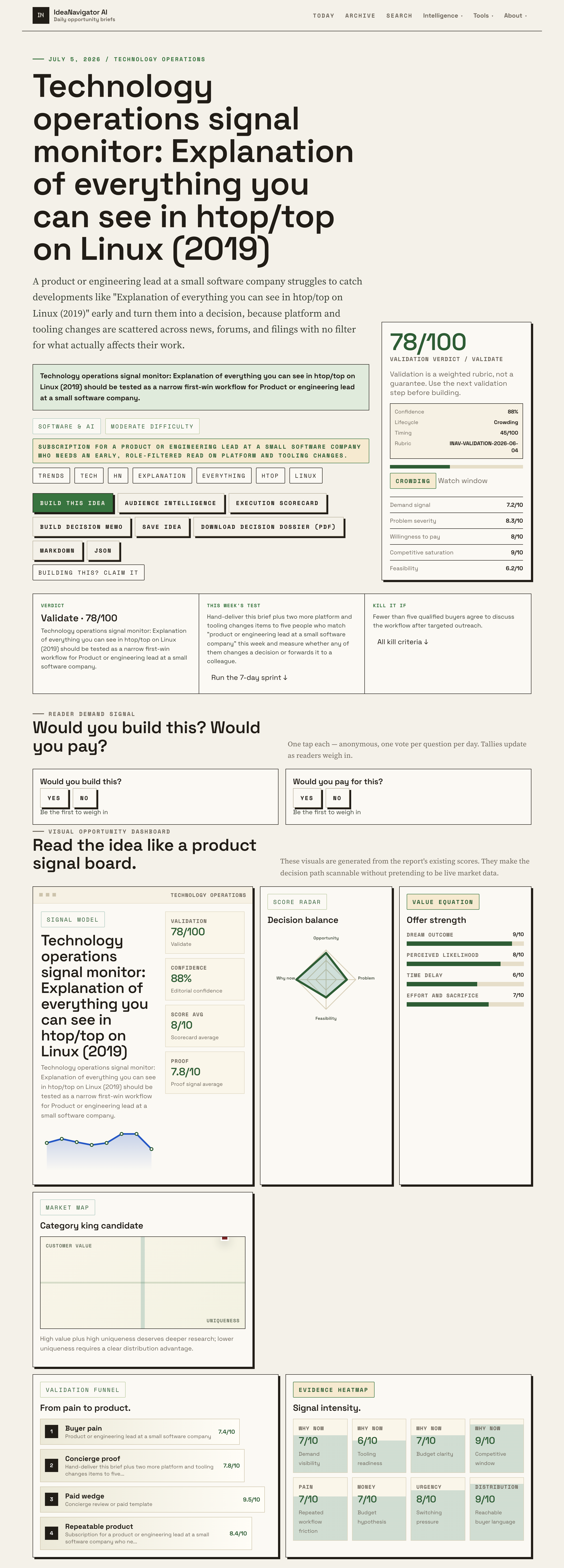
This article explains what the ‘h’ in Linux monitoring tools like htop and top displays. It clarifies what system information is visible and why understanding this helps technical leads make better decisions.
The ‘h’ option in Linux system monitoring tools such as htop and top displays detailed system information, including hardware and process data. This explanation aims to clarify what exactly is visible and how it can inform decisions for product and engineering leads. You can learn more about decentralized video platforms like PeerTube.
In Linux, tools like htop and top are used to monitor system performance and processes in real time. For related monitoring tools, see Fabrice Bellard’s work. When users invoke the ‘h’ option—either explicitly or through help menus—they access a comprehensive overview of system metrics. This includes CPU usage, memory consumption, process details, and hardware information such as CPU type, kernel version, and system uptime.
Specifically, the ‘h’ in these tools typically triggers help menus or displays specific sections of system info. For example, in htop, pressing ‘h’ opens the help menu, which explains key functions and shortcuts. In top, the ‘h’ key often displays help, but the command-line options may also include flags that influence the displayed data. Understanding what these options reveal helps engineers diagnose performance issues or understand system capacity at a glance.
Confirmed by documentation and user experience, the information accessible via ‘h’ and related commands includes hardware specifications, kernel version, system load, process list, and resource utilization. For insights into system operations, see trade and supply chain operations news. This data is vital for product or engineering leads to make informed decisions about system health, capacity planning, and troubleshooting.
Why Linux Monitoring Details Impact System Management
Understanding what the ‘h’ option reveals in Linux system monitoring tools is essential for technical leads managing server health and performance. Accurate interpretation of this data enables faster troubleshooting, capacity planning, and optimization, reducing downtime and improving reliability. As platform and tooling changes evolve rapidly, being able to quickly grasp these details helps teams stay ahead in maintaining stable systems.
Linux system monitoring tools htop
As an affiliate, we earn on qualifying purchases.
As an affiliate, we earn on qualifying purchases.
Evolution of Linux Monitoring Tools and Their Role in Operations
Linux monitoring tools like htop and top have been integral to system administration for decades. Their features have expanded over time, with the ‘h’ key traditionally serving as a help or info toggle. Recent updates and community discussions, such as those surfaced on Hacker News, highlight the importance of understanding these tools’ outputs in a fast-changing tech environment. Small software companies rely on these insights to make quick, data-driven decisions about their infrastructure.
“The ‘h’ key in top and htop is crucial because it explains what all the displayed metrics mean, helping engineers interpret system health quickly.”
— an experienced Linux user
hardware monitoring software for Linux
As an affiliate, we earn on qualifying purchases.
As an affiliate, we earn on qualifying purchases.
Unclear Aspects of ‘h’ Output and Tool Variations
While the general purpose of the ‘h’ option is documented, there is some variation in how different Linux distributions or versions implement or display this information. It is not yet clear how recent updates may alter what is shown or how accessible this data is across different setups. Additionally, some users report differences between htop and top in how the ‘h’ key functions or what info is provided.
CPU and memory usage monitor for Linux
As an affiliate, we earn on qualifying purchases.
As an affiliate, we earn on qualifying purchases.
Monitoring Tool Updates and User Guidance Improvements
Developers and community maintainers are expected to release updates clarifying the scope of information accessible via ‘h’ in these tools. For product and engineering leads, staying informed about these changes will be critical. Future efforts may include enhanced documentation, tutorials, or automated briefs that summarize system info from these tools for quick decision-making.
Linux server performance analysis tools
As an affiliate, we earn on qualifying purchases.
As an affiliate, we earn on qualifying purchases.
Key Questions
What specific system information does the ‘h’ option display in htop and top?
The ‘h’ option generally opens help menus or displays sections with details like CPU type, kernel version, memory usage, process list, and system uptime, depending on the tool and version.
Are there differences between how htop and top show information when pressing ‘h’?
Yes, there are variations in interface and details provided, especially across different versions and distributions. Some may show more hardware details, while others focus on process and resource metrics.
How can understanding the ‘h’ output help in system management?
It allows engineers to quickly interpret system health, identify bottlenecks, and troubleshoot issues without deep dives into logs or external tools, improving response times.
Is the ‘h’ option consistent across all Linux monitoring tools?
Not necessarily; while common in htop and top, other tools may use different keys or commands for help or system info. Confirming each tool’s documentation is recommended.
Source: IdeaNavigator AI
Halloween Picks
halloween
As an affiliate, we earn on qualifying purchases.