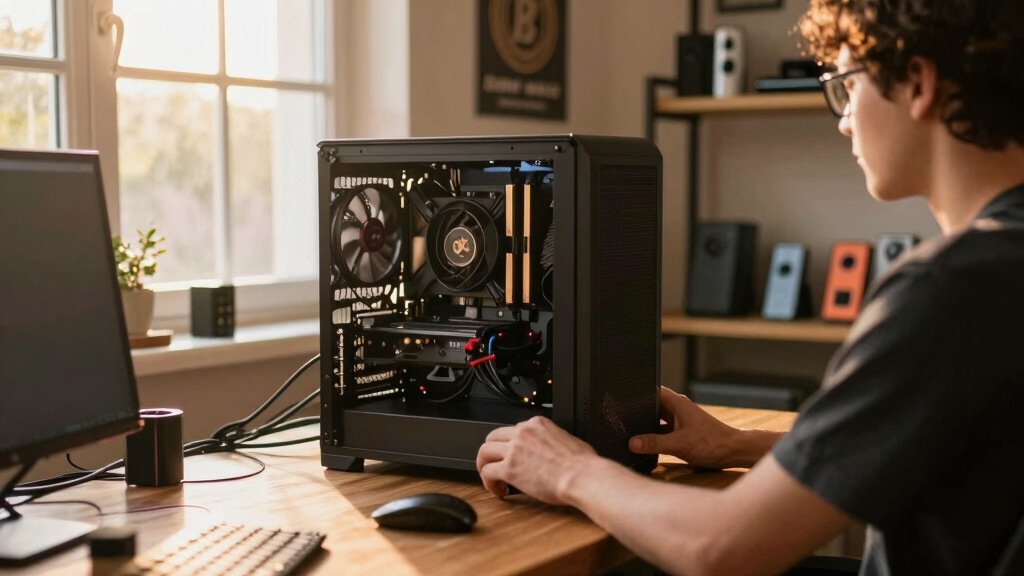

📊 Full opportunity report: The Real Cost Of A Local-Inference Rig In 2026 on ThorstenMeyerAI.com — validation score, market gap, and execution plan.

Get hardware and tech essentials delivered free with Prime
- Fast, free delivery on millions of items
- Prime Video, Amazon Music and more included
- Member-only deals all year
TL;DR
By 2026, owning a local inference rig for large language models involves significant hardware costs, especially around VRAM capacity. The most cost-effective options favor used GPUs and multi-GPU setups over the latest flagship cards, impacting AI deployment strategies.
In 2026, the cost of building a local inference rig for large language models varies widely depending on hardware choices, with significant emphasis on VRAM capacity. The most affordable and practical solutions often involve used GPUs and multi-GPU setups, rather than the latest flagship cards, challenging assumptions about hardware investment for AI practitioners.
The core constraint for local inference is the VRAM cliff: models must fit entirely in GPU memory to run efficiently. For example, a 70B model requires around 43GB of VRAM at full precision, meaning a single high-end GPU like the RTX 5090 (32GB) can only handle smaller models or require multiple GPUs for larger ones. Conversely, older used GPUs like the RTX 3090 (24GB) offer a better VRAM-per-dollar ratio, often outperforming newer cards in cost efficiency, especially when used in multi-GPU configurations with NVLink.
Estimating costs, a used RTX 3090 can be purchased for $600–$850, providing roughly five times the VRAM-per-dollar of a new RTX 5090, which costs around $2,000. Multi-3090 setups, combining four cards, can pool nearly 96GB of VRAM for under $3,200, enabling the operation of models up to 70B at high quality. The choice of hardware depends heavily on the size of the model targeted and the budget constraints, with the trend favoring multi-GPU systems for affordability and scalability.
The real cost of a local-inference rig
Owning beats renting for steady AI work — so what does a local rig cost in 2026? The unintuitive, good news: the most expensive build is almost never the smartest one. It all comes down to one rule.
The difference is only whether the weights fit. LLM inference is memory-bandwidth-bound — VRAM capacity is the hard limit you build around. Compute specs are mostly noise.
The squeeze reframes the rig like everything else in this series: discipline beats maximalism. VRAM is exactly the memory under most pressure, so over-buying it is the 128GB-“to-be-safe” trap, only worse per gigabyte. Take the cheap, high-value step to 24GB (the gateway to the 30B class), reach for used 3090s and MoE models, and use quantization to climb a tier without buying silicon. Sized right, the rig pays for itself against the cloud’s ever-rising hidden bill. Next: Apple Silicon’s quiet memory advantage.
Impact of Hardware Choices on AI Deployment Costs
Understanding the true costs of local inference rigs in 2026 is crucial for AI developers, researchers, and organizations aiming to reduce cloud expenses and improve data privacy. Hardware decisions directly influence the feasibility of running larger models locally, shaping the AI landscape by making high-performance inference more accessible to those with limited budgets. The trend toward used GPUs and multi-GPU setups also raises questions about hardware longevity, maintenance, and scaling strategies.
used NVIDIA RTX 3090 GPU for AI inference
As an affiliate, we earn on qualifying purchases.
As an affiliate, we earn on qualifying purchases.
Current Market Trends and Technical Constraints
In 2026, the hardware landscape for AI inference is dominated by the VRAM cliff, where models exceeding VRAM capacity experience drastic performance drops. The community widely recognizes that VRAM capacity, not raw compute power, determines practical model size. Recent developments include the availability of used GPUs like the RTX 3090, which offer high VRAM at lower prices, and multi-GPU configurations that enable larger models without flagship cards. Additionally, Apple Silicon’s unified memory presents an alternative path for large models, though primarily on specialized hardware.
Previous years saw rapid growth in GPU performance, but the emphasis has shifted toward VRAM capacity as the key bottleneck. This shift impacts hardware purchasing strategies and influences the total cost of ownership for local inference rigs.
“Four used RTX 3090s can pool nearly 96GB of VRAM for less than $3,200, making them a practical choice for large model inference.”
— A hardware reseller specializing in used GPUs
multi-GPU NVLink setup for AI models
As an affiliate, we earn on qualifying purchases.
As an affiliate, we earn on qualifying purchases.
Unresolved Questions About Hardware Longevity and Performance
It remains unclear how long used GPUs like the RTX 3090 will remain reliable for intensive inference workloads, and whether rapid advancements in AI models will soon outpace current hardware capabilities. Additionally, the impact of upcoming hardware releases on the cost-effectiveness of existing setups is still uncertain, as is the long-term scalability of multi-GPU configurations.
high VRAM graphics card for large language models
As an affiliate, we earn on qualifying purchases.
As an affiliate, we earn on qualifying purchases.
Next Steps for Building Cost-Effective Local Inference Systems
As 2026 progresses, hardware prices and availability, especially for used GPUs, will influence the optimal configurations for local inference rigs. Developers and organizations should monitor GPU market trends, evaluate multi-GPU pooling options, and consider emerging hardware like Apple Silicon’s unified memory to optimize costs. Further technical developments and new hardware releases may shift the landscape, making ongoing reassessment essential.
affordable GPU for AI inference 2026
As an affiliate, we earn on qualifying purchases.
As an affiliate, we earn on qualifying purchases.
Key Questions
What is the most cost-effective GPU for local inference in 2026?
Used RTX 3090s, especially when combined in multi-GPU setups, currently offer the best VRAM-per-dollar ratio for inference tasks, outperforming newer flagship cards in cost efficiency.
How does VRAM capacity affect model size and performance?
VRAM capacity determines whether a model can run entirely in GPU memory. If the model exceeds VRAM, performance drops dramatically, making VRAM the key factor in hardware selection for inference.
Are newer GPUs always better for local inference?
Not necessarily. For inference, the newest GPUs often have less VRAM per dollar. Older used GPUs can be more economical, especially when pooled in multi-GPU configurations.
Can Apple Silicon chips handle large models effectively?
Yes, Apple Silicon’s unified memory allows system RAM to serve as VRAM, enabling large models to run on Macs with high memory capacity, though with different performance characteristics.
What hardware upgrades are worth considering for 2026?
Prioritizing increased VRAM capacity, especially through used GPUs or multi-GPU systems, remains the most effective upgrade path for local inference in 2026.
Source: ThorstenMeyerAI.com
Halloween Picks
halloween
As an affiliate, we earn on qualifying purchases.