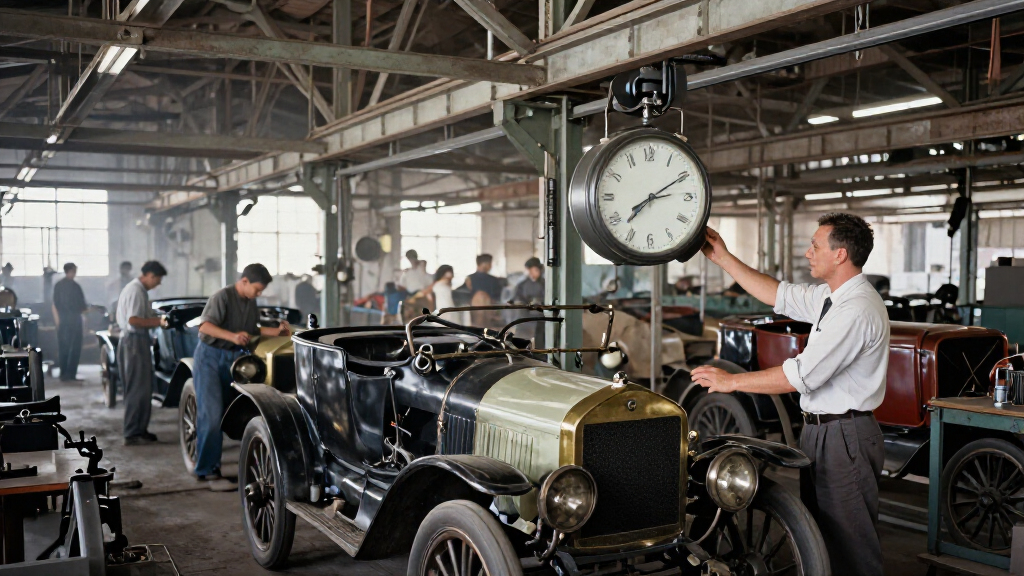
🔍 Read the full analysis: The Assembly Line And A Landmark Daily Wage on ThorstenMeyerAI.com

Get hardware and tech essentials delivered free with Prime
- Fast, free delivery on millions of items
- Prime Video, Amazon Music and more included
- Member-only deals all year
TL;DR
On January 5, 1914, Ford Motor Co. raised the minimum daily wage to $5 and cut the workday from nine hours to eight. The move followed severe turnover as the moving assembly line accelerated production; Ford’s own account and later research differ on some figures, and the pay came with eligibility conditions.
Ford Motor Co. announced a $5 minimum daily wage and an eight-hour workday on January 5, 1914, after workers were leaving its Detroit factory at a high rate as production shifted to a moving assembly line. The change, described by the company as profit sharing and subject to conditions, was intended to address a staffing problem as well as alter pay.
The production change had sharply reduced the labor time needed to assemble a Model T chassis. In My Life and Work, published in 1922, Henry Ford said chassis assembly took 12 hours and 28 minutes when the car remained stationary, compared with 1 hour and 33 minutes on the moving line by early 1914. Those figures come from Ford’s account, written with journalist Samuel Crowther, and should be read as the company’s version of events.
That faster process did not mean Ford could easily keep workers. Figures cited in the source from economists Daniel Raff and Lawrence Summers’ 1987 study put the company’s 1913 labor turnover at 370%: it hired 50,448 people to maintain an average workforce of 13,623. A separate Henry Ford Museum estimate is about 380%. Ford later wrote that the company was hiring at a rate of about 53,000 a year in 1914 to keep a workforce of 14,000.
The wage announcement combined higher minimum daily pay with a shorter shift: the workday fell from nine hours to eight, and minimum daily pay rose from $2.34 to $5. The five-dollar rate was not described as an unconditional wage for every worker; it was tied to profit-sharing rules and strict eligibility requirements. The source says turnover fell to 54% in 1914, though that figure does not by itself establish how much of the change resulted from the wage policy rather than other factors.
Higher Pay as a Retention Measure
The episode complicates the familiar story that Ford raised wages mainly so employees could afford the cars they built. The account argues that the immediate business problem was workers leaving faster than Ford could replace them, not a shortage of buyers. It says the company had around 14,000 workers and made about 250,000 cars a year around 1914, although those figures do not establish Ford’s motive on their own.
The wage increase mattered because the assembly line’s efficiency depended on having workers present and keeping production moving. High turnover meant repeated hiring and disruption, while absences also affected staffing: the source reports that roughly one worker in ten was absent on an average day. Ford later called the five-dollar policy “one of the finest cost-cutting moves we ever made,” a statement that reflects his retrospective view, not an independent measurement of the policy’s full effects.
The case also shows how productivity gains can create pressure on working conditions and employment. Repetitive, tightly divided tasks helped reduce assembly time, but the same system could make retention difficult. The wage policy is therefore relevant not just as a pay milestone, but as an early example of an employer responding to the labor consequences of industrial reorganization.
Products Worth Considering

Trezor Safe 7 Crypto Hardware Wallet

Logitech MX Mechanical Wireless Illuminated Keyboard, Tactile Quiet, Graphite

Apple MacBook Air 13-inch Laptop with M5 Chip, 16GB Memory, 512GB SSD, 12MP Center Stage Camera, Touch ID, Wi-Fi 7, Midnight
As an affiliate, we earn on qualifying purchases.
From Stationary Cars to Moving Lines
Before the moving line, workers assembled a car around a stationary chassis, bringing parts to it. Ford’s Highland Park plant began experimenting with a moving assembly line in 1913, first on a small component, the flywheel magneto. Ford wrote that the idea came in part from overhead rails used in Chicago meatpacking plants, where carcasses moved past workers.
Ford’s account says the magneto task was split into 29 operations. It reports that the time to assemble one fell from about 20 minutes to 13 minutes and 10 seconds, then to seven minutes and later five minutes after further changes. These are company-reported figures. On the chassis, an early rope-and-windlass experiment brought the reported labor time to 5 hours and 50 minutes; later changes to the line and division of tasks brought it to 1 hour and 33 minutes.
The assembly line was part of wider industrial change, but the source cautions against treating it as an immediate job-destruction story. It says U.S. factory employment rose by about a third between 1910 and 1920. The longer-term picture it sketches is one in which assembly lines persist while more production tasks are performed by robots; the excerpt provides no detailed figures for that comparison.
““the reduction of the necessity for thought on the part of the worker and the reduction of his movements to a minimum.””
— Henry Ford, in My Life and Work
What the Figures Cannot Establish
The source relies partly on Ford’s 1922 account for production times and on later research for turnover figures. It also notes that the Henry Ford Museum gives a turnover estimate of about 380%, compared with the 370% cited from Raff and Summers’ study. The supplied material does not reconcile the difference or provide a single definitive measure.
The exact effect of the five-dollar policy on turnover is also not isolated. The source reports a fall to 54% in 1914, but gives no method for separating the wage increase’s effect from the shorter workday, changing production practices, or other developments. The profit-sharing conditions and how many workers qualified are not detailed in the excerpt.
The account also does not establish that the pay increase was motivated solely by retention, or that making cars affordable to workers played no role. Its evidence supports turnover as a major problem; the company’s full internal reasoning remains outside the supplied material.
The Line’s Longer Labor Legacy
The supplied source is a historical account published by ThorstenMeyerAI.com on November 6, 2026, as part of “Work After Work,” Episode 5 of Arc 1. It does not report a new Ford policy or a current company announcement. The next step for readers assessing the historical claim is to compare Ford’s account with contemporary company records and independent labor research, especially on eligibility rules and how turnover was measured.
The account places the 1914 wage decision within a longer history of factory work, ending with the observation that modern assembly lines use more robots. It provides no forecast or supporting figures for that shift. What is clear from the material is the sequence it describes: production was reorganized, labor time fell, Ford faced serious retention problems, and the company responded with shorter hours and higher conditional daily pay.
Key Questions
What did Ford announce in January 1914?
Ford announced an eight-hour workday, reduced from nine hours, and a minimum daily wage of $5, up from $2.34. The five-dollar rate was tied to profit-sharing conditions.
Why did Ford raise daily pay?
The source identifies severe worker turnover as a central problem. Figures cited from a 1987 study say Ford hired 50,448 people in 1913 to maintain an average workforce of 13,623. The material does not prove that retention was the only reason for the policy.
How much faster did the moving assembly line make chassis production?
According to Henry Ford’s 1922 account, labor time per Model T chassis fell from 12 hours and 28 minutes when assembled at a standstill to 1 hour and 33 minutes on the moving line by early 1914. These are company-reported figures.
Did every Ford worker automatically receive $5 a day?
No. The source describes the increase as profit sharing with strict conditions. It does not specify the eligibility rules or how many workers qualified.
Did the wage increase cause turnover to fall?
The source reports that turnover fell to 54% in 1914, but it does not isolate the wage policy’s effect from the shorter workday or other changes. The figures do not establish a single cause for the decline.
Source: ThorstenMeyerAI.com