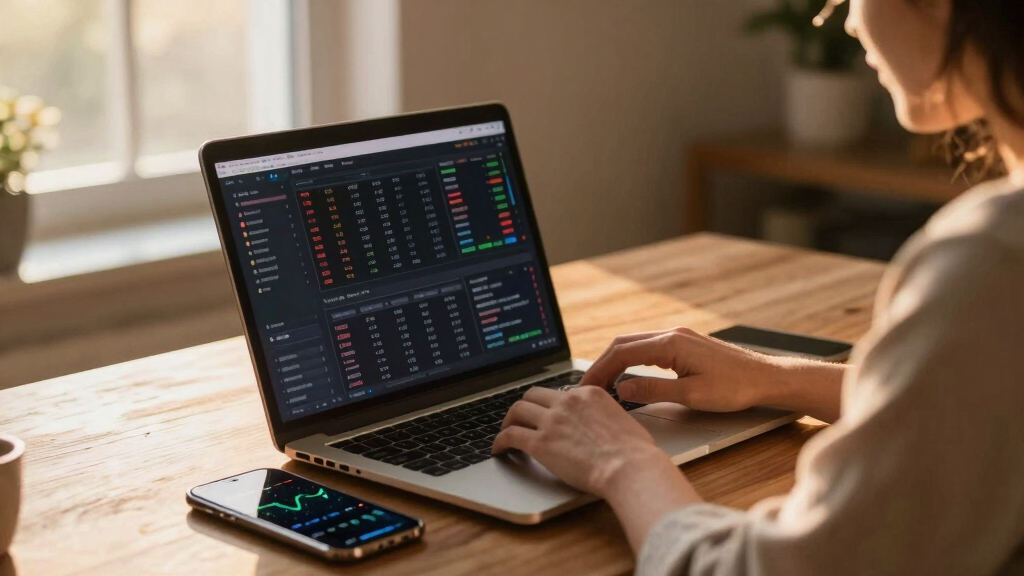

📊 Full opportunity report: Introducing Forezai · TradingAgents — a committee of LLMs decides paper-trades on ThorstenMeyerAI.com — validation score, market gap, and execution plan.
TL;DR
Forezai · TradingAgents has introduced an autonomous system where a committee of specialized LLMs executes paper trades based on structured debates and decision-making protocols. This development aims to explore AI’s potential in trading without risking real money.
Forezai · TradingAgents has unveiled a new system that allows a committee of large language models (LLMs) to autonomously generate and execute paper trades based on structured, multi-role debates and decision-making processes. This development marks a significant step in AI-driven research for trading strategies, focusing on decision transparency and multi-agent reasoning rather than prediction accuracy.
The system is a fork of an existing open-source multi-agent framework called TradingAgents, originally designed to test whether LLMs, when assigned specialized roles, can produce trading decisions comparable to or better than random chance. The new Forezai version adds operational features: an automated scheduler, paper-trading interfaces with multiple broker modes, and a web dashboard for monitoring. It does not trade with real money by default, emphasizing research and simulation.
Specifically, the framework involves multiple analyst roles—covering market structure, news, fundamentals, and social sentiment—that generate independent reports. These reports are debated by bull and bear agents, with a research manager synthesizing them into a cohesive view. A risk team evaluates upside and downside, culminating in a final buy, hold, or sell decision by a trader agent, which is then aggregated by a portfolio manager agent into a detailed rating and target price. The entire process is designed to articulate reasoning explicitly, avoiding reliance on raw data recall.
Forezai’s operational layer introduces a scheduler that runs daily, mapping the decision outputs into paper orders with filtering and risk controls, including position management and exit rules. It supports multiple modes: local Python, Alpaca paper trading, and a shadow mode for comparison. A web dashboard provides real-time analytics, including equity curves, drawdowns, and performance metrics. The system runs locally, with no data sent to external servers, maintaining a focus on controlled research environments.
Introducing Forezai · TradingAgents.
A committee of LLMs
decides paper-trades.
Analysts · Debate · Risk · Decision
combined with -33% bankroll
services, HTTP routes (starting baseline)
(falls back to public API per token)
The bet is on a different mechanism, not a different parameter setting. The point is not to find a money-printing AI. The point is to put honest measurements of these systems into the public record — so the next person looking at the space starts a step further along than the last.Thorsten Meyer AI · Introducing Forezai · TradingAgents · § 03
Potential Impact on AI-Driven Trading Research
This development is significant because it demonstrates a practical implementation of multi-agent LLM systems making autonomous trading decisions in a simulated environment. While not designed for real trading, it provides a testbed for exploring how structured reasoning, role specialization, and explicit articulation of decision rationale can improve AI decision-making. If successful, it could influence future research on AI explainability and collaborative reasoning in financial contexts.
Moreover, by emphasizing transparency and modularity, Forezai · TradingAgents offers a framework for researchers to experiment with multi-voice AI systems, potentially leading to more robust and interpretable AI trading agents. It also highlights the current limitations of LLMs in prediction and the importance of structured debate and reasoning, rather than raw forecasting, in trading applications.

Chemical Process Simulation and the Aspen HYSYS Software
- Condition: Used Book in Good Condition
As an affiliate, we earn on qualifying purchases.
As an affiliate, we earn on qualifying purchases.
Background and Evolution of AI in Trading Research
Previous research with parametric trading strategies has shown that many seemingly promising rules fail to survive out-of-sample testing, often due to overfitting or mechanical artifacts. Recent efforts have shifted toward understanding whether less rule-bound AI systems, like multi-agent LLM frameworks, can produce more reliable decisions. The original TradingAgents project was designed to test whether specialized LLM roles, engaging in structured argumentation, could outperform random or naive strategies.
Forezai’s fork builds on this foundation, adding operational features necessary for systematic research. While earlier experiments focused on paper-trading against prediction markets, the new system emphasizes the decision process itself, with a focus on explainability, risk management, and automation. This aligns with broader trends in AI research that seek to combine multi-agent reasoning with practical testing environments.
“This system allows us to test whether a committee of specialized LLMs can produce decisions that are at least as reliable as random chance, with the added benefit of explicit reasoning.”
— Thorsten Meyer, lead researcher

Analyze Stocks Faster With AI: Turn hours of filings, earnings calls, and market noise into clearer investment decisions.
As an affiliate, we earn on qualifying purchases.
As an affiliate, we earn on qualifying purchases.
Limitations and Unanswered Questions About AI Trading Agents
It remains unclear how well the system’s decision-making would translate to live trading environments or whether the structured debate approach significantly improves performance over simpler models. The effectiveness of the multi-voice reasoning in reducing overfitting or bias has yet to be empirically validated in real market conditions. Additionally, the impact of operator intervention and the system’s robustness under volatile market scenarios are still being studied.
Advanced Stock Market Analysis Dashboard: Design and Implementation of a Real-Time Financial Analytics Platform
As an affiliate, we earn on qualifying purchases.
As an affiliate, we earn on qualifying purchases.
Next Steps for Testing and Developing AI-Driven Trading Systems
Researchers plan to run extended experiments using Forezai · TradingAgents, analyzing the decision quality, consistency, and explainability of the AI committee. Future work may include integrating real-time market data, refining role definitions, and testing the system in live paper trading with more complex risk controls. The goal is to establish whether structured multi-voice AI can meaningfully contribute to more transparent and reliable trading decision frameworks.

Algorithmic Trading – Algorithmic Trading Strategies – Compendium: Volumes 1 to 20: Trading Systems Research and Development
- Condition: Used Book in Good Condition
As an affiliate, we earn on qualifying purchases.
As an affiliate, we earn on qualifying purchases.
Key Questions
Can Forezai · TradingAgents trade with real money?
Currently, the system is configured for paper trading only. While it supports modes that could be adapted for live trading, actual real-money trading requires deliberate operator override and additional risk controls.
How does the system ensure decision transparency?
The system explicitly articulates reasoning through multiple specialized agents debating and synthesizing their arguments, which are logged and accessible for review.
Is this system designed to outperform human traders?
No. The primary goal is research and understanding of multi-agent AI reasoning in trading contexts, not to replace or outperform human traders in live markets.
What are the main limitations of this approach?
Its effectiveness depends on the quality of the LLMs and the structure of the debate; it has not yet demonstrated consistent outperformance or robustness in volatile or real trading environments.
When will the system be available for broader research use?
It is currently active for research and testing; broader deployment or open access will depend on ongoing validation and development efforts.
Source: ThorstenMeyerAI.com