
📊 Full opportunity report: Food Safety Standards And Pesticide-Residue Compliance: What You Need To Know on IdeaNavigator AI — validation score, market gap, and execution plan.
TL;DR
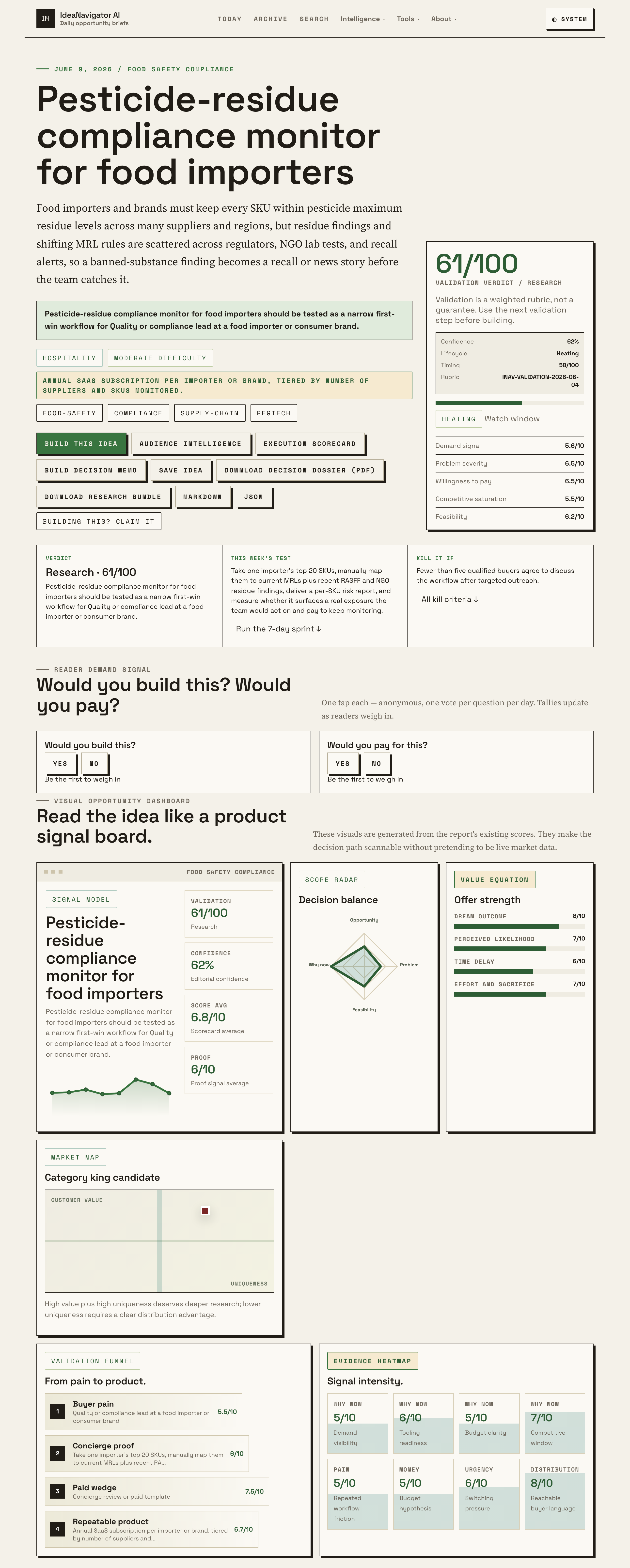
Food importers can now use a pesticide-residue compliance monitor to better track and manage residue levels across suppliers. This development addresses rising regulatory and consumer demands for food safety. The tool maps SKUs to current MRLs and alerts for residue risks, but wider adoption and validation are ongoing.
A new pesticide-residue compliance monitor designed for food importers is emerging as a practical solution to ensure products meet regional maximum residue levels (MRLs). This development responds to rising regulatory and consumer demands for food safety, particularly as NGO testing and regulator alerts increasingly surface EU-banned pesticides in staples like rice, tea, and spices.
The monitor is intended for quality or compliance leads at food importers and consumer brands. It aims to map a brand’s suppliers and SKUs against current EU and regional pesticide MRLs, as well as recent residue findings from regulator alerts such as RASFF and NGO tests. The goal is to identify products at risk of exceeding legal limits and generate audit-ready compliance reports for each SKU.
Developers suggest that the minimum viable product (MVP) involves manually mapping a sample of top SKUs to current MRLs and recent residue alerts, then evaluating whether the tool effectively surfaces real exposure risks. The subscription-based SaaS model would be tiered based on the number of suppliers and SKUs monitored.
While still in validation, this tool could streamline compliance workflows, reduce recall risks, and help brands demonstrate due diligence in food safety. The approach is seen as a first step toward broader, automated residue monitoring systems that could evolve with tightening regulations.
Implications for Food Importers and Regulatory Compliance
This development matters because it offers a practical means for food importers and brands to manage complex pesticide residue regulations more effectively. As MRLs tighten worldwide and NGOs continue to surface banned pesticides in key staples, ensuring compliance is critical to avoid costly recalls, brand damage, and regulatory penalties.
Implementing such tools can improve transparency, facilitate audits, and help companies meet retailer demands for documented residue compliance. Although still in early validation, this approach could significantly enhance food safety management across the supply chain.

Pesticide Test Strips by RenekaBio, Food Pesticide Testers, Fruit Pesticide Test Kit, Pesticide Testing Equipment, Home Use Science Fair Projects Vegetables Fruits Marijuana 20 Test
- Compact and Portable: Lightweight, easy to carry and use
- Rapid Results: Provides results in approximately 15 minutes
- Cost-Effective: Reduces need for expensive lab tests
As an affiliate, we earn on qualifying purchases.
As an affiliate, we earn on qualifying purchases.
Rising Regulatory Pressure and Market Demands for Food Safety
Over recent years, NGO testing and regulator alerts have increasingly identified EU-banned pesticides in imported staples like rice, tea, and spices. These findings have led to recalls and negative publicity, prompting retailers and regulators to demand stricter documentation and compliance measures from importers and brands.
In response, industry stakeholders are exploring digital tools to automate residue tracking, mapping SKUs to current MRLs and alert data. The concept of a pesticide-residue compliance monitor aligns with broader efforts to modernize food safety management and meet evolving legal standards.
While the idea is promising, it remains in early testing phases, with validation focused on a small set of SKUs before wider deployment.
“This monitor could be a game-changer for food importers seeking to stay ahead of regulatory changes and avoid costly recalls.”
— an anonymous researcher
As an affiliate, we earn on qualifying purchases.
Validation and Adoption Challenges for the Monitoring Tool
It is not yet clear how effectively the initial manual mapping and risk assessment will translate into a scalable, automated system. The broader adoption depends on successful validation with real-world data and integration into existing compliance workflows. Additionally, the accuracy of residue data from NGO and regulator sources may vary, affecting reliability.
Further developments are needed to confirm whether this approach can be expanded to larger SKU sets and different regional standards.
regulatory pesticide testing device
As an affiliate, we earn on qualifying purchases.
As an affiliate, we earn on qualifying purchases.
Next Steps for Development and Industry Adoption
Developers plan to test the monitor with one importer’s top 20 SKUs, comparing risk reports against actual residue findings to assess effectiveness. If successful, they aim to refine automation features and expand the tool’s scope. Industry stakeholders will watch for validation results and consider integrating such systems into their compliance processes to better manage food safety risks.
As an affiliate, we earn on qualifying purchases.
Key Questions
How does the pesticide-residue compliance monitor work?
The tool maps a brand’s SKUs to current MRLs and recent residue alerts, flagging products at risk of exceeding legal limits and generating compliance reports.
Is this system already widely available?
No, it is currently in early validation stages, with testing focused on a small set of SKUs to evaluate effectiveness before broader deployment.
Will this replace manual residue testing?
It aims to complement manual testing by providing a risk assessment framework, but does not eliminate the need for laboratory analysis.
What are the benefits for food importers?
The monitor can help identify high-risk products early, streamline compliance documentation, and reduce recall risks, ultimately supporting better supply chain management.
What remains uncertain about this development?
Validation results, scalability, and reliability of the system are still being tested, and wider industry adoption will depend on these outcomes.
Source: IdeaNavigator AI