
📊 Full opportunity report: How Rack-Level Deployment Data Ensures Data Center Performance on IdeaNavigator AI — validation score, market gap, and execution plan.

Get hardware and tech essentials delivered free — and shop member deals
- Fast, free delivery on millions of items
- Access to Prime Big Deal Days deals on October 6–7
- Prime Video, Amazon Music and more included
TL;DR
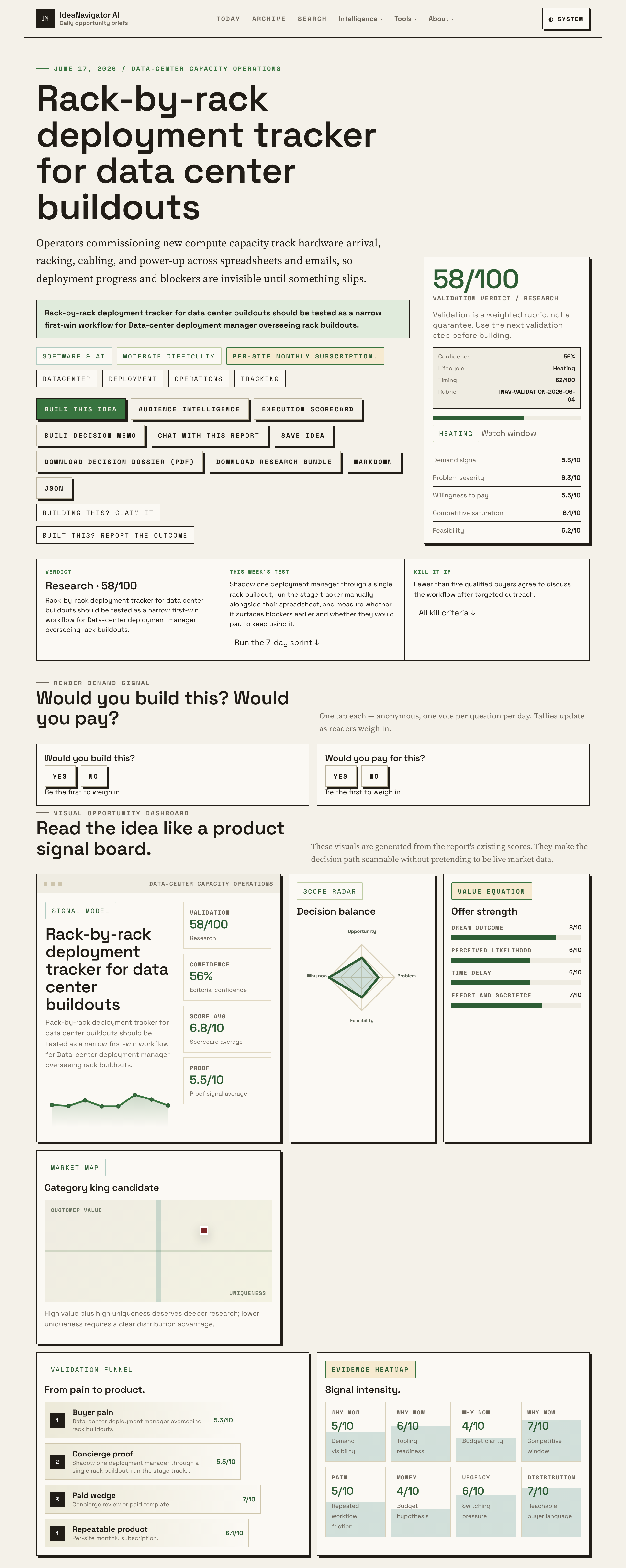
A rack-by-rack deployment tracker is being tested to improve data center buildout management. It offers real-time progress updates, helping operators identify delays early. This innovation aims to streamline capacity expansion amid record demand.
Data center operators are testing a rack-by-rack deployment tracker designed to provide real-time visibility into hardware installation progress. This development aims to address longstanding issues with manual tracking methods, which often lead to delays due to unrecognized blockers. The tracker is seen as a potential solution to improve efficiency during rapid capacity expansions driven by record AI demand.
The proposed system allows deployment managers to log each rack through fixed stages, including delivered, racked, cabled, powered, and validated. This data is then displayed on a live dashboard, showing the percentage complete for each site and highlighting any stalled racks. The tracker is intended as a simple, per-site subscription service, providing immediate insights that could prevent delays caused by unnoticed issues.
According to an anonymous researcher involved in the pilot, the goal is to validate whether this tool can surface blockers earlier than traditional spreadsheet and email methods. The initial approach involves shadowing a deployment manager during a single buildout, comparing the manual process with the new tracker, and assessing if it leads to earlier intervention and cost savings.
Impact of Real-Time Rack Deployment Data on Data Center Efficiency
This development matters because it addresses a critical bottleneck in data center capacity expansion—manual tracking and delayed identification of deployment issues. By providing real-time, rack-level visibility, the tracker could significantly reduce deployment times, lower operational costs, and improve overall performance during rapid buildouts. As data centers race to meet the surge in AI infrastructure demand, such tools could become essential for maintaining schedule and quality.
data center rack deployment tracker
As an affiliate, we earn on qualifying purchases.
As an affiliate, we earn on qualifying purchases.
Current Challenges in Data Center Deployment Management
Data center operators currently rely on spreadsheets and email communication to track hardware delivery and installation stages. This manual process often results in delayed recognition of problems, causing project delays and increased costs. The recent surge in AI-related compute capacity has accelerated buildout timelines, making efficient management tools more urgent. Industry experts note that purpose-built progress trackers are rarely used at scale, despite their potential benefits.
“The goal is to see if a simple deployment board can surface blockers earlier and help operators stay on schedule.”
— an anonymous researcher
rack-level hardware deployment monitor
As an affiliate, we earn on qualifying purchases.
As an affiliate, we earn on qualifying purchases.
Unconfirmed Benefits and Adoption Challenges
It is not yet clear how widely the tracker will be adopted beyond the pilot phase or whether it will significantly outperform existing manual methods in real-world scenarios. The effectiveness of the system in different deployment environments and its ability to integrate with existing workflows remain to be validated through broader testing.
real-time data center management tool
As an affiliate, we earn on qualifying purchases.
As an affiliate, we earn on qualifying purchases.
Next Steps for Validation and Broader Deployment
The initial pilot will continue with shadowing a deployment manager during a rack buildout, collecting data on blocker detection and time savings. If successful, plans may include expanding the trial to additional sites and refining the platform based on user feedback. Industry observers expect that, if proven effective, subscription-based deployment trackers could become standard tools in data center capacity expansion projects.
data center buildout progress dashboard
As an affiliate, we earn on qualifying purchases.
As an affiliate, we earn on qualifying purchases.
Key Questions
What is the main purpose of the rack-level deployment tracker?
The tracker aims to provide real-time visibility into each stage of hardware deployment, helping operators identify delays early and improve buildout efficiency.
How does the tracker work?
Operators log each rack through fixed stages—delivered, racked, cabled, powered, validated—and see live progress on a dashboard, including stalled racks.
Will this system replace manual tracking methods entirely?
It is too early to say; the system is currently in pilot testing to evaluate whether it can supplement or replace manual methods effectively.
What are the potential benefits of adopting this tracker?
Potential benefits include earlier detection of deployment issues, reduced delays, lower costs, and improved overall project management during rapid capacity expansions.
When will broader deployment or commercial availability be expected?
There is no confirmed timeline yet; further testing and validation are needed before considering wider rollout.
Source: IdeaNavigator AI
Fall Picks
fall essentials
As an affiliate, we earn on qualifying purchases.





![Consumer Trends And Innovations In Tying Gym Shorts [Video]](https://dailycoinfeed.com/wp-content/uploads/2026/09/consumer-trends-and-innovations-in-tying-gym-shorts-video-featured-260x140.jpg)