📊 Full opportunity report: The Critical Point For Data Center Hardware Replacement on IdeaNavigator AI — validation score, market gap, and execution plan.
TL;DR
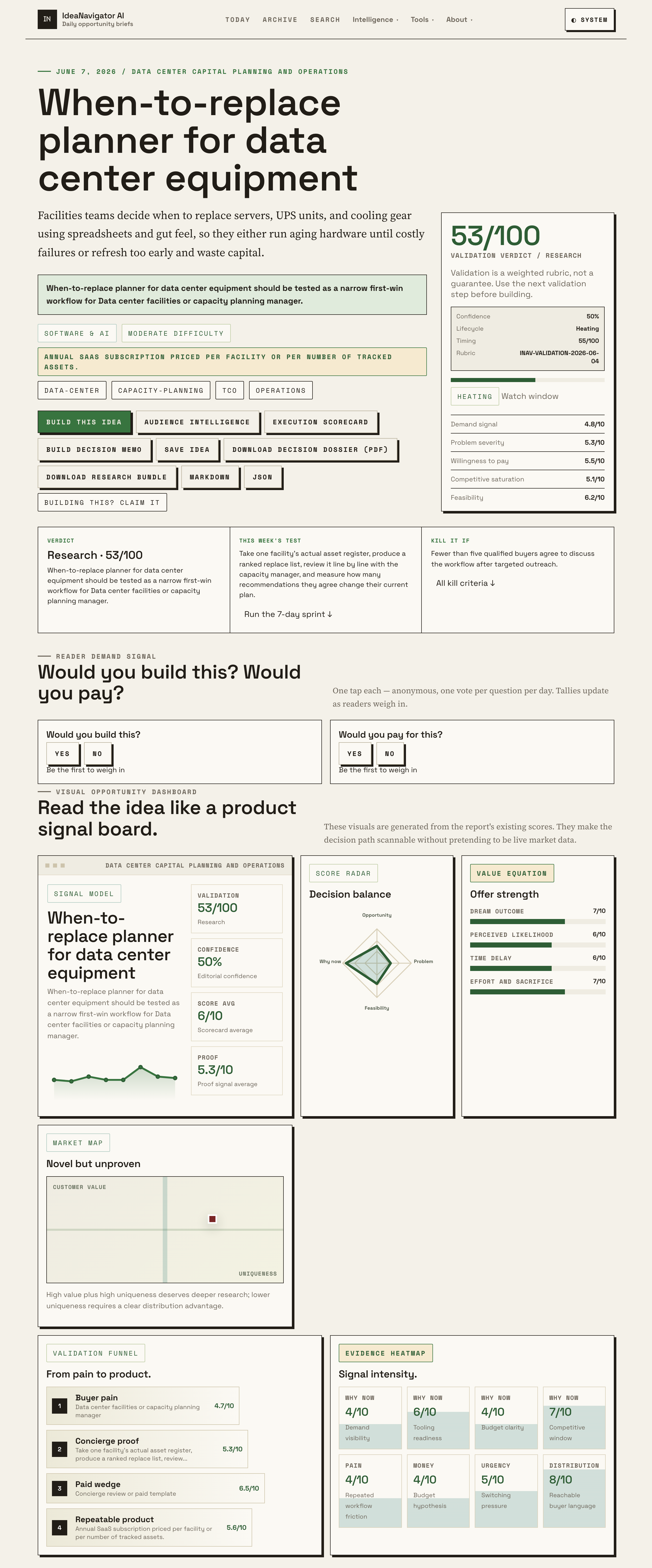
A new software-based planner for data center hardware replacement is being tested, helping facilities managers decide optimal upgrade timing amid rising energy costs and aging equipment. This could improve capital efficiency and reduce failures.
A new ‘when-to-replace’ planner for data center equipment is being tested as a tool to help facilities managers determine the optimal timing for replacing servers, UPS units, and cooling systems. This development addresses the challenge of balancing aging hardware risks against capital costs, especially as energy costs and hardware efficiency pressures increase.
The proposed planner ingests data about a facility’s assets, including age, power consumption, and maintenance costs. It then produces a ranked list of equipment based on a score comparing current failure risks and energy inefficiencies against the benefits of replacing hardware with newer, more efficient models. This approach aims to replace subjective decision-making — often based on spreadsheets or gut feeling — with a data-driven process.
According to sources involved in the project, the tool is designed for capital planning and operational efficiency. Validation involves applying the planner to an actual facility’s asset register, reviewing the ranked recommendations with the capacity manager, and measuring agreement and potential plan adjustments. The SaaS solution is expected to be priced per facility or per asset count, with initial testing focused on real-world validation.
Potential Impact on Data Center Capital Planning
This development could significantly improve how data centers manage hardware refresh cycles, reducing unnecessary capital expenditure while minimizing the risk of failures caused by aging equipment. As energy costs rise and hardware becomes more efficient, the ability to precisely time replacements becomes increasingly important. Implementing such a tool could lead to more sustainable, cost-effective operations and extend the lifespan of existing infrastructure.

DUO20 1RU Series II Rack Mount Solution – Effortless Alternative to Traditional Rack Screws and Cage Nuts & Server Rack Screws Ideal for Server Hardware Setup – 20-Pack, Universal Version
- Fast 1RU Mounting System: Mount servers 50% faster with DUO
- Tool-Free Installation: Install in under 30 seconds without tools
- High Strength and Durability: Supports up to 20 kg (44 lbs)
As an affiliate, we earn on qualifying purchases.
As an affiliate, we earn on qualifying purchases.
Growing Pressure to Optimize Hardware Replacement Timing
Currently, data center facilities often rely on manual assessments, spreadsheets, or intuition to decide when to replace critical equipment. This approach can lead to either premature upgrades, wasting capital, or delayed replacements, risking costly failures. Rising energy prices and advancements in hardware efficiency have sharpened the economic tradeoffs, prompting a need for more precise decision tools. The concept of a ‘when-to-replace’ planner has been discussed within the industry but has not yet been widely adopted or validated in operational settings.
“This tool could transform how data centers approach hardware lifecycle management by providing data-backed recommendations.”
— an anonymous researcher

Power Backup Systems for Data Centers: UPS, Generators, and Redundancy
As an affiliate, we earn on qualifying purchases.
As an affiliate, we earn on qualifying purchases.
Uncertainties About Implementation and Adoption
It is not yet clear how widely this planner will be adopted or how accurately it will predict optimal replacement timing across different facility types. The validation process is still ongoing, and results from initial tests have not been publicly disclosed. Additionally, the impact on existing workflows and capital planning strategies remains to be seen, as some facilities may prefer manual or hybrid approaches.

The Data Center Engineering Handbook: A Practical Guide to Infrastructure Design, Power Systems, Cooling, Security, Compliance, and Operational Excellence
As an affiliate, we earn on qualifying purchases.
As an affiliate, we earn on qualifying purchases.
Next Steps for Validation and Industry Adoption
The next phase involves applying the planner to multiple real-world facilities, gathering feedback from capacity managers, and refining the algorithm. If validation proves successful, vendors may begin offering the tool as a SaaS product, with wider industry adoption expected over the coming year. Further research will likely explore integration with existing facility management platforms and long-term impact studies.

TechMikeNY Server 2.6Ghz 4-Core 32GB RAM Energy-Efficient ProLiant DL360 G9 (Renewed)
- Packaging Included: Proprietary packaging and boxing
- Quality Assurance: Refurbished with proprietary testing process
- Complete Setup: Includes power cords and custom packaging
As an affiliate, we earn on qualifying purchases.
As an affiliate, we earn on qualifying purchases.
Key Questions
How does the ‘when-to-replace’ planner work?
The planner analyzes asset data such as age, power consumption, and maintenance costs to produce a ranked list of equipment based on a score that compares the risks and inefficiencies of keeping hardware versus replacing it with newer models.
What are the benefits of using this tool?
It aims to optimize capital expenditure, reduce failures caused by aging equipment, and improve energy efficiency by providing data-driven replacement recommendations.
When will this tool be available for general use?
It is currently in testing with initial validation underway. Broader availability depends on successful validation and industry acceptance, likely within the next year.
Will this replace manual decision-making entirely?
Probably not immediately; the tool is designed to augment existing processes, providing data-backed insights to support human judgment rather than replace it entirely.
What challenges might affect adoption?
Challenges include integrating the tool into existing workflows, validating its accuracy across diverse facility types, and convincing facilities to rely on automated recommendations over traditional methods.
Source: IdeaNavigator AI