
📊 Full opportunity report: Vocal-strain load tracking for working singers on IdeaNavigator AI — validation score, market gap, and execution plan.

Get hardware and tech essentials delivered free — and shop member deals
- Fast, free delivery on millions of items
- Access to Prime Big Deal Days deals on October 6–7
- Prime Video, Amazon Music and more included
TL;DR
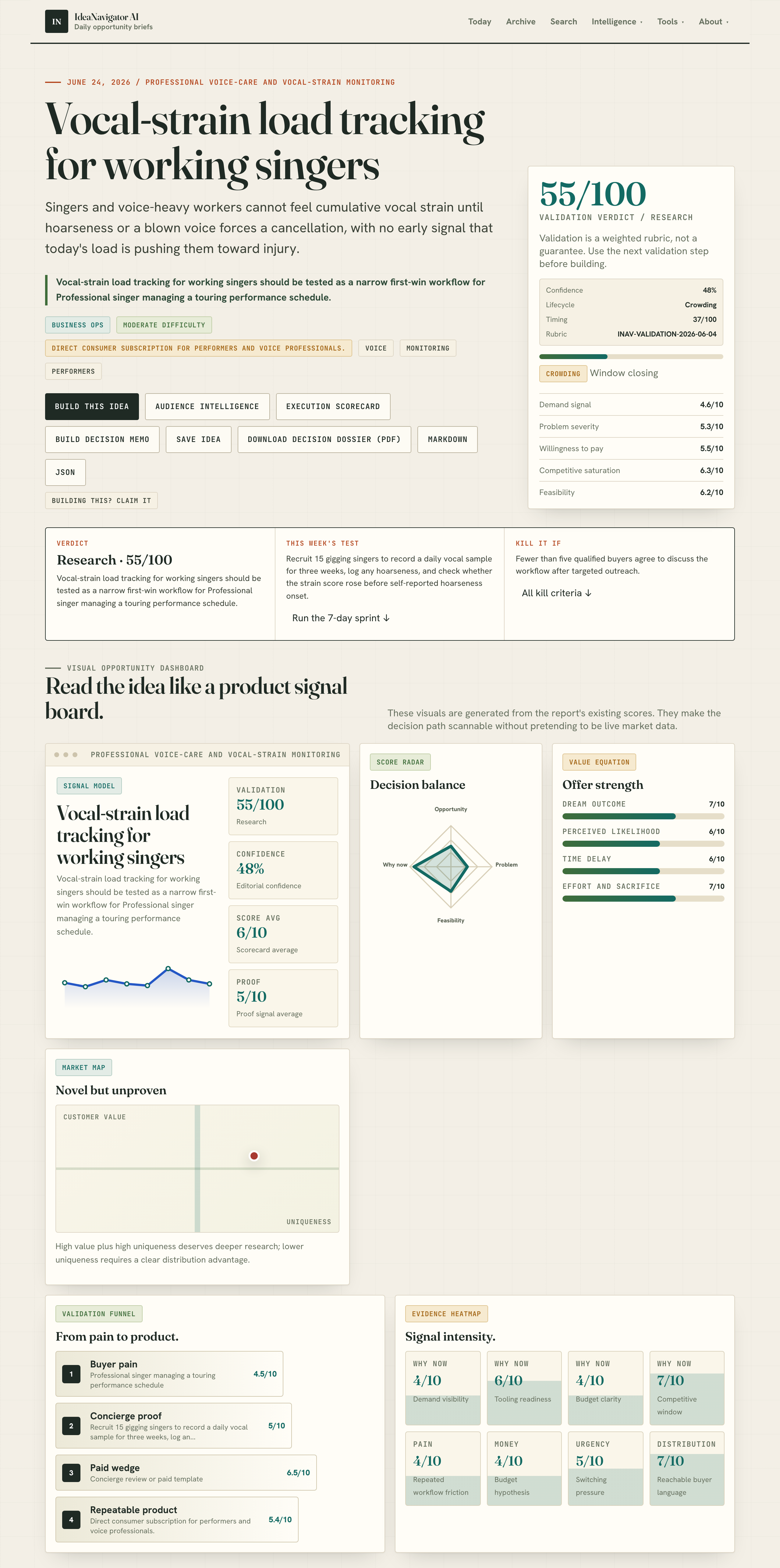
Researchers are testing a vocal load tracking app for touring singers, which analyzes voice samples after performances to predict strain and prevent injury. Validation involves 15 singers over three weeks.
A new vocal strain load tracking system is currently being tested with professional singers managing touring schedules, aiming to provide early warnings of vocal fatigue and injury risk through daily voice analysis.
The proposed system involves recording short vocal samples after each performance, which are then analyzed by an app to assess cumulative vocal strain relative to each singer’s baseline. The app flags tone shifts that have historically preceded hoarseness and suggests warm-up routines to mitigate injury risk.
This initiative targets gig economy performers and voice professionals who often self-manage their schedules without immediate access to vocal coaches. The goal is to offer a simple, accessible tool that provides early signals of vocal overload before symptoms like hoarseness or voice loss occur.
Validation involves recruiting 15 professional singers to record daily vocal samples over a three-week period, tracking any self-reported hoarseness, and analyzing whether the app’s strain scores increase prior to visible symptoms. The project is still in the testing phase, with results pending.
Potential Impact on Voice Injury Prevention
If successful, this technology could significantly reduce voice injuries among touring singers by providing real-time, personalized feedback on vocal health. It could enable performers to adjust their schedules proactively, reducing cancellations and long-term damage. The approach also opens pathways for broader applications in voice therapy and professional voice care, especially as on-device audio analysis becomes more accessible.
As an affiliate, we earn on qualifying purchases.
Growing Need for Self-Managed Vocal Health Tools
Currently, singers and voice-heavy workers rely heavily on subjective feelings and occasional vocal assessments from coaches or medical professionals. Often, they do not receive early warnings until damage has occurred, leading to cancellations or long recovery periods. The rise of gig work and remote management of schedules increases demand for self-monitoring tools that can be used without direct supervision.
Advances in on-device audio analysis now make it feasible to develop apps that score vocal characteristics and detect subtle tone shifts. The concept aligns with broader trends toward personalized health monitoring, but its validation in professional singing contexts is still in early stages.
“This technology could give singers an early warning system, much like a fitness tracker for the voice, helping prevent injuries before they happen.”
— an anonymous researcher
As an affiliate, we earn on qualifying purchases.
Unconfirmed Effectiveness and Validation Results
It is not yet clear how accurately the app’s strain scores will predict hoarseness or injury across diverse singing styles and individual vocal characteristics. The validation study is ongoing, and results are expected in the coming months. There remains uncertainty about how well tone shifts correlate with actual injury risk and whether the app can reliably provide actionable recommendations.
As an affiliate, we earn on qualifying purchases.
Next Steps in Validation and Deployment
The current phase involves completing the three-week testing with 15 singers, analyzing the data for correlations between strain scores and symptoms. If results show promise, developers plan to refine the algorithm, expand testing to larger cohorts, and explore commercialization options. Further research may also investigate integration with existing voice therapy tools and professional coaching platforms.
As an affiliate, we earn on qualifying purchases.
Key Questions
How does the vocal strain tracking app work?
The app analyzes short vocal samples recorded after performances to assess vocal strain levels by comparing tone characteristics to each singer’s baseline. It flags potential issues and suggests warm-up routines to prevent injury.
Who is this technology designed for?
It is aimed at professional singers managing touring schedules, voice professionals, and gig economy performers who need self-managed tools to monitor their vocal health.
When will the app be available to the public?
The app is currently in testing, with validation results expected soon. If successful, a commercial version could be launched within the next year, pending further development and approval.
Can this technology replace traditional vocal coaching?
No, it is intended as a supplementary tool to help singers monitor their vocal load, not replace professional coaching or medical assessment.
What are the limitations of this system?
Its accuracy depends on consistent recording practices and individual vocal characteristics. It is still under validation, and its predictive power has not been fully established.
Source: IdeaNavigator AI
Halloween Picks
halloween
As an affiliate, we earn on qualifying purchases.