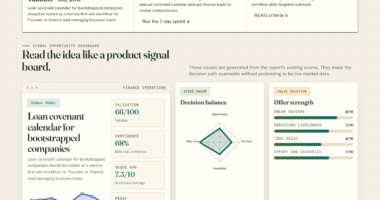
📊 Full opportunity report: The 2028 Model Lab Endgame: How Six Becomes Two, Three, or Twelve on ThorstenMeyerAI.com — validation score, market gap, and execution plan.
TL;DR
By the end of 2028, the Western frontier AI sector may shrink to two or three dominant labs, or expand to twelve, depending on market, regulatory, and strategic developments. This scenario forecast highlights key forces shaping this outcome.
By 2028, the Western frontier AI industry could see its six leading labs consolidate into just two or three, or alternatively, expand into twelve, depending on emerging strategic, regulatory, and market forces. This forecast, based on a scenario analysis by Thorsten Meyer, underscores the high stakes and uncertain future of AI dominance and investment.
As of May 2026, six major Western AI labs—Anthropic, OpenAI, Google DeepMind, xAI, Meta Superintelligence Labs, and Reflection AI—control significant capabilities and capital. These labs are positioned differently: Anthropic is closing a massive funding round and preparing for an IPO; OpenAI has secured over $120 billion in funding with performance milestones tied to its valuation; Google DeepMind benefits from Alphabet’s internal resources and a dominant cloud and AI product suite; xAI has merged interests with SpaceX and raised substantial funding. The future scenario depends on factors such as regulatory environments, capital flows, technological breakthroughs, and strategic alliances, which could lead to a highly concentrated market with only a few labs dominating, or a more diffuse landscape with many players thriving.
The 2028 Model Lab Endgame.
How six becomes two, three, or twelve — and which combination of forces decides.
There are six credible Western frontier AI labs in May 2026. By the end of 2028 there will be two, or three, or twelve. Each outcome is internally coherent, supported by different combinations of forces already visible today, and consequential for trillions of dollars of capital allocation. The question is not which scenario is correct. The question is which one you are positioned for.
Six Western labs. Different positions on the same forces.
The competitive picture is easier to compare side-by-side than the financial press has made it. Capital structure, revenue quality, distribution depth, regulatory exposure — each lab sits on a different combination. The same six forces will resolve to different outcomes for each of them.

The FPGA Programming Handbook: An essential guide to FPGA design for transforming ideas into hardware using SystemVerilog and VHDL
As an affiliate, we earn on qualifying purchases.
As an affiliate, we earn on qualifying purchases.
Six independent forces. Their combinations produce the scenarios.
Each force operates on its own trajectory; the scenarios that follow are simply the three coherent ways the forces can resolve together. None is destiny. All are visible in the data through May 2026.
Compute economics.
Training cost growing 2.4× per year. GPT-4 amortized $40M (2023) → $1B by early 2027 → $10B+ by 2028. Hardware acquisition cost 1–2 OOM higher. Only labs with sustained access to that capital maintain frontier competition.
Capital availability and quality.
Q1 2026: $180B AI funding, more than all of 2024. ~80% to OpenAI, Anthropic, xAI. Sovereign wealth + PE channels dominate. May 4 OpenAI/Anthropic enterprise JV announcements (Blackstone, TPG, Brookfield) confirm: the relationships that matter are with alternative asset managers.
Capability convergence and the open-weight floor.
Stanford AI Index: Chinese frontier “effectively closed” the gap. 3–6 months behind on benchmarks; 1/20th the price per token. Frontier-tier capability is a depreciating asset on a 6–12 month cycle. The model commoditizes; the moat is enterprise distribution.
Talent flow.
$3.4B seed capital to 12 founders departing the major labs in 12 months. xAI lost all 11 co-founders. DeepSeek opening external financing largely to retain talent. The 2027–2028 frontier will be competed for by some of the 6 + 3–5 well-capitalized spinouts + companies not yet founded.
Regulatory gating.
EU AI Act enforcement August 2, 2026. Pentagon two-channel architecture (multi-vendor + Mythos sole-source). Anthropic SCR in litigation. Each lab’s regulatory exposure is now a primary variable in competitiveness.
The agentic transition.
Q1 2026 was the quarter “agentic” stopped being a feature and became a category. May 4 OpenAI/Anthropic enterprise JVs are explicit: forward-deployed engineers, Palantir-style integration, PE-backed channel distribution. Agents are now the unit of economic value, not models.

AI Innovation Labs: AI Lab Equipment Needs | AI Ethics and Policies | Case Studies in AI | Emerging AI Technologies | AI in Finance Innovations
As an affiliate, we earn on qualifying purchases.
As an affiliate, we earn on qualifying purchases.
Three coherent futures. One branch point pattern.
The forecast horizon is end of 2028 — long enough for capital cycles to play out, short enough that today’s data points constrain the analysis. The branches fork at three identifiable inflection points: Anthropic’s IPO outcome (Q4 2026), the open-weight capability gap (mid-2027), and the agentic transition’s revenue distribution (Q4 2027).

Performance Tuning with SQL Server Dynamic Management Views (High Performance SQL Server)
Used Book in Good Condition
As an affiliate, we earn on qualifying purchases.
As an affiliate, we earn on qualifying purchases.
Each lab. Each scenario. The outcome it implies.
A scenario forecast is only useful if it specifies what each scenario means for each player. The matrix below is the bet you place when you allocate capital. Read across each row to see what happens to a single lab; read down each column to see what each scenario looks like in aggregate.
| Lab · sphere | Scenario A · Duopoly 35% | Scenario B · Equilibrium 30% | Scenario C · Stratification 25% |
|---|---|---|---|
| Anthropic | Scaled · $1.5–2.5TCement duopoly position.Frontier-tier-1 dominant. PE-channel distribution captures enterprise share. Mythos sole-source channel persists. | Tier-1 · $1.2–1.8TOne of three majors.Frontier-tier-1 alongside OpenAI and Google. EU regulated-market share grows; federal SCR situation resolves favorably or expires. | Tier-1 premium · $800B–1.2TAGI-adjacent premium tier.Smaller addressable market; higher margins; revenue concentrated in 5% of workloads requiring genuine frontier-tier-1. |
| OpenAI | Scaled · $1.5–2.5TOther half of duopoly.Microsoft partnership deepens. Conditional Amazon capital arrives in full. PE-channel JV (Development Co) becomes primary enterprise vehicle. | Tier-1 · $1.5–2.0TOne of three majors.Microsoft expands own internal models (Phi-tier) but maintains OpenAI exclusivity for frontier. IPO 2027 at $1.5T+. | Tier-1 premium · $1.0–1.5TAGI-adjacent premium leader.Compute commitments (5GW) become structural overhead; margin compression on commodity workloads. |
| Google DeepMind | Internal supplierCloud-line revenue, not standalone.Frontier capability supplies Google Cloud and Workspace. Not externally measurable as frontier-model business. | Tier-1 · $400–700B notionalThird frontier-tier-1 lab.Cloud growth sustains; AI line item becomes investor-attributable. TPU full-stack matters. | Tier-1 premiumFrontier capability internal.Less commercial differentiation than A or B; consumer-product distribution preserves position. |
| xAI | Defense verticalPentagon Channel 1 specialist.Generalist frontier-tier abandoned. SpaceX IPO is the public vehicle. Federal classified workload concentration. | Sub-frontier · $400–600BSpecialty + Pentagon.Defense-aligned vertical with Musk-network political durability; not frontier-tier-1 generalist. | Tier-2 frontierCommodity-frontier provider.Loses 11 co-founders catches up via SpaceX network; serves federal + Twitter-ecosystem distribution. |
| Meta · Superintelligence | Open-weight exitStops chasing frontier-tier-1.Llama 5 / Muse 2 become open-weight standard; capex revised down; investor pressure forces clarity. | Open-weight enterpriseEnterprise share via cost-efficiency.Open-weight provider of choice for cost-sensitive workloads; sustained capex but disciplined. | Tier-2 frontier · openFrontier-tier-2 leader.Open-weight competition with Chinese cohort; meaningful enterprise share at commodity-tier pricing. |
| Reflection AI | Acquired · $15–25BStrategic capability bolt-on.Microsoft, Google, or Nvidia acquires by mid-2027. Founders cash out; teams integrate. | Persists · $40–80BSpecialty frontier-tier-2.Productization 2026 H2; enterprise customer references signed; possible IPO 2028. | Tier-2 specialistDefense + specialty workloads.Persists at $20–60B; specialization-by-design wins. |
| 12 Founders cohort | 1–2 surviveMost fail or get acquired.Capital crunch compresses options; specialization isn’t enough without distribution. | 3 reach near-frontierThinking Machines, AMI, Periodic.Well-capitalized cohort survives via specialization; 9 fail to scale. | 5–6 viable specialistsVertical specialization wins.Stratification rewards focused capability; 5–6 reach commercial scale. |
| China sphere | Parallel sphereOperating in own zone.3–4 frontier-tier in China; export-controlled access for non-restricted markets; ~3–6 month gap holds. | 4 frontier-tier in sphereStable equilibrium.Gap closes to 3 months; Apache 2.0 base models adopted globally; Alibaba Qwen most-downloaded family. | Tier-2 globallyDefines commodity-frontier.Gap closes to under 3 months; China sphere defines tier-2 pricing globally. |
| Europe sphere | EU-regulated onlyMistral as regional champion.EU Act-driven procurement preference; bounded outside the EU; €30–50B Mistral. | EU + spillover2–3 viable players.Mistral expands beyond EU on cost-efficiency; Aleph + BFL specialize; €40–80B Mistral. | Tier-2 + specialtyModality + sovereign deployment.European bet vindicated as the regulated-market category captures real share. |

LOCAL LLM DEPLOYMENT: Training, Fine-Tuning, & Offline Inference: The Complete Developer’s Guide to Building, Training, and Running Private Open-Source AI Offline (with full source code)
As an affiliate, we earn on qualifying purchases.
As an affiliate, we earn on qualifying purchases.
A 15–25% probability event that reshapes any base scenario.
Tail risk is not orthogonal to the base scenarios; it overlays them. Whichever scenario plays out, a Mythos-class capability proliferation event compresses returns, increases regulatory complexity, and shifts the equity structure of the major labs toward government-influenced governance.
The proliferation event that reshapes the equity structure of the labs.
Path 1. A Glasswing consortium member’s access is compromised; nation-state or organized criminal actor obtains Mythos-class capability; major cyberattack on critical infrastructure (financial, power, healthcare). Political response immediate and severe.
Path 2. Open-weight models reach Mythos-class offensive cybersecurity capability independently. Estimated timeline based on capability progression: 12–18 months from May 2026, putting it in 2027 H1–H2 window.
Either path triggers the same response: Defense Production Act authorities, “Strategic AI Reserve” framework with government preferred-equity in Anthropic and OpenAI, mandatory sovereign-cloud deployment for federal-classified workloads. EU does similar via Article 7 reclassification. China closes domestic market.
Probability: 15–25% in 18 months, 30–40% in 36 months. Tail-risk hedging is appropriate in any portfolio with significant frontier-AI exposure. The probability is not low.
Fifteen leading indicators. The next 18 months will tell.
The signposts operate together. A pattern across multiple indicators is more meaningful than any single one. The first six months of EU AI Act enforcement (August 2026 – February 2027) should produce enough signal to identify which scenario is most consistent with the unfolding data.
- Anthropic IPO pricing (Oct 2026). >$1T → A. $700B–$1T → B. <$700B → C or stress.
- OpenAI IPO timing. Announcement before end-2026 → A or B. Delay to 2028 → C or capital stress.
- Meta Q2 capex revision. Pulled back <$115B → B/C. Held or raised >$135B → B.
- Reflection AI productization. Commercial product 2026 H2 → B/C. None by Q1 ’27 → A (acquisition).
- Microsoft positioning. Internal model expansion → B. Deepening OpenAI exclusivity → A.
- Google DeepMind disclosures. Sustained $20B+ Q-over-Q with explicit AI attribution → B viable.
- xAI capability vs SpaceX IPO. Frontier-tier benchmarks before IPO → B. Sub-frontier confirmed → A or vertical-only.
- DeepSeek V5 release. By Q1 2027 at frontier parity → C. Delayed to mid-2027+ → A or B.
- Open-weight gap to frontier. <6mo by end-2026 → C. 9–12mo holds → B. Widens → A.
- Spinout cohort funding rounds. Frontier-tier valuations ($30B+) by end-2026 → B/C. Stalled → A.
- Pentagon multi-vendor expansion. Channel 1 to civilian agencies 2026 H2 → B/C. Consolidation to 2–3 vendors → A.
- EU AI Act enforcement actions. Major US-hyperscaler penalty within 12 months → real teeth (relevant to all).
- Sovereign wealth positioning. Concentration in OpenAI/Anthropic → A. Diversification → B.
- Mythos-class proliferation events. Any major incident or open-weight Mythos-class disclosure → tail risk activates.
- Talent flow direction. Net positive flow to top three → A. Net positive flow to spinouts/tier-2 → B/C.
The endgame is six becoming two, three, or twelve. The bet you place today is the bet on which of those is real.
Implications of AI Industry Consolidation or Expansion
The potential consolidation to two or three labs could centralize AI innovation and control, impacting competition, regulation, and global power dynamics. Conversely, a broader landscape with twelve or more labs could foster innovation diversity but complicate regulation and oversight. These scenarios will influence trillions of dollars in investment, geopolitical strategies, and technological development pathways, making the 2028 landscape a critical juncture for global AI governance and economic impact.Current State of Western AI Labs and Market Dynamics
As of May 2026, the Western AI sector is characterized by a handful of dominant labs with substantial capital and capabilities. Anthropic, with a $50 billion round and scheduled IPO, is focused on enterprise and regulated industries. OpenAI has secured a $122 billion valuation with conditional funding tied to milestones. Google DeepMind benefits from Alphabet’s vast resources, with cloud revenues and AI products growing rapidly. xAI has merged with SpaceX and raised significant funding, positioning itself as a key player. The competitive landscape is shaped by factors such as funding, regulation, technological breakthroughs, and strategic alliances, which will influence whether the industry consolidates or diversifies by 2028.
“The question is not which scenario is correct, but which one you are positioned for.”
— Thorsten Meyer
“Each scenario is internally coherent, causally connected to today, and strategically consequential.”
— Thorsten Meyer
Uncertainties in AI Industry Trajectory and Timing
It is not yet clear which scenario will materialize by 2028. Key uncertainties include regulatory developments, technological breakthroughs, funding flows, and geopolitical shifts. The timing of these influences and their relative strength remain uncertain, making precise predictions difficult. The scenario analysis provides a structured way to understand possible outcomes but cannot specify which will occur with certainty.
Monitoring Key Indicators for Industry Direction
Over the next 18 months, observers should watch for signs such as regulatory policy changes, funding rounds, technological breakthroughs, and strategic alliances. These indicators will help disambiguate which scenario is unfolding. Additionally, developments in AI regulation, international competition, and capital investment patterns will be crucial to understanding the trajectory toward either consolidation or diversification of the sector.
Key Questions
What are the main factors influencing AI industry consolidation?
Key factors include regulatory environments, funding availability, technological breakthroughs, and strategic partnerships or mergers among labs.
Why does the number of dominant AI labs matter?
The number of leading labs affects innovation diversity, market competition, regulatory oversight, and geopolitical influence, shaping the global AI landscape.
What could cause the industry to diversify instead of consolidate?
Factors such as regulatory barriers, technological differences, strategic preferences, or geopolitical tensions could enable more labs to thrive independently, leading to a more fragmented landscape.
How reliable are these scenario forecasts?
They are not predictions but structured analyses based on current trends and forces, designed to help decision-makers prepare for multiple possible futures.
Source: ThorstenMeyerAI.com