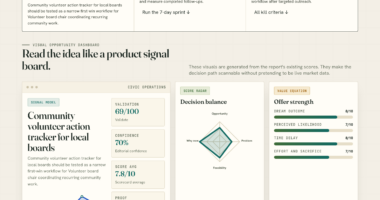

📊 Full opportunity report: The Agent Trap: Why 90% of AI “Launches” Are Infrastructure Liars on ThorstenMeyerAI.com — validation score, market gap, and execution plan.
TL;DR
In 2026, 90% of AI ‘agent’ launches are misrepresentations—features on vendor infrastructure, not genuine autonomous platforms. This shifts procurement risks and enterprise dependencies.
Most AI ‘agent’ launches in 2026 are actually features built on vendor infrastructure, not independent, governable platforms, according to recent industry analysis. This mislabeling affects enterprise dependencies and procurement practices.
In May 2026, industry analysis indicates that approximately 90% of AI product launches labeled as ‘agents’ are in fact features layered on top of vendor-controlled infrastructure. These products typically lack runtime, state persistence, or governance capabilities essential for true autonomous agents. A recent example includes a vendor announcing a chat-based meeting summarizer priced at $30 per seat per month, which does not meet the traditional definition of an agent, yet is marketed as such.
Meanwhile, enterprise CIOs are terminating AI pilots that are simply API-connected chat tools without independent runtime or governance features. These pilots, marketed as ‘agent platforms,’ are often just feature sets that depend on vendor infrastructure, leading to increased dependency and lock-in for enterprises. Experts emphasize that distinguishing real platform plays from feature-based offerings requires procurement skills, not technical expertise.
The agent trap.
Why 90% of AI “launches” are infrastructure liars.
A vendor announces an “AI agent.” The product is a chat box that summarises meeting notes — wired to a SaaS via OAuth, no runtime, no audit trail, no portable state. List price: $30 per seat per month. This is the agent trap. The label has been stripped from its meaning. What enterprises are buying — under the word agent — is overwhelmingly a feature on top of someone else’s infrastructure.
Most “agents” are features wearing infrastructure as a costume.
In 2026, the word agent has been stripped from its meaning. Vendors monetize the label. Buyers inherit the dependency. The asymmetry has a number — and the number does the work this story needs.
A request that fails three or more is a feature.
Run the request against five questions before signing any “AI agent” PO. The 90% fail at least three. The 10% pass all five. Price the line item accordingly — because the vendor won’t.
Does it run when no human is logged in?
A real agent runs on a schedule, on a trigger, or as a daemon. If it only works when a user opens a tab, it’s a feature.
Can you swap the model without losing the work?
Real agents treat the model as substitutable. The runbook, tools, memory, and workflow survive a model change. Features are welded to one model.
Where does the state live?
Real agents persist state to a customer-controlled store with a schema you can query. Features persist to “your conversation history” inside the vendor’s database.
What does the audit trail look like to your SOC?
Real agents emit events into a SIEM or webhook stream the security team subscribes to. Features emit nothing — or vendor-side logs you can’t ingest.
What do you keep when the contract ends?
Real agents leave you with skills, prompts, runbooks, memory, integrations as exportable artifacts. Features leave you with the labor you sank into the vendor’s UI — and nothing else.
Salesforce isn’t selling agents. It’s removing the seat.
The dominant 2026 enterprise pattern is “headless 360” — the same Customer 360 / Employee 360 data model the suite sold for two decades, except agents now read and write directly. SDR · CSM · support agent are increasingly configurations of an agent runtime, not job descriptions for human seats.
The 9% genuinely AI-driven layoffs cluster exactly where headless is shipping.
Tier-1 support, junior software engineering, structured-data work — paying customers of a UI. If agents become the operators, the seat license attached to the human disappears. The vendor still gets paid; they just get paid per agent action instead of per human login.
Before · Per-seat humans
After · Headless 360
A feature cannot be routed.
When you buy a feature agent from a SaaS vendor, you commit to whatever model the vendor chose, at whatever margin the vendor charges. Real infrastructure exposes the model layer. If the vendor can’t tell you what model is running underneath, that is the answer.
QUERY
The leverage moves to whoever owns the motherboard — not the chip.
Claude is increasingly the engine inside other people’s products. Legal-tech vendors, customer-success platforms, contract-review startups. This is the Intel Inside playbook. The implication for buyers is not “therefore buy Anthropic.” It is the reverse.
Built on a single closed model.
Brand sits on top of someone else’s chip. Looks like a platform. Priced like one.
- Cabinet vendor sells the platform pricing
- Chip vendor (Anthropic / OpenAI) sets margin
- If the chip vendor moves up the stack, cabinet gets squeezed
- Customer keeps nothing portable when leaving
Runtime that uses models.
Routing, governance, audit, skills layer. The chip is replaceable. The motherboard captures value.
- Multiple models, swappable per-request
- Customer-controlled governance plane
- Skills + integrations are exportable artifacts
- Survives the chip vendor moving up the stack
Skills are the portable infrastructure.
A skill written for Claude Code can be loaded into Codex, into Cursor, into any agent runtime that understands the format. The skill is the IP the customer wrote. The model is the chip. A buyer with 40 skills against an internal runtime can swap the model layer in an afternoon.
declarative · versioned · portable
If the vendor cannot or will not tell you what model is running underneath, that is the answer. You’re not buying an agent platform. You’re buying a wrapper.
Five questions any executive can ask in any vendor pitch.
- Does it run when no human is logged in?
- Can I swap the model without breaking the workflow?
- Where does the state live, and can I query it directly?
- Does it emit events my SOC can ingest?
- When the contract ends, what do I keep?
Four assignments. By role.
Run the five-point filter against every agent line item.
Reclassify each as feature or infrastructure. Re-price accordingly. The exercise will recover budget — usually significant budget.
Inventory the OAuth scopes granted to feature agents.
After Vercel, the agent supply chain is your perimeter. Tokens granted to chat-box agents holding Workspace, GitHub, and CRM scopes are the largest unmanaged risk in the stack.
Per-seat agent SaaS is the most expensive way to buy LLM compute.
Per-action and per-token routing typically costs 60–85% less for the same throughput. Demand the comparison. Vendors that refuse to provide it have answered the question.
Add “AI infrastructure vs feature” to the quarterly risk review.
If management cannot draw the line, the line has not been drawn — and someone else is drawing it for you, on a price tag.
Implications of Misleading ‘Agent’ Marketing in AI
This trend matters because enterprises risk increasing dependency on vendor infrastructure, which limits control, portability, and security. The mislabeling inflates vendor valuations and complicates procurement decisions, potentially leading to costly lock-ins and operational risks. Recognizing the difference between true platforms and features is crucial for strategic AI investments.

The Enterprise Integration Architect Designing Secure, Resilient, and AI-Ready Digital Platforms
As an affiliate, we earn on qualifying purchases.
As an affiliate, we earn on qualifying purchases.
Evolution of the ‘Agent’ Definition and Market Dynamics
Before 2024, an ‘agent’ in software was a process that operated continuously, maintained state, and was governable externally. However, many products launched in 2026 labeled as ‘agents’ do not meet these criteria. Instead, they are often simple chat interfaces calling one tool, sometimes invoking an LLM, but lacking persistent state, runtime, or governance features. Vendors increasingly use the ‘agent’ label to command higher prices, despite these products being only features wrapped in marketing.
Recent enterprise actions, such as CIOs terminating AI pilots, underscore the gap between marketed capabilities and actual infrastructure. Industry experts warn that the market is flooded with feature-based ‘agent’ products, which can be distinguished by applying a five-point filter assessing runtime, model swapping, state management, auditability, and portability.
“What enterprises are buying—under the word agent—is overwhelmingly a feature on top of someone else’s infrastructure. The vendor monetizes the label. The buyer inherits the dependency.”
— Thorsten Meyer
Principles of Agentic AI Governance: A Playbook for Managing AI Risk, Fairness, and Compliance (Agentic Governance and Architecture)
As an affiliate, we earn on qualifying purchases.
As an affiliate, we earn on qualifying purchases.
Extent of Market Mislabeling and Future Trends
It is not yet clear how many enterprises fully understand this distinction or how vendors will adapt their marketing strategies. The actual proportion of genuine platform launches remains difficult to quantify, and evolving industry standards may influence future labeling practices.
Grelife 2026 AI Portable Waist Fan Rechargeable with LED Display & 40H Runtime,5 Speed 10000RPM Cooling Personal Clip Fan,33ft/s Wind Speed Neck fan for Outdoor Work,Camping,Farm,Jobsite(Black)
- All-Day Cooling: Double clip design for secure attachment
- Powerful 5-Speed Turbine: Adjustable wind speeds up to 33ft/s
- LED Display: Shows wind speed and battery level
As an affiliate, we earn on qualifying purchases.
As an affiliate, we earn on qualifying purchases.
Next Steps for Enterprises and Vendors
Enterprises should apply rigorous filters—such as runtime independence, model swapability, and state control—when evaluating AI products labeled as ‘agents.’ Industry groups and standards bodies may develop clearer definitions to curb mislabeling. Vendors might need to clarify product capabilities and shift toward genuine platform offerings to meet enterprise needs.

Synthetic Media Disclosure Tracker: A Professional Audit Trail for Artificial Intelligence Workflows and Digital Replicas
As an affiliate, we earn on qualifying purchases.
As an affiliate, we earn on qualifying purchases.
Key Questions
What is the main difference between a real AI agent and a feature?
A real AI agent operates independently, persists state, can be governed externally, and runs continuously or on triggers. Features lack these qualities and depend on vendor infrastructure, often only functioning when a user is active.
Why are vendors marketing features as agents?
Labeling features as ‘agents’ allows vendors to command higher prices and create a perception of advanced capabilities, even when the product lacks core agent functionalities.
How can enterprises identify genuine AI platforms?
By applying a five-point filter assessing runtime independence, model swapability, state ownership, auditability, and portability, enterprises can distinguish real platforms from feature-based offerings.
Source: ThorstenMeyerAI.com