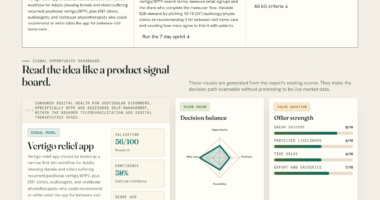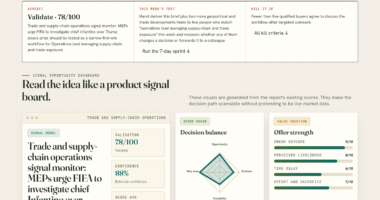

📊 Full opportunity report: The Switch: You Never Owned the AI You Depend On on ThorstenMeyerAI.com — validation score, market gap, and execution plan.
TL;DR
Governments and companies can now turn off AI models instantly through export controls or product deprecation, highlighting the lack of ownership over AI services. This dependency poses risks for users relying on these models.
On June 12, the U.S. government issued an export-control directive that forced Anthropic to disable its latest models, Fable 5 and Mythos 5, worldwide within roughly ninety minutes, citing national security concerns. This action exemplifies how access to AI models can be revoked instantly by authorities, underscoring a critical dependency risk for users and developers relying on these services.
The U.S. directive ordered Anthropic to disable its models for all users globally, including its own employees, with no prior warning. This move was driven by national security considerations, but it also demonstrated how government can exert immediate control over deployed AI models through API restrictions, effectively turning them off at a moment’s notice.
Similarly, in February, OpenAI retired GPT-4o and other models from ChatGPT, citing product and economic reasons, with API shutdowns following. This deprecation was a routine business decision, not a government action, but it still resulted in models becoming inaccessible, sometimes with only weeks’ notice.
Both events highlight a shared reality: AI models are accessed via APIs controlled by companies or governments, not owned outright by users. Access can be revoked through regulatory, economic, or operational decisions, making reliance on these models inherently uncertain and dependent on external actors’ choices.
The Switch: You Never Owned It
In 2026 a government turned off a frontier model worldwide in ~90 minutes — and a company retired a beloved one with ~2 weeks’ notice. You don’t own the model you build on. You access it. Access can be revoked.
Access is the only chokepoint that flips in an afternoon — and the version that hits you won’t be Washington, it’ll be a deprecation. Open weights you host can’t be deprecated, geofenced, repriced, or revoked. Short of that: route through a provider-agnostic gateway, keep a tested fallback, and treat every model string as a dependency that will be pulled.
Implications of Instant AI Access Revocation
This development reveals that most AI reliance is essentially dependence on a service that can be turned off instantly. For businesses and users, this means that AI models are not assets they own but services they depend on, which can be revoked due to security, economic, or regulatory reasons. The ability for a government or company to pull the plug at a moment’s notice raises critical questions about control, sovereignty, and the future of AI deployment.
Understanding this dependency is vital, as it impacts everything from cybersecurity to compliance, and highlights the importance of developing ownership models or alternative infrastructures that reduce vulnerability to sudden shutdowns.

Samsung Galaxy Buds 3-FE (2025) True Wireless Bluetooth Earbuds, Active Noise Cancellation, Clear Calls, Long Lasting Battery, Hands Free AI, Latin American Stock SM-R420NZKALTA – (Black)
SAMSUNG Galaxy Buds 3-FE (2025) True Wireless Bluetooth Earbuds, Active Noise Cancellation, Powerful Sound, Clear Calls, Long Lasting…
As an affiliate, we earn on qualifying purchases.
As an affiliate, we earn on qualifying purchases.
The Evolution of AI Access Control
Historically, AI models were trained and owned outright, with control over the data and weights. However, the rise of API-based models has shifted reliance toward cloud services provided by a handful of labs and providers. Recent events, including export controls and product deprecations, underscore how access to these models is now a chokepoint—one that can be manipulated or cut off rapidly.
The June 2026 U.S. export directive marked a turning point, demonstrating how government can enforce instant shutdowns, even on models already deployed globally. Meanwhile, companies like OpenAI regularly retire older models as part of product lifecycle management, further emphasizing that users do not own the models they use but merely access them via controlled endpoints.
“The move to shut down models via export controls is baffling, especially when it affects allies and critical infrastructure, but it demonstrates the government’s ability to pull the plug at a moment’s notice.”
— Former U.S. administration AI adviser

The GPT-4 Millionaire: Future of Business Featuring Microsoft 365 Copilot: How to Leverage AI Language Models to Grow Your Company and How AI-driven Language Models Will Revolutionize the Way We Work
As an affiliate, we earn on qualifying purchases.
As an affiliate, we earn on qualifying purchases.
Unclear Long-Term Impact of Instant Shutdowns
It is still uncertain how widespread and permanent these control mechanisms will become. While recent events demonstrate the capability for immediate shutdowns, the long-term legal, economic, and technical frameworks that will govern such actions are still evolving. There is also uncertainty about how users and developers will adapt to this dependency risk, including whether alternative ownership or decentralization strategies will emerge.

Local LLM Inference Optimization: A Comprehensive Guide to Quantization, Hardware Acceleration, and Efficient Private AI Deployment
As an affiliate, we earn on qualifying purchases.
As an affiliate, we earn on qualifying purchases.
Future Developments in AI Ownership and Control
Moving forward, expect increased scrutiny of API-based AI dependency, with potential shifts toward ownership models, open-source alternatives, or decentralized frameworks to mitigate shutdown risks. Regulatory responses may also evolve, aiming to establish clearer rules around control and access, especially for critical infrastructure and security applications. Companies and governments are likely to refine their strategies for balancing control with availability, possibly leading to new standards for AI deployment.
AI dependency risk mitigation products
As an affiliate, we earn on qualifying purchases.
As an affiliate, we earn on qualifying purchases.
Key Questions
Can AI models be owned outright instead of accessed via APIs?
While current commercial models are primarily accessed via APIs, there is ongoing research and development into ownership models, including on-premise deployment and open-source alternatives, but these are less common at scale.
What are the risks of relying on API-based AI models?
The main risks include sudden shutdowns, access restrictions, regulatory bans, and dependency on external providers’ stability and policies, which can impact continuity and security.
Could governments ban all AI models from certain regions?
Yes, regional bans and geofencing are already in place in some cases, and future policies could expand restrictions, further fragmenting access and control over AI services.
What can users do to protect themselves from sudden AI shutdowns?
Users can consider developing or adopting ownership-based solutions, such as local deployment of open-source models, or diversifying service providers to reduce dependency on a single API source.
Source: ThorstenMeyerAI.com