📊 Full opportunity report: Acoustic Dampening, Placement, and the “Rig in the Closet” Setup on ThorstenMeyerAI.com — validation score, market gap, and execution plan.

Get hardware and tech essentials delivered free — and shop member deals
- Fast, free delivery on millions of items
- Access to Prime Big Deal Days deals on October 6–7
- Prime Video, Amazon Music and more included
TL;DR
This article explains how to minimize noise from high-power AI workstations by strategic placement, acoustic treatment, and using closet or cabinet setups. Moving the rig away from the workspace is the most effective method, while sealed enclosures require proper ventilation.
Moving high-power AI workstations into separate rooms or closets, combined with proper ventilation, is the most effective way to eliminate noise in a workspace, according to recent expert guidance. You can learn more about Acoustic Dampening, Placement, and the “Rig in the Closet” Setup.
Recent technical advice highlights that the most effective method to reduce noise from AI rigs is to physically distance the machine from the user, such as placing it in another room or a dedicated closet. This approach leverages the fact that sound diminishes significantly with distance, making acoustic treatment unnecessary in many cases.
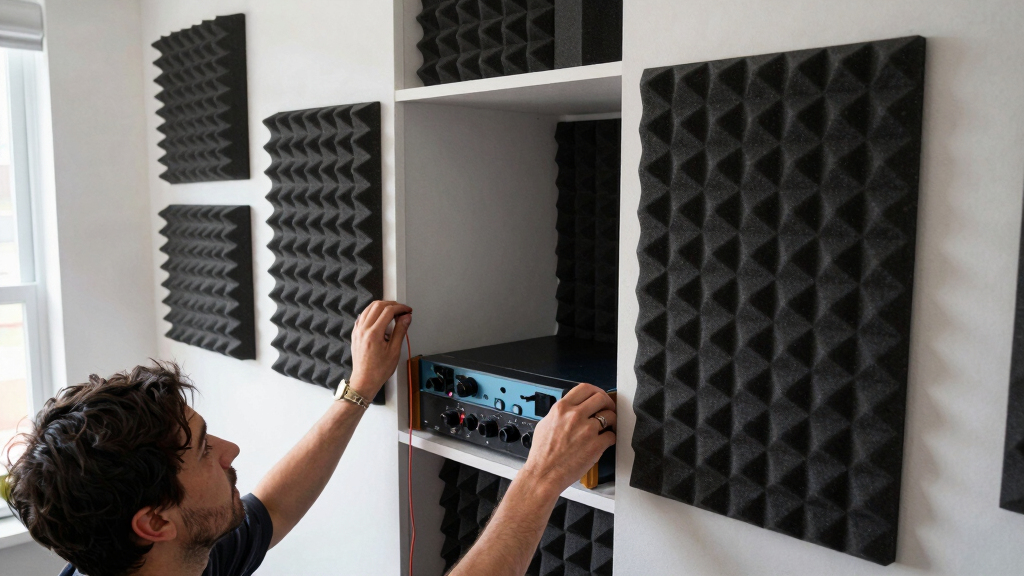
For setups where the rig must be in the same space, strategies include acoustic dampening, soundproof barriers, and vibration isolation. However, foam-based acoustic treatment alone is less effective than physical barriers or decoupling mechanisms that address airborne and structure-borne noise.
The ‘rig in the closet’ setup is gaining popularity due to its simplicity and effectiveness. Nonetheless, it requires careful consideration of airflow and heat dissipation, as sealed enclosures trap heat, risking hardware overheating. For more details, see Acoustic Dampening, Placement, and the “Rig in the Closet” Setup.
Acoustic dampening
& the rig in the closet.
The most powerful noise fix isn’t a material — it’s a floor plan. A rig you can’t hear because it’s in another room beats any amount of foam. Tap the approaches in Part 1 to see what actually works.
(another room)
(levers 1–4)
(door / barrier)
(acoustic foam)
Contain the noise, not the heat
Why Placement and Ventilation Are Critical for Quiet AI Workstations
This approach fundamentally changes how users manage noise and heat in high-performance AI setups. By relocating the rig or using ventilated enclosures, users can maintain a quieter workspace without sacrificing hardware performance, which is especially relevant for remote work, shared offices, or noise-sensitive environments. To explore more about these techniques, visit Acoustic Dampening, Placement, and the "Rig in the Closet" Setup.As an affiliate, we earn on qualifying purchases.
The Evolution of Noise Management in AI Workstations
Traditionally, users relied on acoustic foam and soundproofing within their workspaces, but recent insights emphasize the superiority of physical separation. Experts note that the hierarchy of noise reduction prioritizes distance and isolation over absorption. The 'rig in the closet' concept has emerged as a practical solution, especially as AI hardware becomes more powerful and generates more heat and noise. Proper ventilation remains a critical consideration, with dedicated soundproof cabinets designed to balance noise suppression and thermal management becoming more common."Moving the rig into another room is by far the most effective way to eliminate noise, especially since most AI work is done remotely via network access."
— Thorsten Meyer, AI workspace expert
acoustic dampening panels for computer room
As an affiliate, we earn on qualifying purchases.
As an affiliate, we earn on qualifying purchases.
Remaining Questions About Practical Implementation
While the principles are clear, specifics about optimal ventilation solutions, cost-effectiveness of custom soundproof cabinets, and long-term hardware reliability in sealed environments are still evolving. Further testing and real-world case studies are needed to refine best practices for various setups.
As an affiliate, we earn on qualifying purchases.
Next Steps for Users Considering a 'Rig in the Closet' Setup
Users should evaluate their workspace and hardware needs, prioritize proper ventilation when placing rigs in enclosed spaces, and consider investing in purpose-built soundproof cabinets if noise reduction is critical. Ongoing research and community sharing of best practices will help refine these techniques further.
As an affiliate, we earn on qualifying purchases.
Key Questions
Is moving my AI rig to another room always the best solution?
Generally, yes. Distance is the most effective way to reduce noise. However, if space constraints prevent this, proper enclosures with ventilation can also work well.
Can I just use acoustic foam to quiet my AI workstation?
Acoustic foam alone is generally ineffective for significant noise reduction because it only absorbs reflections within a room, not airborne or structure-borne noise. Combining it with barriers and decoupling is more effective.
What are the risks of putting a high-power GPU in a sealed closet?
The main risk is heat buildup, which can cause thermal throttling or hardware failure. Proper ventilation or active cooling is essential to prevent overheating.
Are specialized soundproof cabinets worth the investment?
Yes, for environments requiring low noise levels and high thermal management, purpose-built cabinets provide a balanced solution, but they can be costly.
Source: ThorstenMeyerAI.com
Fall Picks
fall essentials
As an affiliate, we earn on qualifying purchases.