
📊 Full opportunity report: ADU Construction And Zoning: A Backyard Home Overview on IdeaNavigator AI — validation score, market gap, and execution plan.

Get hardware and tech essentials delivered free — and shop member deals
- Fast, free delivery on millions of items
- Access to Prime Big Deal Days deals on October 6–7
- Prime Video, Amazon Music and more included
TL;DR
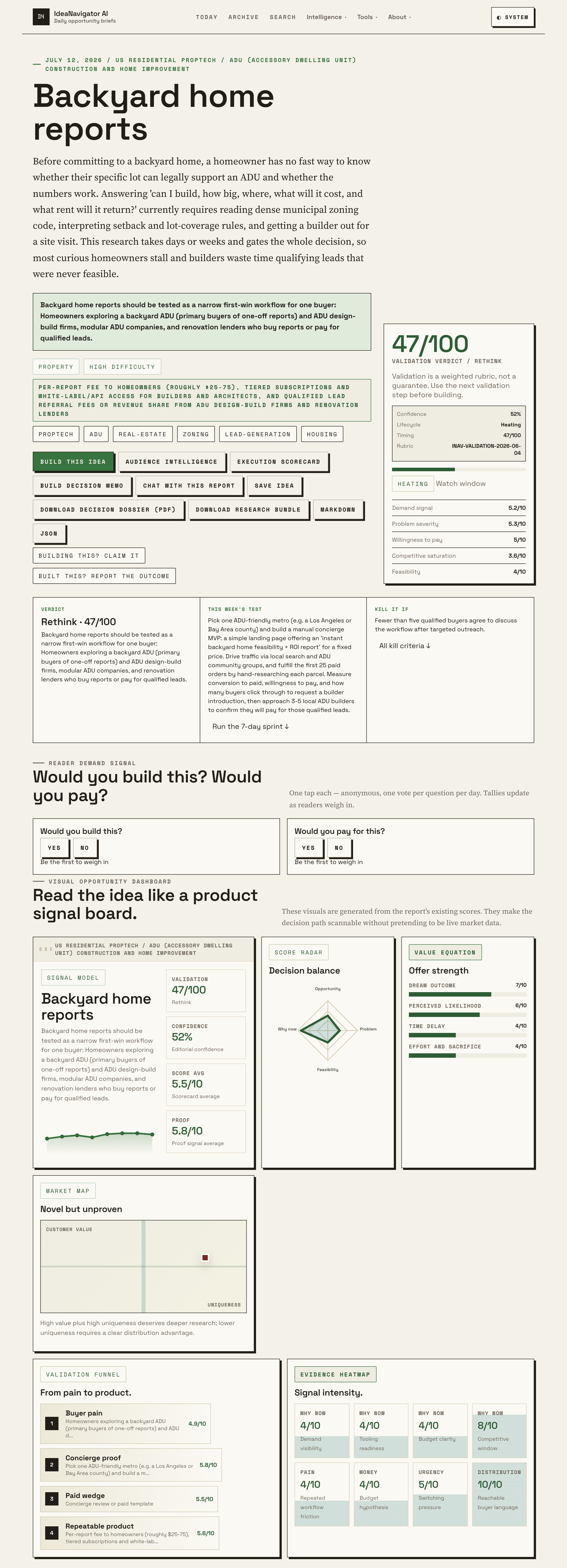
IdeaNavigator AI proposes testing paid, address-specific reports that estimate whether a property can support an accessory dwelling unit (ADU) and whether the project could make financial sense. The concept has not been shown to be a launched or validated service; its zoning accuracy, customer demand and builder interest remain untested.
IdeaNavigator AI has proposed a paid report service that would estimate whether a specific residential lot can support an accessory dwelling unit (ADU), including possible size, costs and rental income. The concept is framed as an early business opportunity to test, not as an operating service or a confirmed change to zoning rules.
The proposed web app would let a homeowner enter a property address and buy a PDF report. For a first version, the plan calls for using county parcel data such as lot boundaries, size and existing building footprint, then comparing those details with state ADU law and a manually curated set of local rules in one launch area. The report could estimate which ADU types are allowed, maximum size, setbacks, lot coverage and buildable area.
The concept also includes a build-cost range and projected rental income based on local rent comparisons. The proposal suggests charging homeowners about $25 to $75 per report, while offering subscriptions or white-label and API access to builders and architects. Referral fees or revenue sharing with design-build firms and renovation lenders are additional possible revenue streams, not established deals.
To test whether customers will pay, the proposal recommends choosing one ADU-friendly metro, creating a landing page and manually researching the first 25 paid orders. The pilot would measure purchases and requests for builder introductions. It also calls for approaching three to five local builders to ask whether they would pay for qualified leads. No pilot results, customer figures or participating firms are reported.
A Faster First Check for Homeowners
An address-level estimate could help homeowners decide whether to pursue an ADU before spending time on code research or arranging a site visit. That question can determine whether a project moves forward at all, and an early estimate of feasibility, cost and potential rent may help owners decide whether to seek professional advice.
For builders, a report could also screen inquiries before staff spend time evaluating a property. But the practical value depends on whether the estimates are accurate enough to guide an initial decision. A report that misses a local restriction or understates construction costs could give a homeowner a misleading picture; it would need to distinguish preliminary estimates from official approvals and contractor bids.
ADU Rules Vary by Locality
The proposal places the idea against changes in ADU policy, citing California’s statewide legalization beginning in 2016 and subsequent loosening of rules. It also points to rising permitting: its figures state that Los Angeles County permitted more than 45,000 ADUs in 2023 and that ADUs account for roughly one in five new housing units produced in California. These are figures presented in the proposal; it does not provide a separate underlying data citation here.
Even with statewide laws, local requirements can affect where a unit fits, its dimensions and the approval process. Parcel records and language-model tools for parsing zoning codes may make address-based research more practical, as the proposal argues, but local rules still require careful interpretation. That is why its suggested initial version limits coverage to one metro and uses manually curated zoning rules rather than attempting nationwide coverage.
Accuracy and Demand Remain Untested
The proposal does not establish whether homeowners will pay the suggested fee, whether builders will purchase leads or whether its estimates can reliably reflect local zoning and project costs. It reports no completed pilot, verified conversion rate or builder agreement. The scale of the stated housing shortage is described as millions of homes, but no estimate, date or method is supplied in the proposal.
A preliminary report would not itself settle whether a project can be permitted or built. The proposal does not specify how the service would handle incomplete parcel records, zoning updates, site conditions or differences between projected rent and actual rental outcomes. Those details would matter to users interpreting a cost or income estimate.
A 25-Order Pilot Is Proposed
The next proposed step is a concierge pilot in a single market, potentially a county in the Los Angeles or Bay Area region. The team behind the concept would manually research 25 paid property reports, track whether buyers request a builder introduction and then ask three to five local firms whether those leads are useful enough to pay for.
No launch date or pilot market has been confirmed. Until results are available, the idea remains a business proposal, and its suggested report prices, revenue channels and customer demand should be treated as hypotheses.
Source: IdeaNavigator AI
Key Questions
Is the backyard ADU report service available now?
The proposal does not say that a service has launched. It recommends testing the idea with a small, manually fulfilled pilot.
What would a report estimate?
It would aim to estimate allowed ADU types, size limits, setbacks, lot coverage, buildable area, a construction-cost range and potential rental income for a property address.
Would the report guarantee that an ADU can be built?
No such guarantee is described. The proposed document is an initial feasibility estimate; the proposal does not say that it would replace local approvals or a site assessment.
How would the idea be tested?
The suggested pilot would manually research 25 paid orders in one metro, track purchases and requests for builder introductions, and ask three to five builders whether they would pay for qualified leads.
Source: IdeaNavigator AI
Fall Picks
fall essentials
As an affiliate, we earn on qualifying purchases.