
📊 Full opportunity report: Driver Monitoring Cameras Are Now Required In Every New Car Sold In The EU on IdeaNavigator AI — validation score, market gap, and execution plan.

Get hardware and tech essentials delivered free — and shop member deals
- Fast, free delivery on millions of items
- Access to Prime Big Deal Days deals on October 6–7
- Prime Video, Amazon Music and more included
TL;DR
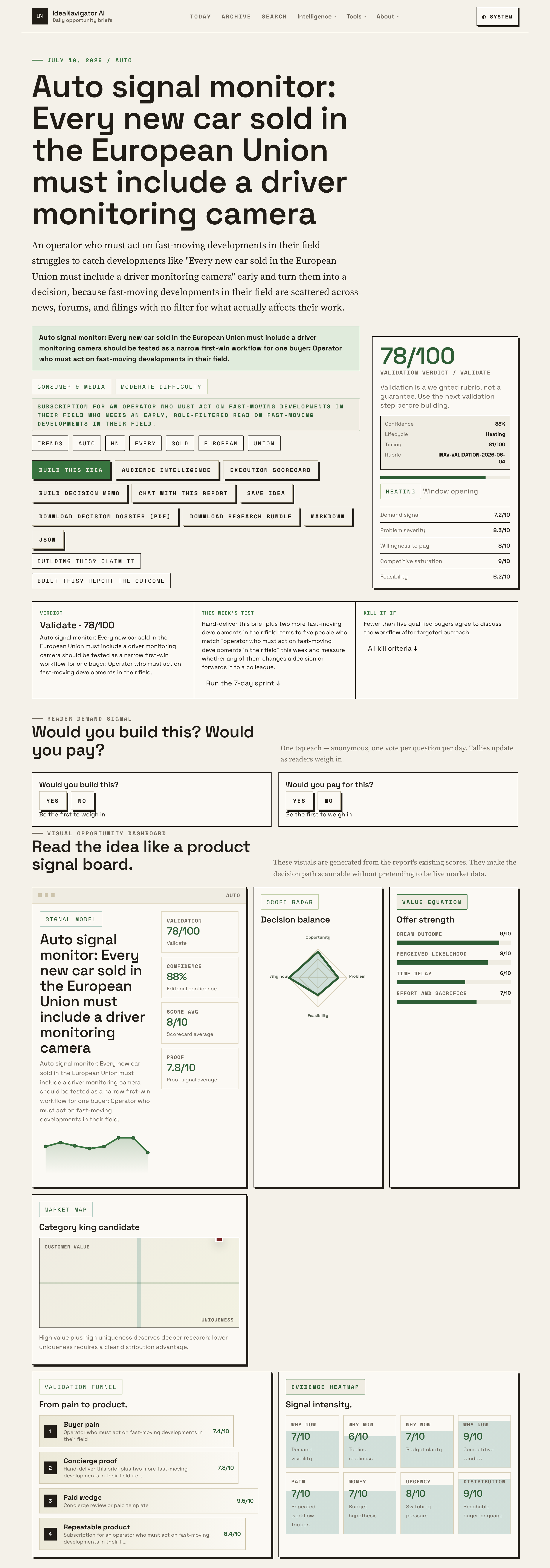
IdeaNavigator AI flagged a claim that every new car sold in the EU must include a driver-monitoring camera. The item provides no regulation, effective date, or official confirmation, so the alleged requirement cannot be independently established from the information supplied.
IdeaNavigator AI has flagged a claim that every new car sold in the European Union must include a driver-monitoring camera, describing it as a development for automotive operators to track. The claim and its characterization come from IdeaNavigator AI’s item; that item does not cite an EU law, regulator announcement, or implementation date, so it does not establish that such a requirement is in force.
According to IdeaNavigator AI, the alleged camera requirement surfaced on Hacker News and received a signal score of 88 out of 100. The score is IdeaNavigator AI’s prioritization, not an official assessment of the claim’s accuracy or legal status.
The supplied IdeaNavigator AI item does not identify the underlying Hacker News post or link to legislative text, a government statement, or an EU institution. It gives no date for when a rule was adopted or would take effect, and does not define the camera or monitoring system involved. Those omissions mean the broad claim about all new cars cannot be verified from the information available here.
IdeaNavigator AI also frames the item as an example of a proposed monitoring service that would collect industry developments and turn them into short decision briefs. The item proposes delivering the brief and two other developments to five people matching its intended user profile, then measuring whether the information affects a decision or is forwarded to a colleague. This is IdeaNavigator AI’s product-testing proposal, not evidence about EU vehicle rules.
Why Automakers Need a Verified Rule
If an EU-wide requirement of this breadth were confirmed, it could matter to vehicle manufacturers, suppliers, and operators planning designs, compliance work, and production schedules. But those consequences are conditional: the IdeaNavigator AI item does not establish that the requirement exists, identify which vehicles it would cover, or explain what technical standard might apply.
For readers tracking regulation, the distinction between a surfaced claim and an enacted requirement affects the decisions they can reasonably make. IdeaNavigator AI’s signal score may help prioritize review, but it cannot substitute for checking the relevant legal text or an announcement from an EU authority. Until such documentation is identified, the claim should be treated as unverified, rather than as a confirmed deadline or compliance obligation.
How the Camera Claim Surfaced
The account available here is published by IdeaNavigator AI, which describes a possible monitoring product for industry operators. The company says developments are scattered across news, forums, and filings, and proposes filtering those signals by a user’s role before preparing a brief on what changed, why it matters, and what action may be needed.
IdeaNavigator AI says Hacker News surfaced the item and assigns it an 88/100 signal. The account does not identify the specific Hacker News post or provide a separate report confirming the claimed EU measure. It documents no prior adoption, legislative timeline, or related official announcement.
Legal Status and Scope Unverified
The central uncertainty is whether an EU rule requiring a driver-monitoring camera in every new car exists at all. IdeaNavigator AI’s account does not name a law, regulation, vote, agency, or publication in an official journal. It also does not state an adoption date or effective date.
The term driver-monitoring camera is not defined in the account. It remains unclear whether the claim refers to a camera specifically, another driver-monitoring technology, a system limited to certain vehicle categories, or a broader safety requirement being described imprecisely. The item supplies no technical requirements, exemptions, enforcement details, or transition period.
Check for an Official EU Record
Anyone assessing the claim should locate the underlying post cited by IdeaNavigator AI and check it against official EU legislation and regulator communications. Until a legal text or authoritative announcement is identified, readers should not treat the claim as proof that manufacturers face a new camera mandate or compliance date.
IdeaNavigator AI proposes testing its monitoring brief with five people in its intended audience and tracking whether they change a decision or share the item. That proposed test may assess whether the format is useful to those readers; it will not resolve the camera rule’s legal status. The account specifies no further confirmation or milestone.
Source: IdeaNavigator AI
Key Questions
Is a driver-monitoring camera now required in every new EU car?
The IdeaNavigator AI item makes that claim but does not provide EU legal text or an official announcement to confirm it.
When would the alleged requirement take effect?
The IdeaNavigator AI item gives no adoption date or effective date.
IdeaNavigator AI presents it as a signal score for prioritizing the item. The account does not describe it as an official rating or verification of the legal claim.
What should automotive operators verify?
They should locate the underlying item referenced by IdeaNavigator AI and check any claimed requirement against official EU legislation or regulator communications before treating it as a compliance obligation.
Source: IdeaNavigator AI
Fall Picks
fall essentials
As an affiliate, we earn on qualifying purchases.