🔍 Read the full analysis: Explore 13 Game-Changing AI Automation Tools For 2026 on ThorstenMeyerAI.com

Get hardware and tech essentials delivered free with Prime
- Fast, free delivery on millions of items
- Prime Video, Amazon Music and more included
- Member-only deals all year
TL;DR
A new wave of 13 AI automation tools are emerging in 2026, offering advanced capabilities for developers and enterprises. This report details their features, significance, and what remains to be seen about their adoption and integration.
Thirteen AI automation tools are gaining prominence in 2026, offering a range of capabilities from scalable workflow building to testing automation. These tools are designed to enhance productivity, reduce manual effort, and support complex development environments. Their emergence is significant for developers, enterprises, and organizations seeking to leverage AI for operational efficiency.
Recent evaluations by industry experts highlight that these 13 tools stand out for their ability to integrate seamlessly with existing development pipelines, especially through API and CI/CD support. Among the top performers is Google AI Studio, praised for its scalability and ease of building workflows. Spec-Driven AI Testing is noted for its specialized focus on automation testing, offering detailed test automation capabilities. The landscape is marked by a tradeoff: tools that prioritize user-friendliness often lack the advanced customization options found in enterprise-grade solutions.
Pricing models vary widely, with premium tools offering extensive features at higher costs, which may be suitable for large organizations but less so for small teams. For more insights, see the original analysis. Many of these tools emphasize minimal coding, enabling rapid deployment and automation development across diverse platforms. The evaluation process prioritized factors such as integration ease, scalability, documentation quality, and community support, ensuring long-term reliability for users.
The 13 picks
- 1
 Software Testing with Generative AIView on Amazon →
- 2
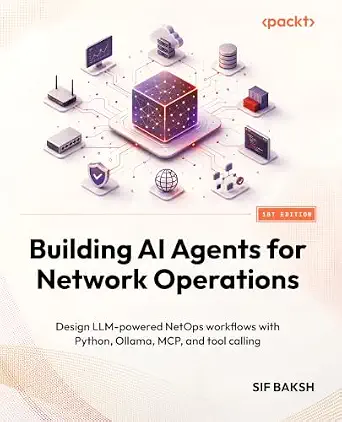 Building AI Agents for Network Operations: Design LLM-powered NetOps workflow…View on Amazon →
- 3
 40 Python Programming Projects for AI Agents and AutomationsView on Amazon →
- 4
 The Claude Code Operating Model: Build Scalable AI Coding Systems with Skills…View on Amazon →
- 5
 Spec-Driven AI Engineering: Build Reliable Software from Requirements to Code…View on Amazon →
- 6
 Building Agentic AI Systems: A Step-by-Step Guide to Creating LLM-Powered AI…View on Amazon →
- 7
 AI for Quality Assurance and Software Testing: The Practitioner’s Complete Gu…View on Amazon →
- 8
 Building Intelligent Applications with Claude AI: A Practical Guide to Creati…View on Amazon →
- 9
 Spec-Driven Software Testing with AI: Build Reliable Test Suites from Specifi…View on Amazon →
- 10
 Mastering Claude AI: The Complete Practical Guide to Prompt Engineering, Proj…View on Amazon →
- 11
 Claude AI Automation & Monetization: Build AI-Powered Systems, Automate Workf…View on Amazon →
- 12
 Google AI Studio Guide 2026: Master Google AI Studio to Build Intelligent AI…View on Amazon →
- 13
 Agentic Coding with Claude Code (5-in-1): A Practical Developer’s Handbook fo…View on Amazon →
Impact on Development and Business Operations
The emergence of these 13 AI automation tools in 2026 signals a shift toward more intelligent, efficient workflows across industries. They enable organizations to automate complex tasks with minimal coding, facilitate faster deployment cycles, and improve testing accuracy. This trend could lead to significant cost savings, faster time-to-market, and enhanced scalability for both small teams and large enterprises. However, the rapid evolution also raises concerns about integration challenges, vendor lock-in, and the learning curve associated with adopting new technologies.
Evolution of AI Automation in 2026
Over the past few years, AI automation tools have transitioned from experimental solutions to essential components of modern development pipelines. In 2024, early adopters demonstrated the potential for AI to streamline testing, coding, and network management. By 2026, the market has expanded with a diverse array of tools tailored for specific needs, from enterprise-scale workflow builders to niche testing platforms. Industry reports indicate that integration capabilities and ease of use remain critical factors influencing adoption. Major players like Google, Microsoft, and emerging startups have introduced solutions that emphasize minimal coding and rapid deployment, reflecting a broader industry shift toward AI-assisted automation.
Adoption Challenges and Integration Uncertainties
While these 13 AI automation tools show promise, several uncertainties remain. It is not yet clear how quickly organizations will adopt these solutions at scale, especially given concerns about integration complexity, vendor lock-in, and the learning curve for teams unfamiliar with advanced AI tools. Additionally, long-term support, updates, and community engagement are still evolving, which could impact their reliability and effectiveness in real-world scenarios.
Upcoming Evaluations and Adoption Milestones
In the coming months, industry analysts and early adopters will evaluate these tools’ performance in diverse environments. Key milestones include broader deployment in enterprise settings, integration with existing development pipelines, and feedback on usability and support. Vendors are expected to release updates and new features aimed at addressing current limitations, while organizations will assess cost-effectiveness and ROI. Monitoring these developments will be crucial for understanding how these tools reshape AI automation in 2026 and beyond.
Key Questions
Which of the 13 tools is best for small teams?
Tools emphasizing ease of use, minimal coding, and quick setup—such as Google AI Studio—are generally more suitable for small teams. These platforms often offer ready-to-use templates and scalable plans that align with smaller budgets and staffing levels.
Can these AI automation tools integrate with existing development pipelines?
Most leading tools support integration with popular platforms like Jenkins, GitHub, and Docker through APIs and plugins. Proper integration is key to maximizing automation efficiency across testing, deployment, and monitoring processes.
What are the main factors to consider when choosing an AI automation tool?
Important considerations include ease of integration, scalability, customization options, cost, learning curve, and community support. Balancing these factors based on your organization’s needs will help select the most suitable solution.
Will these tools replace human developers?
While these tools enhance automation and reduce manual effort, they are designed to augment human roles rather than replace developers entirely. They facilitate faster workflows, but strategic oversight and complex decision-making still require human expertise.
What are the risks of adopting these AI automation tools?
Potential risks include integration challenges, vendor lock-in, high costs for premium features, and the need for staff training. Organizations should evaluate these factors carefully to ensure successful adoption and long-term value.
Source: ThorstenMeyerAI.com
Fall Picks
fall essentials
As an affiliate, we earn on qualifying purchases.