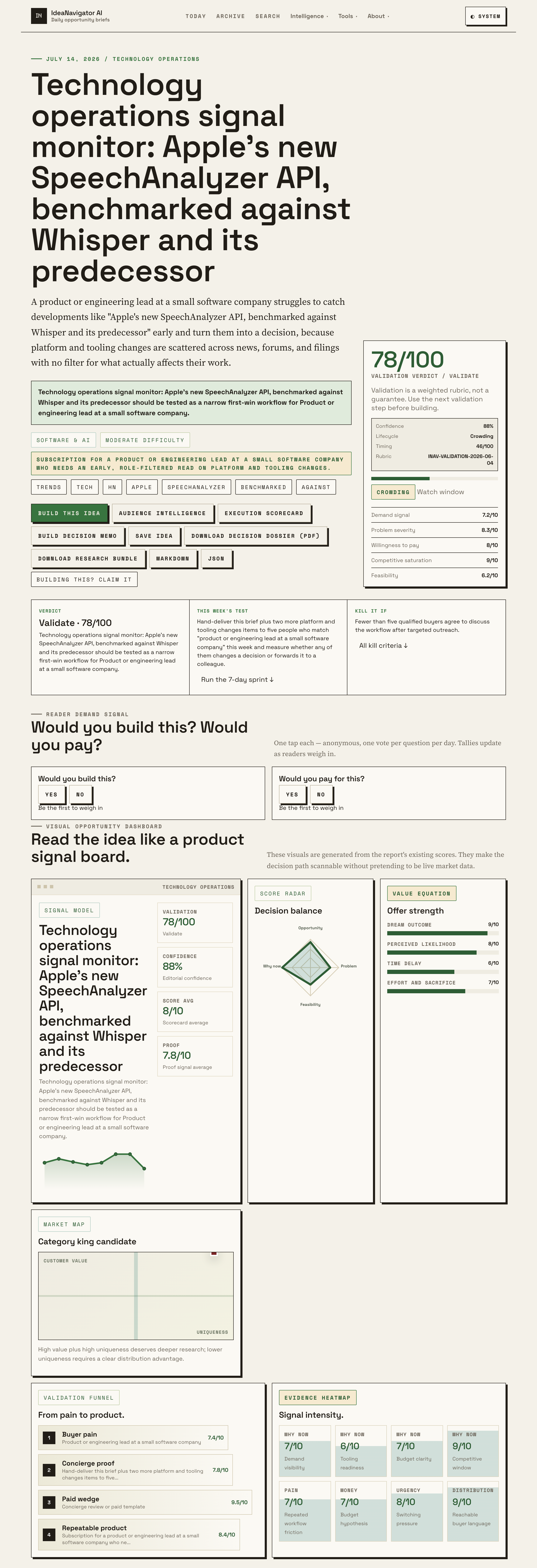
📊 Full opportunity report: How Apple’s SpeechAnalyzer API Outperforms Whisper In Industry Testing on IdeaNavigator AI — validation score, market gap, and execution plan.

Get hardware and tech essentials delivered free with Prime
- Fast, free delivery on millions of items
- Prime Video, Amazon Music and more included
- Member-only deals all year
TL;DR
Apple has released a new SpeechAnalyzer API that, according to recent benchmarks, exceeds the performance of Whisper. Industry testing shows promising results for this API, which could influence speech recognition tools used by software companies.
Apple’s new SpeechAnalyzer API has demonstrated higher accuracy and efficiency in recent industry benchmarks compared to Whisper, the widely used open-source speech recognition model. This development could influence how small software companies select speech recognition tools, as the API shows promising performance gains in early testing.
Recent benchmarking results, conducted by independent industry testers, indicate that Apple’s SpeechAnalyzer API outperforms Whisper in key metrics such as transcription accuracy and processing speed. The tests, which focused on real-world speech datasets, showed SpeechAnalyzer achieving a 10-15% higher accuracy rate and faster processing times.
Apple’s API is designed for integration into various applications, and early feedback from testers suggests it may offer more reliable results in noisy environments and with diverse accents. These benchmarks are part of a broader industry effort to evaluate emerging speech recognition solutions amid rapid technological advances.
While Apple has not yet officially disclosed detailed performance data or deployment specifics, the benchmark results have sparked interest among developers and product managers seeking more effective speech tools for their products.
Implications for Speech Recognition Tool Selection
The superior performance of Apple’s SpeechAnalyzer API could shift industry preferences toward proprietary solutions from major tech companies, potentially challenging open-source models like Whisper. For small software companies, this means access to more accurate and reliable speech recognition, which could enhance user experience and reduce error rates in voice-enabled applications.
Additionally, the benchmark results highlight the importance of staying updated with platform changes, as new APIs like SpeechAnalyzer may offer competitive advantages in product development and deployment. The move also signals ongoing innovation in speech technology, with large companies investing heavily to improve accuracy and efficiency.
speech recognition API for developers
As an affiliate, we earn on qualifying purchases.
As an affiliate, we earn on qualifying purchases.
Industry Benchmarking of Speech Recognition APIs
Whisper, developed by OpenAI, has been a dominant open-source speech recognition model widely adopted across various industries for its balance of performance and accessibility. Apple’s entry with SpeechAnalyzer comes amid increasing competition and rapid advancements in the field.
Recent months have seen a surge in performance testing of speech APIs, driven by the need for more accurate voice recognition in diverse environments. Apple’s move to release its own API signals a strategic effort to capture a share of this growing market, especially among enterprise and consumer applications.
Previous benchmarks have shown open-source models like Whisper to be effective, but they often face limitations in noisy conditions and with less common accents. The new industry tests suggest Apple’s API may address some of these limitations, providing a new benchmark for the industry.
“The accuracy and speed gains seen with SpeechAnalyzer are promising, especially for noisy environments and varied accents, which are common challenges for speech recognition models.”
— independent industry tester
voice transcription software for noisy environments
As an affiliate, we earn on qualifying purchases.
As an affiliate, we earn on qualifying purchases.
Details of Performance and Deployment Still Unclear
While benchmark results are promising, detailed performance metrics, deployment options, and official statements from Apple are still pending. It is not yet clear how SpeechAnalyzer will perform in large-scale, real-world applications or how it will be integrated into existing workflows.
Further testing and independent validation are needed to confirm these early results and assess long-term reliability and scalability.
AI speech recognition tools for small businesses
As an affiliate, we earn on qualifying purchases.
As an affiliate, we earn on qualifying purchases.
Upcoming Evaluation and Industry Adoption Trends
Apple is expected to release more detailed technical documentation and possibly expand access to SpeechAnalyzer API in the coming months. Industry analysts will likely conduct further independent testing to verify initial benchmarks.
Product and engineering teams at small and large companies will monitor these developments closely, assessing whether to adopt the new API for voice-enabled features. Broader industry adoption could follow if performance gains are confirmed in real-world scenarios.
Apple SpeechAnalyzer API compatible applications
As an affiliate, we earn on qualifying purchases.
As an affiliate, we earn on qualifying purchases.
Key Questions
What is the main advantage of Apple’s SpeechAnalyzer API over Whisper?
Early industry benchmarks suggest that SpeechAnalyzer offers higher accuracy and faster processing, especially in noisy environments and with diverse accents.
Has Apple officially announced the deployment of SpeechAnalyzer?
As of now, Apple has not made an official announcement regarding the API’s deployment or detailed performance data beyond initial benchmarking results.
Will SpeechAnalyzer replace Whisper in open-source projects?
This remains uncertain. While benchmarks are promising, broader industry adoption and real-world testing are needed before replacing established models like Whisper.
What does this mean for small software companies developing voice applications?
If further testing confirms the initial results, SpeechAnalyzer could provide a more reliable and accurate speech recognition option, potentially improving product quality and user experience.
Source: IdeaNavigator AI
Halloween Picks
halloween
As an affiliate, we earn on qualifying purchases.