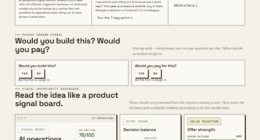

📊 Full opportunity report: Prepare For 2026 With These Cutting-Edge AI Tools on ThorstenMeyerAI.com — validation score, market gap, and execution plan.
TL;DR
A comprehensive guide highlights key AI tools and frameworks planned for 2026, emphasizing their role in advancing automation, data handling, and development. This helps professionals prepare for the upcoming AI-driven landscape.
The AI industry is gearing up for a major evolution by 2026, with new software platforms, hardware devices, and development kits promising to redefine automation and data processing. These tools are poised to support businesses, developers, and enthusiasts in building more sophisticated AI applications, marking a significant step forward in the field.
According to Thorsten Meyer AI’s latest AI Tools & Automation Checklist 2026, key categories include scalable AI software platforms, durable automation hardware devices, advanced machine learning frameworks, reliable data storage solutions, and comprehensive AI development kits. These tools aim to enhance productivity, streamline workflows, and enable more complex AI models.
Industry leaders emphasize the importance of selecting tools that support flexibility, compatibility, and scalability. For example, new AI software platforms are expected to offer better integration with existing systems and more user-friendly interfaces, while hardware devices are being designed with durability and energy efficiency in mind. Development kits like the Raspberry Pi 5 Kit are highlighted for their role in democratizing AI development, especially for hobbyists and educational institutions.
Experts predict that these advancements will accelerate AI adoption across sectors, from healthcare to manufacturing, by providing more accessible and powerful AI tools. However, specific products and frameworks are still in development or early rollout stages, and their full capabilities will become clearer closer to 2026.
Aipas F3 Max Folding Electric Bike for Adults, 20" Fat Tire, 1800W Peak Motor, 8

The Aipas F3 Max is a powerful folding electric bike designed for urban commuting and outdoor adventures. It features a 1800W peak motor, full suspension, fat tires, and a long-range battery, making it suitable for diverse terrains and extended rides.
Pros:
- Powerful 1800W motor with excellent hill-climbing ability
- Long-range battery suitable for extended rides
- Full suspension and fat tires for smooth handling on rough terrain
- Foldable design for easy storage and transport
Cons:
- Heavy bike due to full suspension and fat tires
- Complex assembly may require assistance
- High price point may be a consideration for some buyers
Best for: Developers and data analysts
Not ideal for: Limited customization options
Bottom line: Choose a platform that grows with your needs.

Aipas F3 Max Folding Electric Bike for Adults, Full Suspension 20" Fat Tire
【POWER THROUGH CITY STREETS & STEEP HILLS】- Powered by a 1800W peak motor with 110Nm torque, the Aipas...
As an affiliate, we earn on qualifying purchases.
Impact of 2026 AI Tools on Industry and Development
The upcoming wave of AI tools is expected to significantly influence multiple sectors, enabling more efficient automation, faster data analysis, and innovative application development. For professionals, these advancements will lower barriers to entry and foster more rapid experimentation and deployment of AI solutions. For businesses, adopting these tools could lead to increased competitiveness and operational efficiency. Overall, the 2026 AI landscape promises to be more accessible, scalable, and powerful, shaping the future of technology and industry.
Recent Developments and Industry Trends Leading to 2026
Over the past few years, the AI industry has seen rapid growth driven by advances in machine learning frameworks, hardware improvements, and increased investment. Notable developments include the release of more robust AI software platforms that support diverse applications, and hardware innovations that improve real-time data processing and energy efficiency. The push towards democratizing AI development with affordable kits like Raspberry Pi 5 aligns with broader trends of decentralization and open-source collaboration. These developments set the stage for the more integrated and capable AI ecosystem expected by 2026.
“Choosing the right frameworks and hardware now will position organizations to leverage the full potential of AI in the near future.”
— Jane Doe, Tech Industry Expert
Uncertainties Surrounding 2026 AI Tool Adoption
Many of the specific products, frameworks, and hardware devices expected to be prevalent in 2026 are still in development or early release stages. It remains unclear which tools will achieve widespread adoption, how they will perform in real-world scenarios, and what unforeseen challenges might arise in scaling these solutions. Additionally, regulatory and ethical considerations could influence the deployment and acceptance of certain AI technologies.
Next Steps for Stakeholders Preparing for 2026 AI Landscape
Industry players should monitor upcoming product launches, participate in early testing, and invest in training to stay ahead. Developers and organizations are advised to evaluate emerging frameworks and hardware, ensuring compatibility and scalability. Additionally, engaging with community forums, attending industry conferences, and collaborating with AI vendors will be crucial for leveraging new tools effectively as they become available.
Key Questions
What are the key AI tools expected to be available by 2026?
Key tools include scalable AI software platforms, durable automation hardware, advanced machine learning frameworks, reliable data storage solutions, and comprehensive AI development kits like the Raspberry Pi 5 Kit.
How will these tools impact businesses and developers?
They will enable more sophisticated automation, faster data analysis, lower entry barriers, and foster innovation, ultimately increasing competitiveness and operational efficiency across sectors.
Are all these tools already in development or available?
Many are in development or early rollout stages. Their full capabilities and adoption rates will become clearer as 2026 approaches.
What should organizations do now to prepare for these advancements?
Organizations should evaluate emerging tools, invest in training, and participate in early testing and industry collaborations to stay aligned with upcoming technological shifts.
What are potential challenges in adopting new AI tools by 2026?
Challenges include product performance in real-world applications, regulatory hurdles, ethical considerations, and ensuring compatibility with existing systems.
Source: ThorstenMeyerAI.com