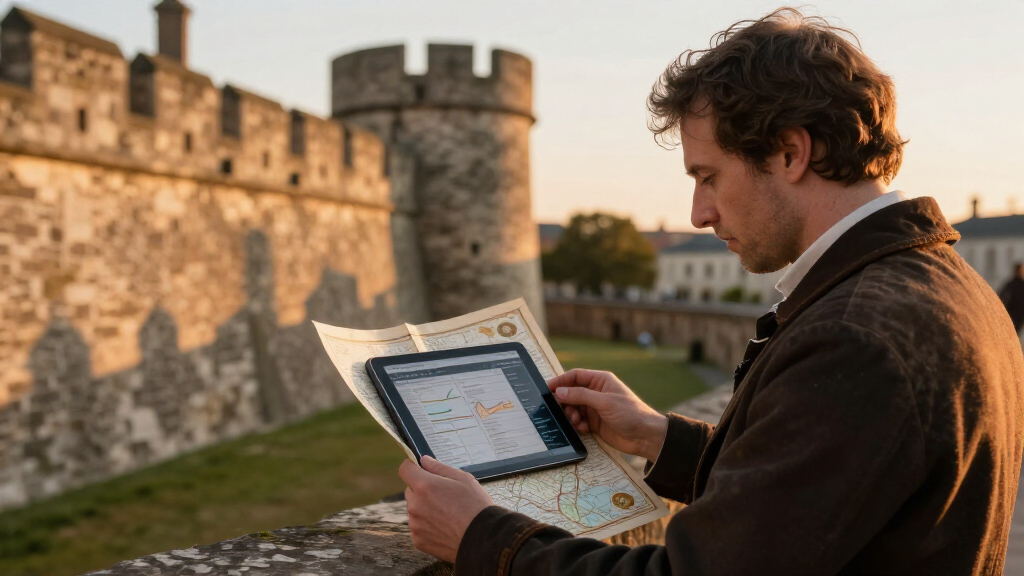
🔍 Read the full analysis: The Intersection Of AI And Military History: La Citadelle, 1693 on ThorstenMeyerAI.com
TL;DR
An AI-generated interactive exhibit reconstructs the 1693 siege of La Citadelle, offering a detailed, cinematic visualization of military tactics. This innovative approach merges history with AI-driven digital storytelling, opening new avenues for historical education and analysis.
An AI-powered interactive exhibit reconstructs the 1693 siege of La Citadelle, offering a detailed, cinematic visualization that combines historical accuracy with artistic storytelling. This digital monument, built without images but relying on layered SVGs, CSS, and canvas elements, exemplifies a novel intersection of artificial intelligence and military history, providing new tools for education and analysis. Learn more about the digital reconstruction of historical sieges in this detailed archive.
The project, titled La Citadelle — An Anatomy of Siege, 1693, is hosted as an interactive website that simulates the historic siege of Montfaucon’s fortress, as detailed in the original analysis. It employs AI-guided workflows for construction, critique, and approval, ensuring a high level of historical plausibility and visual coherence. The site uses a restrained color palette inspired by archival materials—parchment, fortress ink, smoke gray, and vivid red accents—and combines sophisticated JavaScript-driven animations to depict earthworks, artillery fire, and defensive maneuvers in real time, similar to the visual reconstructions found in the original analysis.
According to the creators, the simulation features a layered SVG siege map, animated trajectories for cannon shells, and a cinematic fortress at dusk, all orchestrated without static images. The process involves an AI analysis of visual coherence and responsiveness, with final approval by an art director dedicated to balancing educational intent with aesthetic restraint. The project aims to demonstrate how AI can produce complex, layered digital exhibits that preserve historical fidelity while engaging viewers through artistic storytelling.
Innovative Use of AI in Historical Reconstructions
This project exemplifies how artificial intelligence can revolutionize the presentation of military history by creating immersive, detailed reconstructions that are both educational and visually compelling. It offers a new method for exploring complex military tactics and architecture, making history more accessible and engaging for a broad audience. The approach also raises questions about the role of AI in historical interpretation, accuracy, and storytelling, potentially influencing future digital exhibits and educational tools.
interactive military history exhibit
As an affiliate, we earn on qualifying purchases.
As an affiliate, we earn on qualifying purchases.
Historical and Technological Foundations of the Siege
The siege of La Citadelle in 1693 was a pivotal event during the warfare of the late 17th century, involving complex fortification strategies and artillery tactics typical of Vauban’s military engineering. Historically, the fortress’s star-shaped bastion design exemplified the era’s defensive innovations. Recent advances in AI-driven visualization have enabled the recreation of such events with unprecedented detail. The project builds on centuries of military engineering knowledge and combines it with cutting-edge digital technology to produce a layered, explorable simulation that emphasizes both the technical and strategic aspects of the siege.
Previous digital reconstructions have often relied on static images or simplified models, but this project’s dynamic, scroll-driven interface offers a cinematic experience that allows users to explore the terrain, troop movements, and artillery engagements in a sequential, immersive manner. The development process involved iterative critique driven by AI, ensuring the simulation’s historical plausibility and visual coherence, culminating in a final approval that balances fidelity with artistic storytelling.
“This project demonstrates the potential of AI to produce layered, interactive history exhibits that are both educational and artistically compelling.”
— Thorsten Meyer
AI-powered historical reconstruction software
As an affiliate, we earn on qualifying purchases.
As an affiliate, we earn on qualifying purchases.
Uncertainties in Historical Accuracy and AI Interpretation
While the simulation emphasizes historical plausibility, it is not yet clear how accurately the AI models the specific tactical decisions or terrain features of the 1693 siege. The critique process involves AI analysis, but the extent to which it can replicate the nuanced strategic choices of historical commanders remains uncertain. Additionally, the interpretative layer added by artistic storytelling may influence perceptions of the event, raising questions about the balance between factual accuracy and narrative engagement.
As an affiliate, we earn on qualifying purchases.
Future Developments in Digital Military History Exhibits
The ongoing project aims to refine the simulation based on user feedback and further AI critique, potentially expanding to other historical sieges or battles. Developers plan to incorporate more interactive elements, such as user-controlled troop movements or real-time decision-making scenarios, to deepen engagement. Broader adoption of AI-driven visualization in military history could influence educational curricula, museum exhibits, and scholarly research, fostering new ways to understand complex historical events.
As an affiliate, we earn on qualifying purchases.
Key Questions
How accurate is the AI reconstruction of the 1693 siege?
The reconstruction emphasizes historical plausibility, but the precise accuracy of tactical details and terrain features is still under evaluation. It aims to balance fidelity with artistic storytelling.
Can users interact with the simulation?
Yes, the site features scroll-driven animations and layered maps that allow users to explore different phases of the siege dynamically, but real-time user control over troop movements is not yet implemented.
What does this project demonstrate about AI’s role in history?
It shows that AI can produce detailed, layered reconstructions that enhance understanding of complex military events, opening new possibilities for digital education and scholarly analysis.
Will this technology be used for other historical events?
Potentially, yes. The project serves as a proof of concept for expanding AI-driven visualizations to other battles, sieges, and military strategies, broadening the scope of digital history.
Source: ThorstenMeyerAI.com