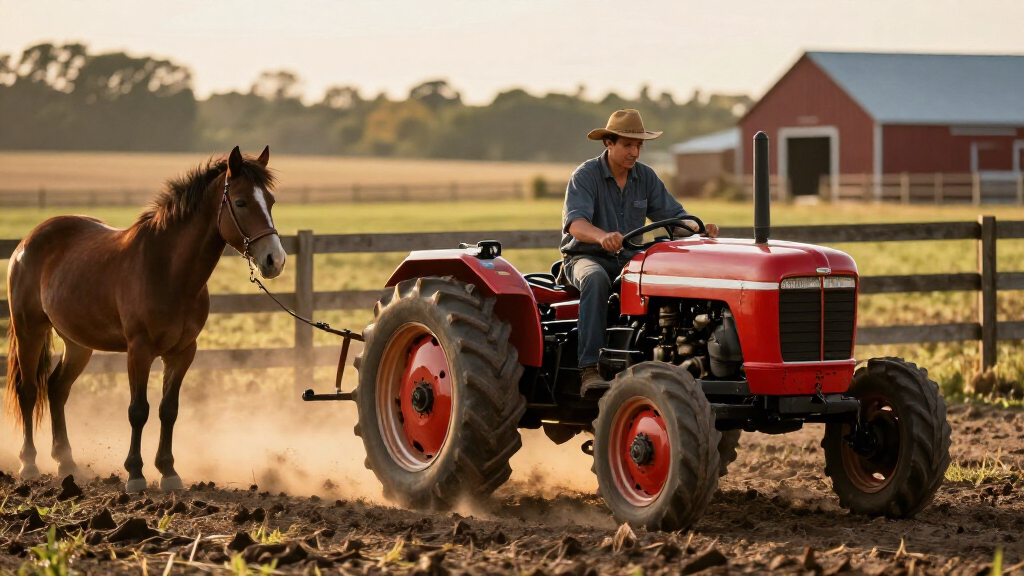

🔍 Read the full analysis: What The Switch To Tractors Meant For Farm Horses on ThorstenMeyerAI.com

Get hardware and tech essentials delivered free with Prime
- Fast, free delivery on millions of items
- Prime Video, Amazon Music and more included
- Member-only deals all year
TL;DR
American farms had 26.7 million horses and mules in 1918; by 1960, the count had fallen to 3.1 million as tractors and other machinery took over farm work. The shift freed cropland from growing animal feed and reduced farm employment, while many workers moved into other parts of the economy. The comparison with modern automation is useful but incomplete: the effects on people differed, and the future reach of current farm robots remains uncertain.
U.S. farms had 26.7 million horses and mules on January 1, 1918, but only 3.1 million by 1960, as tractors and other machinery replaced animals in field work. The transition cut the land needed to grow feed and transformed farm employment, making the shift a useful, though limited, comparison for current debates over automation.
The figures, reproduced in the U.S. Census Bureau’s Historical Statistics of the United States from Department of Agriculture estimates, show horses and mules remaining numerous through the early years of tractor adoption. The combined animal count was 25.7 million in 1920, when about 246,000 tractors were reported on U.S. farms. By 1940, tractor numbers had reached 1.57 million while horses and mules had fallen to 14.6 million. Around 1955, tractors first outnumbered the animals: 4.35 million compared with 4.31 million.
By 1960, the U.S. had about 4.69 million tractors and 3.1 million farm horses and mules. The animal count had fallen by almost 90% from its 1918 peak. Horses alone reached their high earlier, at 21.4 million in 1915; mules continued increasing for several more years. The figures count animals on farms, not every horse in the country.
The animals also required substantial land to feed them. In 1915, about 93 million acres of harvested cropland—out of 340 million acres—grew feed for horses and mules. The source says that area was about 5 million acres in 1960. Tractors were part of a broader mechanization of agriculture: combine harvesters, corn pickers, balers and milking machines also spread. The number of people supplied by each U.S. farm worker rose from 7.1 in 1910 to 47.1 in 1970, according to the Department of Agriculture series cited in the source; that measure includes people abroad supplied through exports.
How Mechanization Reshaped Farm Work
The horse-to-tractor shift changed more than the equipment used in fields. As fewer animals were needed, farmers stopped breeding replacements and land once used to grow feed could be used for other crops. The source describes the transition as gradual rather than a single event: the working population declined over decades as animals aged out.
Farm employment also contracted. The source gives a peak of 13.6 million U.S. farm workers in 1916 and 4.5 million in 1970, while the overall U.S. labor force doubled. Those figures show a major movement of work away from farms, but they do not by themselves establish what happened to each worker or how much of the decline came from tractors rather than other changes. The source says new jobs were in cities and that people had to move; it does not provide figures on individual workers’ routes or outcomes.
The episode matters to current automation debates because it shows how a technology can displace a longstanding form of work while also changing land use, production and the wider economy. But the comparison has limits. A horse was not a person, and human workers have political rights and can retrain or move between jobs—though those options may be difficult and unevenly available.
Products Worth Considering

Ledger Flex + Folio Crypto Hardware Wallet

LG 24G414B-B 24-Inch UltraGear Full HD IPS Gaming Monitor

Apple MacBook Air 15-inch with M5 chip, 16GB Memory, 512GB SSD, and Liquid Retina Display
As an affiliate, we earn on qualifying purchases.
From Fordson to Farm Machines
Tractors existed before World War I, but the source says early models were heavy, expensive and better suited to large farms. In 1917, Ford launched the Fordson. The Henry Ford museum describes it as “the first mass-produced and inexpensive lightweight tractor,” designed to meet small farmers’ needs, and says it rapidly became America’s most popular tractor. On February 21, 1920, the 100,000th Fordson left the assembly line.
Adoption accelerated, but the reported counts have measurement limits. The tractor figures for 1920 through 1960 are census counts taken on dates that differed slightly; they exclude steam and garden tractors. From 1951 onward, the Department of Agriculture counted horses and mules together. The source notes that the department ended its annual estimates of farm horses and mules soon after 1960.
The historical comparison is now being applied to newer machinery. The source reports that John Deere’s 16-camera autonomy kit, introduced in February 2025, performs tillage on select large tractors. It also says China reported that about 74% of ploughing, sowing and harvesting was mechanized in 2023. These examples describe specific uses and a reported national measure, not proof that farms are fully automated or that today’s systems can perform every task once done by people or animals.
What the Historical Counts Miss
The statistics document falling animal numbers and rising tractor counts, but they do not track what happened to individual horses and mules. The source says farmers stopped breeding replacements and the working population aged out; it provides no detailed account of each animal’s fate. Nor do the employment figures show how many people were displaced specifically by tractors, rather than by the combined effects of machinery, new farming methods and broader economic change.
The tractor and animal series are not perfectly aligned: census dates varied, and the way animals were counted changed after 1950. The source also gives limited detail on the methods behind China’s 2023 mechanization figure and on which farms can use John Deere’s autonomy kit. How quickly current automation will expand, what jobs it may affect, and how workers will adapt remain open questions.
How Farm Automation Develops
The next developments to watch are the practical reach of autonomous equipment and whether it moves beyond selected tasks and large tractors. The source identifies John Deere’s 16-camera kit as a current example for tillage, but gives no deployment totals, performance comparisons or schedule for wider use. It also does not establish how other farm tasks will be automated.
For comparisons with the horse era, useful evidence will include the number and type of farms adopting these systems, the tasks they handle, and changes in farm employment and working conditions over time. Until such figures are available, the historical record offers a warning about large-scale economic change—not a direct forecast of what will happen to today’s workers.
Key Questions
When did tractors first outnumber farm horses and mules in the United States?
The figures in the source place the crossover around 1955, when there were 4.35 million tractors and 4.31 million horses and mules on U.S. farms.
How many farm horses and mules were there at the peak?
The combined count peaked at 26.7 million on January 1, 1918, according to the Department of Agriculture estimates reproduced in the Census Bureau’s historical statistics.
What happened to the farm horses as tractors spread?
The source says farmers generally stopped breeding replacements, and the working population declined as animals aged. It does not provide a detailed account of the fate of individual horses and mules.
Did tractors alone cause farm employment to fall?
The source documents a decline from 13.6 million farm workers in 1916 to 4.5 million in 1970, alongside the spread of machinery. Those figures do not separate the effects of tractors from other changes in agriculture and the wider economy.
Does the horse-to-tractor shift predict what AI will do to workers?
It offers a historical comparison, not a reliable prediction. The source notes that human workers differ from horses, including in their ability to vote and potentially move into other work; the effects of current automation remain uncertain.
Source: ThorstenMeyerAI.com