
🔍 Read the full analysis: What To Consider Before Using Ring’s Flying Home Drone And Patrol Robot on ThorstenMeyerAI.com

Get hardware and tech essentials delivered free with Prime
- Fast, free delivery on millions of items
- Prime Video, Amazon Music and more included
- Member-only deals all year
TL;DR
Ring announced two mobile security devices: an indoor drone priced at $249.99 and a wheeled business patrol robot priced at $999.99. The Rover is scheduled to ship in the U.S. on Dec. 16, 2026; the Drone is listed for Jan. 27, 2027, but Ring says it cannot be sold until it receives required FCC authorization. Privacy protections, internet dependence and the devices’ practical limits are key issues for prospective users.
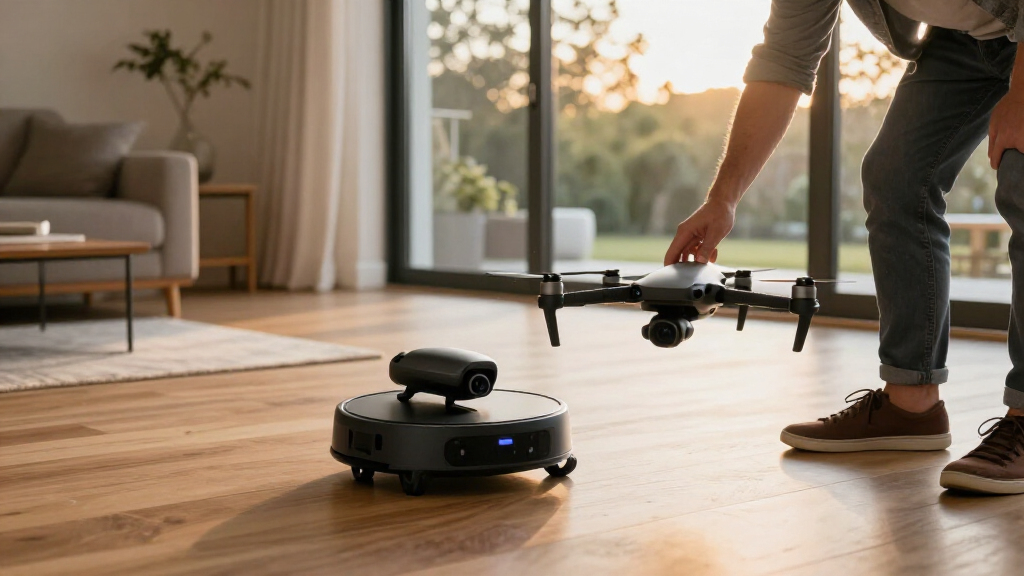
Amazon’s Ring announced two mobile security devices on Nov. 10: a small indoor drone for homes and a wheeled patrol robot for businesses. The products, priced at $249.99 and $999.99, respectively, can move toward activity detected by other Ring devices, but their release schedules, internet requirements and recording practices raise practical and privacy questions for buyers.
The Ring Drone Cam is listed at $249.99, with U.S. shipping scheduled to begin Jan. 27, 2027. Ring says it can fly on demand or along scheduled routes, and can launch when a Ring camera, sensor or alarm is triggered. Its listed specifications include 2K video, a 148-degree field of view, 360-degree rotation and two LED lights. Ring says the camera is off while the drone is docked. However, the company also says the device has not received authorization required by Federal Communications Commission rules and may not be sold until authorization is granted.
The Ring Rover Cam, aimed at businesses, is listed at $999.99 and is scheduled to ship in the United States on Dec. 16, 2026. Ring says it can patrol on a schedule, travel to a location after another Ring device detects an event, and scan 360 degrees when it arrives. Its adjustable mast carries a camera, and the unit also has a siren, light tower and two-way audio. Ring says it can stream and record in up to 4K while moving or patrolling, as well as begin recording after detecting motion while docked.
Both products use a system Ring calls AI Pilot, which the company says maps spaces, proposes patrol points and steers around obstacles using cameras, sensors, vision models and cloud processing. Scheduled patrols require a compatible Ring Protect plan. The Verge reported that the drone’s processing depends on an internet connection; without Wi-Fi, it can only land. The Verge also reported estimates of around five to eight minutes of flight per charge for the drone, and about 30 minutes of battery life and coverage of roughly 5,000 square feet on a single floor for Rover. Those operating estimates were reported by the publication, not listed as confirmed specifications in Ring’s announcement.
Before You Buy Ring’s Mobile Security Devices
Ring’s indoor drone and business patrol robot can move toward alerts, but buyers should weigh privacy, internet dependence and practical limits.
Choose by setting
Both devices respond to activity detected by other Ring devices.
Drone Cam
Flies on demand or scheduled routes to inspect rooms. Ring says its camera is off while docked.
Rover Cam
Patrols on a schedule and can stream and record in up to 4K while moving.
What to weigh
Mobile coverage may help check spaces beyond fixed cameras, while adding new operating and privacy considerations.
- Move toward alerts from Ring cameras, sensors or alarms.
- Check rooms or business areas without sending someone to investigate.
- Rover can patrol after hours on a schedule.
- Scheduled patrols require a compatible Ring Protect plan.
- The drone depends on internet processing; without Wi-Fi, it can only land.
- Footage access, retention and cloud processing details remain unclear.
Release and readiness
The listed dates do not guarantee availability or typical real-world performance.
The Drone cannot be sold until it receives required FCC authorization; no approval date is provided.
Account for the required plan for scheduled patrols and any costs not specified in the announcement.
Battery estimates and other operating details reported from a demonstration are not confirmed product specifications.
Mobile Cameras Change the Security Setup
Ring’s announcement shifts the focus from cameras fixed in one place to devices that can move toward a triggered alert. That could let a household or business check a space outside the view of installed cameras without sending someone to investigate. For businesses, Rover’s scheduled patrols and moving video may appeal to operators seeking coverage after hours; for homeowners, the drone offers a way to inspect rooms from a docked device.
The trade-off is that these products bring cameras and microphones into spaces where people live or work, and the devices may record across a broader area than a stationary camera. Buyers will need to weigh coverage and convenience against privacy, connectivity and operating constraints. The listed prices are only part of the cost picture: scheduled patrols require an eligible Ring plan, while Ring has not specified all possible subscription, installation or ongoing operating costs in the supplied announcement material.
Ring says both devices signal when recording, and it describes them as designed to be seen and heard. Those safeguards may help occupants recognize when a device is active, but they do not by themselves resolve questions about who can access stored footage, how cloud features process it, or how the devices will work in homes and workplaces with unreliable internet.
Products Worth Considering

Apple MacBook Air 13-inch Laptop with M5 Chip, 16GB Memory, 512GB SSD, Liquid Retina Display, and 12MP Center Stage Camera (2026, Silver)

Logitech MX Mechanical Wireless Illuminated Keyboard, Tactile Quiet, Graphite

Apple MacBook Pro 16.2-inch with M5 Pro, 18-core CPU, 20-core GPU, Nano-Texture Display, 48GB Memory, 1TB SSD, Space Black
As an affiliate, we earn on qualifying purchases.
Ring’s Earlier Robotics and Privacy Record
The mobile products extend Ring’s existing security-camera system. Ring says a device can respond when another Ring camera, sensor or alarm is triggered, linking the mobile cameras to the company’s connected products. The concept of a Ring indoor drone predates this launch: CNBC reported that Ring previewed an indoor drone, then called the Always Home Cam, in 2020. The Verge reported that founder Jamie Siminoff said development began in 2016.
Rover also follows Amazon’s earlier effort to sell a security robot to businesses. The Verge reported that Amazon launched Astro for Business in 2023 and discontinued it the following year. Ring says Rover grew out of feedback from Astro customers who valued its roving-security feature. That history does not establish how the new product will perform or how long it will be supported.
Privacy assurances also come amid regulatory scrutiny. In May 2023, the Federal Trade Commission charged Ring with compromising customer privacy by allowing employees or contractors to access private videos and by failing to implement basic privacy and security protections. The FTC’s action was a charge, not a finding presented here as a final determination. Ring says its new products use its TAKE encryption, announced in August 2026. The company describes TAKE as allowing temporary access to keys for cloud features, with those keys deleted afterward; full end-to-end encryption remains an optional setting.
“For years, customers told us they wanted eyes in the places a fixed camera couldn’t reach, and peace of mind in the spots they’d never want one.”
— Jamie Siminoff, Ring founder and chief inventor, in Ring’s announcement
Approval, Privacy and Performance Questions
The timing of the Drone Cam launch depends on FCC authorization; Ring has not provided a confirmed approval date in the supplied material. It is also not clear whether the scheduled January shipping date will change if authorization is delayed. Ring’s announcement does not provide a complete account of expected flight performance in different home layouts, how patrol mapping handles changing environments, or how often the drone may need to recharge under typical use.
Privacy protections will also require scrutiny beyond Ring’s descriptions. Ring says the drone’s camera is off in its dock and Rover has a Sleep Mode that retracts its periscope and turns off its microphone. The company says recording indicators show when devices are active and that video uses TAKE encryption. The EFF has criticized TAKE as falling short of end-to-end encryption, while Ring says full end-to-end encryption remains optional. The supplied information does not settle how footage access, retention and cloud processing will work for each product and plan.
Some reported operating details, including battery estimates and the drone’s loud sound, come from media coverage of a demonstration rather than Ring’s product announcement. Actual performance, reliability and user experience after wider release remain unknown. The supplied announcement also does not establish whether the products will be available outside the United States on the listed schedule.
Shipments and FCC Review Ahead
Ring’s announced schedule calls for Rover Cam shipments to start Dec. 16, 2026, followed by Drone Cam shipments on Jan. 27, 2027. The drone’s availability depends on receiving the FCC authorization Ring says is required. Prospective users can watch for updates to the regulatory status, product specifications, subscription requirements and privacy controls before either device ships.
Once products reach customers, reported battery estimates and coverage claims can be compared with real-world use. Ring’s launch information does not establish how the devices will perform across different sites or what support and software updates will be provided over time. For now, the confirmed development is the product announcement and Ring’s stated pricing and schedule, with the drone’s regulatory approval and both products’ practical performance still to be established.
Key Questions
What are Ring’s new mobile security devices?
Ring announced Drone Cam, an indoor flying camera for homes, and Rover Cam, a wheeled patrol robot aimed at businesses. Both can respond to alerts from other Ring devices, according to the company.
How much do the Drone Cam and Rover Cam cost?
Ring lists the Drone Cam at $249.99 and the Rover Cam at $999.99. Scheduled patrols require a compatible Ring Protect plan; the supplied material does not give a full breakdown of ongoing costs.
When will the devices ship?
Ring says Rover Cam is scheduled to ship in the United States starting Dec. 16, 2026, and Drone Cam starting Jan. 27, 2027. The drone may not be sold until it receives the required FCC authorization.
What privacy features does Ring say the devices have?
Ring says the Drone Cam’s camera is off while docked, Rover has a Sleep Mode that retracts its periscope and turns off its microphone, and both devices have recording indicators. Ring says video is protected by TAKE encryption; full end-to-end encryption is an optional setting, and the EFF has criticized TAKE as weaker than end-to-end protections.
Will the drone work without Wi-Fi?
The Verge reported that the Drone Cam depends on an internet connection and, without Wi-Fi, can only land. Ring’s supplied announcement does not detail how every feature will behave during an internet outage.
Source: ThorstenMeyerAI.com