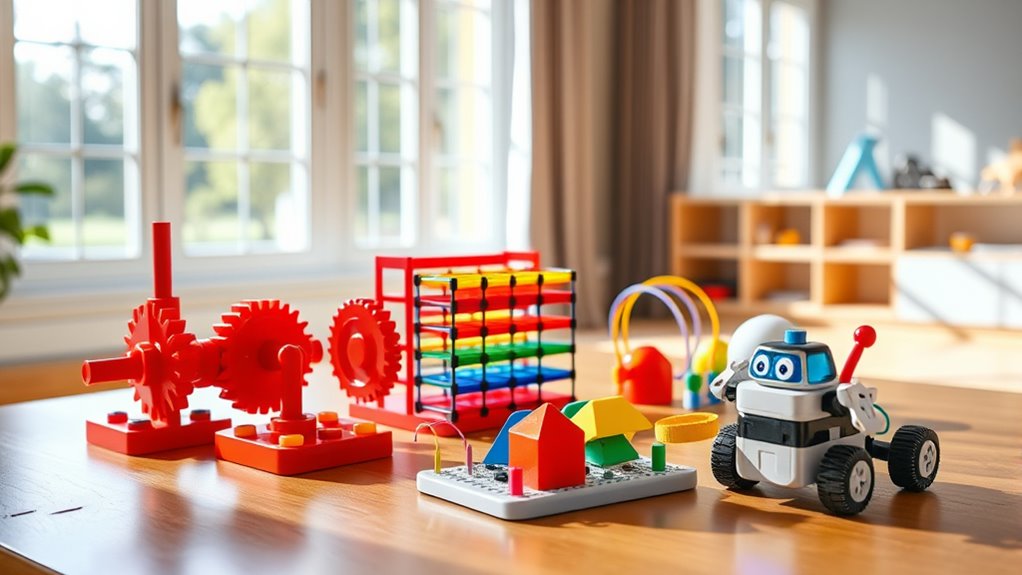

Choosing STEM toys for toddlers means weighing hands-on discovery against the kind of play your child can manage right now. I’d start with the PEBIRA Wooden Shape Sorting and Stacking Toy for early sorting practice, the Pairez Magnetic Building Blocks for open-ended construction, or the HABA Town Maze if you need a compact, quiet activity. Each takes a different route into problem-solving: matching shapes, joining blocks, or guiding a ball through a path.

Get hardware and tech essentials delivered free with Prime
- Fast, free delivery on millions of items
- Prime Video, Amazon Music and more included
- Member-only deals all year
The main tradeoff is between structured and open-ended play. A sorter gives toddlers a clear task, while magnetic cubes invite experimentation but offer fewer pieces for large builds. The ball-drop and car-ramp set brings movement and variety, though it takes more setup and space. I’ve ranked these picks by toddler fit, the learning opportunities their play naturally supports, and practical limits such as assembly, supervision, and age range—not by how many features a box can list.
Key Takeaways
- PEBIRA’s 20-piece wooden sorter is the most direct choice for toddlers learning to match shapes, colors, and peg holes.
- Pairez’s 12 large magnetic cubes suit younger builders who benefit from oversized pieces, but the set limits the scale of finished structures.
- HABA’s tethered magnetic wand and compact board make it the clearest pick for quiet play and travel rather than ambitious construction.
- The Stay Fun ball-drop and car-ramp toy offers the most variety in movement-based play, with the tradeoff of assembling several track parts.
- iPlay, iLearn’s rocket is the most appealing option for children around age three and up who enjoy building stories, but its battery-powered drill and narrower theme make it less flexible for younger toddlers.
| PEBIRA Montessori Wooden Shape Sorting and Stacking Toy |  | Best Overall for Early Sorting | Brand: PEBIRA | Material: Wood | Piece count: 20 | VIEW ON AMAZON | See Our Full Breakdown |
| Pairez Toys Large Magnetic Building Blocks, 12 Pieces |  | Best for Open-Ended Building | Brand: Pairez Toys | Model: PT3010 | Piece count: 12 blocks | VIEW ON AMAZON | See Our Full Breakdown |
| HABA Town Maze Magnetic Busy Board – Travel Toy for Toddlers Ages 2+ |  | Best Compact and Quiet Activity | Brand: HABA | Model number: 301056 | Recommended age: 24 months to 5 years | VIEW ON AMAZON | See Our Full Breakdown |
| 2-in-1 Ball Drop and Car Ramp Race Track Toy for Toddlers |  | Best for Movement and Cause-and-Effect Play | Brand: Stay Fun | Model: SF2503 | Recommended age: 12 months to 5 years | VIEW ON AMAZON | See Our Full Breakdown |
| iPlay, iLearn Rocket Space Building Toy with Electric Drill and 2 Astronauts |  | Best for Older Toddlers Who Love Space | Brand: iPlay, iLearn | Recommended age: 36 months to 8 years | Number of pieces: 4 | VIEW ON AMAZON | See Our Full Breakdown |
| stem toys for toddler | Brand | Recommended age |
|---|---|---|
| PEBIRA Montessori Wooden Shape | PEBIRA | 12 months to 6 years |
| Pairez Toys Large Magnetic Bui | Pairez Toys | 12 months to 3 years |
| HABA Town Maze Magnetic Busy B | HABA | 24 months to 5 years |
| 2-in-1 Ball Drop and Car Ramp | Stay Fun | 12 months to 5 years |
| iPlay | iPlay, iLearn | 36 months to 8 years |
More Details on Our Top Picks
PEBIRA Montessori Wooden Shape Sorting and Stacking Toy
This is my strongest all-around pick because its central activity is easy to understand and offers several ways to practice the same early reasoning skills. Children can sort five geometric shapes and five colors, then try placing pieces over the corresponding peg holes or stacking them. That makes the toy more purposeful than a simple stacker: a child can start by handling blocks and gradually pay attention to matching and order.
Compared with the Pairez magnetic cubes, PEBIRA offers a clearer sorting task and a more direct introduction to shape and color recognition. The Pairez set is better for free-form building, while this one gives a toddler an obvious puzzle to work through. It also avoids the multi-part assembly of the Stay Fun track set and is less specialized than HABA’s maze. The wood and water-based paint may appeal to buyers who prefer a non-plastic activity, though the material alone does not make it the best match for every child.
The tradeoff is the 20 separate pieces. Younger children may need an adult nearby, both to guide play and to keep track of blocks. The activity is also more structured than magnetic construction, so a child who wants to invent vehicles or buildings may lose interest sooner. I rank it first because its sorting, stacking, and matching tasks suit the broadest range of early toddler play among these five, not because it offers the most elaborate playset.
Pros:- Combines sorting, stacking, and shape matching in one activity
- Five colors and five geometric shapes give children several matching cues
- Wood construction and water-based paint
- Long, narrow footprint is easy to place on a table or floor
Cons:- Small pieces call for supervision, especially with younger toddlers
- Structured matching play may feel less open-ended than magnetic blocks
Best for: Toddlers beginning to sort, stack, and match shapes or colors, with an adult available to supervise the pieces.
Not ideal for: Children who prefer moving toys or open-ended building, or families who want a play activity with very few loose pieces.
- Brand:PEBIRA
- Material:Wood
- Piece count:20
- Colors:5
- Geometric shapes:5
- Recommended age:12 months to 6 years
- Dimensions:11.4 x 2.4 x 2.7 inches
- Paint:Water-based
Our verdict“I’d choose PEBIRA for the clearest all-around introduction to toddler sorting and shape recognition.”
Pairez Toys Large Magnetic Building Blocks, 12 Pieces
For a toddler who enjoys fitting pieces together without being assigned one right answer, Pairez’s large magnetic cubes are the most flexible pick here. The set includes 12 cubes measuring 1.65 inches each, with magnets sealed inside and rounded edges. Children can connect them into simple forms, take them apart, and try again—an accessible way to explore how pieces join and how a build changes when its shape changes.
Compared with PEBIRA, these blocks have fewer rules and more room for pretend play; the wooden sorter is better when a parent wants an obvious matching activity. They are also less involved to set up than the Stay Fun track, and their waterproof construction makes bath play another possible setting. Still, 12 cubes put a ceiling on the size and complexity of builds. The rocket has a more recognizable theme and includes astronauts, but Pairez is the more adaptable choice for children who like to invent their own scenes.
The stated age range is 12 months to 3 years, so this is specifically aimed at younger children rather than a set expected to grow through early school years. The size of each cube is a practical feature, but caregivers should still follow age guidance and supervise play. I place it just behind PEBIRA because construction play is appealingly flexible, yet the limited piece count and less defined learning task make it a less reliable fit for a child who benefits from a clear activity.
Pros:- Large 1.65-inch cubes are easier to handle than small construction pieces
- Sealed magnets connect blocks for simple builds
- Waterproof blocks can be used for bath play
- Open-ended format supports pretend play as well as construction
Cons:- Twelve blocks limit the scale of builds
- Open-ended play may need adult ideas to hold a child’s attention
Best for: Younger toddlers who enjoy joining and separating oversized blocks, sensory handling, and imaginative building.
Not ideal for: Families seeking a large construction set or a structured sorting puzzle with a clear matching goal.
- Brand:Pairez Toys
- Model:PT3010
- Piece count:12 blocks
- Block dimensions:1.65 x 1.65 x 1.65 inches
- Recommended age:12 months to 3 years
- Material feature:Waterproof blocks with sealed magnets
- Included:12 blocks and instruction manual
- Weight:0.32 kg
Our verdict“I’d pick Pairez when flexible, toddler-sized construction matters more than build size or a structured puzzle.”
HABA Town Maze Magnetic Busy Board – Travel Toy for Toddlers Ages 2+
HABA’s Town Maze is the most focused option in this group: a child moves a tethered, felt-tipped magnetic wand to guide metal balls through a town-themed board. The task asks for controlled hand movements and attention to a path, making it a useful alternative when a busy playroom or a pile of building pieces is not what you need. At 10 by 8.75 inches, it is also the clearest travel pick in the lineup.
Compared with PEBIRA’s shape sorter, the maze is less about categorizing and more about steering and staying with a task. It takes less floor or table space than the Stay Fun ball-and-car track, which needs multiple components assembled for its broader play. Unlike the Pairez blocks, it does not invite children to create their own structures; its appeal comes from completing the route. The tethered wand has a practical advantage on the go because it stays attached to the board rather than becoming a loose accessory.
The age range starts at 24 months, so it is not my pick for a one-year-old. Its focused format can also become too simple for children beyond the stated upper age of five, particularly if they want a changing challenge. The balls are metal, not magnetic; the wand guides them through the board, but the feel is different from attaching magnetic blocks. I rank it below the more varied choices because it does one job well rather than supporting several kinds of STEM play.
Pros:- Compact board suits car rides and quiet play
- Tethered wand is stored with the activity
- Guiding balls supports hand control, focus, and route-following
- Offers a contained alternative to toys with loose track or block components
Cons:- Recommended age begins at 24 months
- Single maze format may not hold older children’s interest
- The metal balls are guided by the wand rather than attaching to it
Best for: Families seeking a quiet, screen-free activity for a child aged two or older, especially for travel or waiting.
Not ideal for: Children under two, children who want open-ended construction, or older kids seeking increasingly complex puzzles.
- Brand:HABA
- Model number:301056
- Recommended age:24 months to 5 years
- Board dimensions:10 x 8.75 inches
- Included components:Puzzle board
- Wand:Tethered felt-tipped magnetic wand
- Play style:Magnetic-wand ball maze
- Warranty:30 days against manufacturer defects
Our verdict“I’d choose HABA when portability and calm, focused play matter more than open-ended variety.”
2-in-1 Ball Drop and Car Ramp Race Track Toy for Toddlers
This set earns its place for toddlers who want to see what happens when they release, roll, or launch something. A three-layer ball drop tower sits alongside a car ramp, with balls, cars, a launcher, and a hammer adding different actions to the same colorful play area. Rolling objects down a track gives children visible feedback: they can watch a ball or car travel, collect it, and repeat the sequence.
It offers more movement variety than the HABA Town Maze, whose single activity centers on guiding a ball through a path. It is also more active than the PEBIRA sorter, which is better for deliberate matching and stacking. That variety has a cost: this toy includes numerous track components and requires assembly, while the HABA board is ready to use as a contained activity. Compared with the Pairez blocks, it provides a more directed sequence of play but less freedom to create structures.
The maker lists an age range of 12 months to 5 years and describes smooth plastic with rounded edges, along with stated US ASTM/CPSIA compliance. Those claims do not remove the need to supervise a young child or follow the instructions. The many pieces and assembly can make setup less convenient, and the overall play takes more room than a compact busy board. I rank it below the sorter and blocks because it is a lively, feature-rich option but less convenient for families seeking a small, simple activity.
Pros:- Combines ball-drop and car-ramp play in one set
- Includes balls, cars, a hammer, and a car launcher for varied actions
- Rolling play makes cause and effect visible
- Smooth plastic and rounded edges are described for toddler use
Cons:- Requires assembly of multiple track components
- Takes more setup and space than a compact maze or sorter
- Several components can make it less convenient to pack away
Best for: Toddlers who are drawn to rolling, dropping, and repeating actions, and caregivers comfortable assembling a multi-part toy.
Not ideal for: Families with little play space, shoppers wanting a compact travel activity, or toddlers who need a very simple setup.
- Brand:Stay Fun
- Model:SF2503
- Recommended age:12 months to 5 years
- Material:Plastic
- Track pieces:4 straight tracks and 5 turning tracks
- Vehicles and balls:3 racing cars and 3 balls
- Other components:Hammer, base, middle board, ball drop device, car launcher, display board, collection device, sticker, and manual
- Stated safety standards:US ASTM/CPSIA
Our verdict“I’d choose the Stay Fun set for movement-rich cause-and-effect play, provided assembly and space are manageable.”
iPlay, iLearn Rocket Space Building Toy with Electric Drill and 2 Astronauts
This rocket is the most theme-driven selection and the one I’d reserve for a child who is ready for building play with a pretend mission attached. The set includes detachable rocket parts, two astronauts, and a battery-powered electric drill, plus interactive lights and sound effects. Taking the rocket apart and putting it together can introduce simple construction ideas, while the figures help turn assembly into a space story rather than a stand-alone task.
Its 36-month minimum age sets it apart from the three picks listed for children starting at 12 months and from HABA’s two-and-up maze. For an older toddler, the drill and themed parts may offer a more engaging build than the PEBIRA sorter. But the sorter works across more basic skills and does not depend on a particular pretend-play interest. Pairez is more open-ended, while this rocket gives children a specific object and story to build around. That can be a strength for a space fan and a limitation for a child who prefers changing activities.
There are only four main pieces listed, so this is not a complex construction kit. The electric drill needs batteries, and some assembly is required; the interactive sounds and lights add stimulation rather than more building depth. Its recommended range extends to age eight, but toddler buyers should focus on whether a three-year-old is ready for the parts and can follow the play instructions. I place it last for this toddler-focused roundup because it has the narrowest age fit and theme, even though it may be the most appealing pick for an older toddler who loves rockets.
Pros:- Detachable rocket parts introduce simple building play
- Two astronaut figures support imaginative storytelling
- Lights and sound effects add interactive elements
- A space theme can give older toddlers a clear play prompt
Cons:- Recommended age starts at 36 months
- Electric drill requires batteries
- Four listed pieces offer less construction variety than a larger building set
Best for: Children aged three and up who enjoy space themes, pretend missions, and simple hands-on assembly.
Not ideal for: Toddlers under three, families avoiding battery-powered toys, or children who prefer non-themed and open-ended building.
- Brand:iPlay, iLearn
- Recommended age:36 months to 8 years
- Number of pieces:4
- Included components:Battery-powered electric drill, cockpit, instrument cabin, turbine engine, tail engine, and 2 astronauts
- Interactive features:Lights and sound effects
- Dimensions:7.48 x 7.09 x 14.57 inches
- Weight:1.3 kg
- Theme:Rocket and space
Our verdict“I’d choose this rocket for a space-loving child aged three or older, not as a general first STEM toy for toddlers.”

How We Picked
I ranked these toys around what makes an activity a good fit for toddlers: a clear way to use it, manageable pieces and actions, and a learning opportunity that emerges through play instead of relying on adult explanation. The title covers a wide age span, so I paid close attention to the stated minimum ages. A toy listed for 12 months is not automatically right for every one-year-old; supervision and the child’s ability to handle its pieces still matter.
I also compared the type of thinking each toy invites. The wooden sorter asks children to classify and match. Magnetic blocks encourage trial-and-error building. HABA’s maze focuses on controlled movement and focus, while the track set adds cause-and-effect play through rolling and racing. The rocket adds assembly and pretend-play context, but its intended age begins at 36 months, which makes it a less direct fit for the youngest toddlers than the other picks.
Practical differences shaped the order too. I considered whether a toy is portable, how much setup it calls for, whether it has a defined endpoint or open play, and what its stated components suggest about play variety. I have not treated product claims about safety or learning as a substitute for adult judgment. For any toy used by a young child, follow its age guidance, check the parts, and supervise play where needed. The ranking favors broad usefulness for toddler-age play, not a claim that one toy suits every family.
| stem toys for toddler | Brand |
|---|---|
| PEBIRA Montessori Wooden Shape | PEBIRA |
| Pairez Toys Large Magnetic Bui | Pairez Toys |
| HABA Town Maze Magnetic Busy B | HABA |
| 2-in-1 Ball Drop and Car Ramp | Stay Fun |
| iPlay | iPlay, iLearn |
Factors to Consider When Choosing Stem Toys For Toddlers
I’d choose by the kind of play your toddler returns to, then check the stated age and practical demands. A toy can introduce useful ideas without looking like a lesson; for this group, the best fit depends on whether your child enjoys sorting, building, guiding, or watching objects move.
Match the toy to your toddler’s current play
If your child likes putting objects in the right place, start with PEBIRA’s sorter. For a child who would rather connect pieces and invent a result, consider Pairez’s magnetic blocks. The HABA maze asks for careful movement through a route, while the Stay Fun set rewards releasing and watching balls or cars travel. These play styles are not interchangeable: a child who wants active movement may not stick with a quiet maze, and a child who likes clear tasks may need help finding a starting idea with open-ended blocks.
Use the age guidance as a starting point
PEBIRA, Pairez, and the Stay Fun track list an age starting at 12 months; HABA starts at 24 months, and the rocket starts at 36 months. Those labels help narrow the field, but they do not replace checking how your child handles parts and follows play. The sorter notes that its smaller pieces may need supervision for young children. Keep a close eye on any activity with separate parts, and follow the maker’s instructions and age guidance.
Think about setup, storage, and where play happens
For travel or a waiting room, HABA has the clearest advantage: its board is compact and the wand is tethered. The sorter and magnetic cubes need space for pieces, but they avoid the track set’s multi-component assembly. The Stay Fun toy offers more movement-based variety once assembled, though it needs room to lay out. The rocket is a more contained themed build, but its drill needs batteries. A toy that is easy to set up and put away may get more regular use than one with a longer preparation step.
Decide how much direction your child wants
Structured tasks give a young child an immediate prompt. PEBIRA asks for matching and stacking; HABA supplies a route to follow. Open-ended blocks leave the result to the child, which can support experimentation but may call for an adult to suggest a first build. The rocket occupies the middle ground: the parts have a defined purpose, while its astronauts invite pretend play. The track set also has a clear cause-and-effect loop, but assembling its components is part of the adult-facing workload.
Choose the kind of STEM play you want to encourage
For early classification and hand-eye coordination, I’d lean toward the sorter. For experimenting with connection and simple structures, Pairez is a better match. HABA’s maze puts the focus on guiding movement and concentrating on a path. The ball-drop and ramp set makes motion and cause and effect visible, while the rocket pairs basic building with a space story. None covers every type of early STEM play, so I’d choose the activity your child is most likely to repeat.
Frequently Asked Questions
What makes a toy a STEM toy for a toddler?
I look for play that invites a child to explore a simple idea through action: matching shapes, testing how pieces connect, guiding an object, or seeing how a ball moves along a track. A toddler does not need formal instruction for that kind of discovery. The useful question is whether the play gives your child a manageable chance to try something, notice what happens, and repeat or change the action.
Which of these picks is best for a one-year-old?
Three products list a starting age of 12 months: PEBIRA’s wooden sorter, Pairez’s magnetic cubes, and the Stay Fun ball-and-car track. I’d compare their handling demands and supervise play rather than choosing by age label alone. PEBIRA has separate pieces, Pairez has 12 cubes, and the track toy has multiple parts and needs assembly. A caregiver should follow each product’s guidance and decide whether the child is ready for its components.
Which option is easiest to take on a trip?
The HABA Town Maze is the most travel-oriented choice in this lineup. Its board measures 10 by 8.75 inches, and its wand is tethered to the board, reducing the number of loose accessories to manage. The sorter and blocks are also less involved than an assembled track, but their pieces can be misplaced. I’d pick HABA for a contained quiet activity, while remembering that its recommended age begins at two years.
Should I choose a structured puzzle or open-ended building toy?
Choose a structured activity if your toddler likes clear prompts and matching goals. PEBIRA offers sorting and stacking, while HABA gives the child a maze route to follow. Choose Pairez if your child enjoys experimenting without one expected result. The rocket has a defined build and a pretend-play theme, and the track set offers repeatable movement play. The best choice depends less on a general preference for puzzles or building and more on what your child already enjoys doing.
Are these toys suitable for children older than toddler age?
The listed age ranges differ. PEBIRA runs to age six, HABA to five, the Stay Fun track to five, and the rocket to eight; Pairez is listed for ages one to three. A wider age range does not mean a toy will stay equally engaging for every child. The maze may feel simple to an older child, while the rocket’s theme may suit a child who continues to enjoy space play. I’d judge by the child’s interest and the maker’s age guidance.
Conclusion
For one dependable first pick, I’d choose PEBIRA: it combines shape and color sorting with stacking in a clear, toddler-friendly activity, though its loose pieces need supervision. Choose Pairez if your child likes making and remaking simple builds; its cubes are larger and waterproof, but 12 pieces limit the structures. For families who need quiet play on the go, HABA is the compact choice, especially for children aged two and up.
If your toddler wants action and repetition, the Stay Fun ball-drop and ramp brings the most movement, with assembly and space as the tradeoffs. I’d reserve the iPlay, iLearn rocket for a space-loving child aged three or older who enjoys a themed build and does not mind batteries. In short: choose by play style first, then check age guidance, supervision needs, and how much setup your household can comfortably manage.