
📊 Full opportunity report: Appointment no-show recovery planner for therapy practices on IdeaNavigator AI — validation score, market gap, and execution plan.

Get hardware and tech essentials delivered free — and shop member deals
- Fast, free delivery on millions of items
- Access to Prime Big Deal Days deals on October 6–7
- Prime Video, Amazon Music and more included
TL;DR
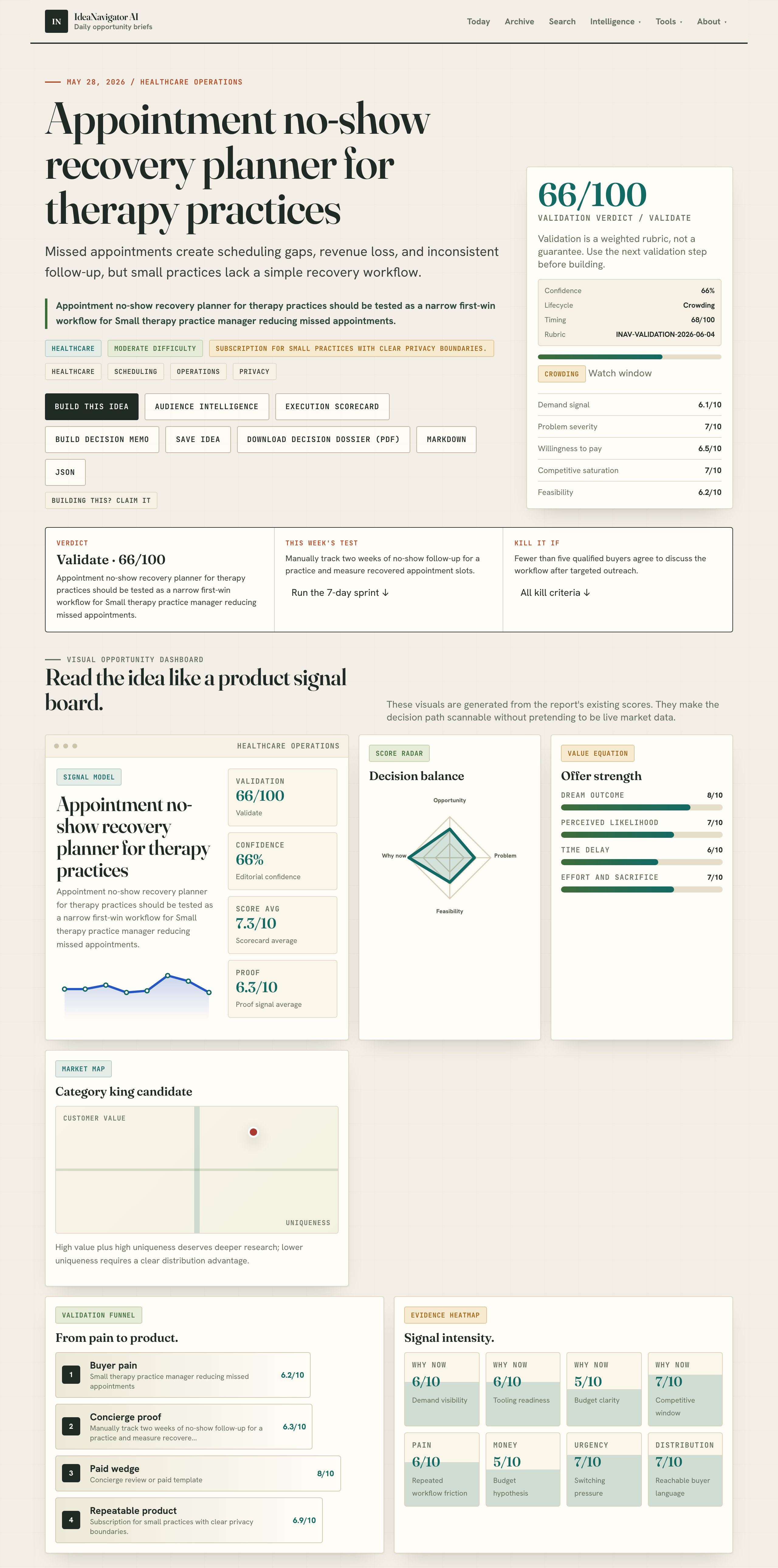
A new workflow tool for small therapy practices aims to reduce missed appointments by tracking no-shows and automating follow-up. Testing is starting with a focus on operational improvements, not clinical claims.
A new appointment no-show recovery planner for small therapy practices is being tested as a workflow tool to log missed visits, automate reminders, and facilitate rescheduling, aiming to reduce revenue loss and scheduling gaps.
The initiative targets small therapy practices that typically lack simple, operational tools to manage missed appointments effectively. The planner is a non-clinical system that tracks missed visits, reminder attempts, reschedule status, and outreach templates. It is designed to be implemented quickly and validated through manual tracking over a two-week period, measuring how many appointment slots can be recovered.
According to sources familiar with the project, this tool will operate within existing practice management systems without making clinical claims, focusing solely on operational efficiency. The revenue model involves a subscription service tailored to small practices, with privacy boundaries clearly defined to protect sensitive patient data.
Potential Impact on Small Therapy Practice Operations
If successful, this no-show recovery planner could improve scheduling efficiency and revenue for small therapy practices. By automating follow-up workflows and reducing manual outreach, practices may recover more appointment slots and potentially improve patient engagement. The initiative addresses operational challenges related to missed appointments in mental health care delivery, where revenue loss and care disruptions are common concerns.
therapy appointment no-show recovery software
As an affiliate, we earn on qualifying purchases.
As an affiliate, we earn on qualifying purchases.
Lack of Simple No-Show Management Tools in Small Practices
Small therapy practices often face challenges in managing no-shows due to limited operational tools. Many rely on manual follow-up, which can be inconsistent and time-consuming. The development of a straightforward, non-clinical workflow to log missed visits and automate outreach is being explored as a potential solution. This initiative aligns with broader healthcare operational trends aimed at improving efficiency while maintaining clinical boundaries.
“This workflow aims to provide small practices with a simple, effective way to reduce missed appointments without adding clinical complexity.”
— an anonymous researcher
practice management system appointment reminders
As an affiliate, we earn on qualifying purchases.
As an affiliate, we earn on qualifying purchases.
Uncertain Outcomes and Validation Timeline
The effectiveness of the no-show recovery planner remains to be seen, as validation is still in early stages. The two-week manual tracking period will generate initial data, but broader adoption and long-term impacts are yet to be determined. The integration process with existing systems and workflows is also still under development.
automated appointment rescheduling tool for therapists
As an affiliate, we earn on qualifying purchases.
As an affiliate, we earn on qualifying purchases.
Next Steps for Testing and Broader Adoption
After the initial testing phase, data will be analyzed to evaluate the number of appointment slots recovered. If results are positive, developers plan to refine the workflow and consider wider deployment. Further validation and user feedback will inform potential improvements, with the aim of creating a scalable solution for small therapy practices.
small practice scheduling automation
As an affiliate, we earn on qualifying purchases.
As an affiliate, we earn on qualifying purchases.
Key Questions
How will the no-show recovery planner integrate with existing practice management systems?
The current plan is for the tool to operate as a standalone system or integrate via simple APIs, but specific integration methods are still being developed.
Will this system include automated reminders or outreach messages?
Yes, the planner will include outreach templates and automated reminder attempts to facilitate follow-up with patients who miss appointments.
Is this tool intended to replace existing scheduling software?
No, it is designed as a supplementary workflow to enhance follow-up processes without replacing core scheduling systems.
What privacy measures will be in place for patient data?
The subscription model emphasizes clear privacy boundaries, with data handling aligned with healthcare privacy standards, but specific measures are still being finalized.
When will broader availability of this recovery planner be announced?
Following successful validation and refinement, developers plan to release the tool to a wider audience, but a specific timeline has not yet been announced.
Source: IdeaNavigator AI
Halloween Picks
halloween
As an affiliate, we earn on qualifying purchases.