
📊 Full opportunity report: IEP Negotiation Simulator Tips Every Parent Should Know on IdeaNavigator AI — validation score, market gap, and execution plan.

Get hardware and tech essentials delivered free — and shop member deals
- Fast, free delivery on millions of items
- Access to Prime Big Deal Days deals on October 6–7
- Prime Video, Amazon Music and more included
TL;DR
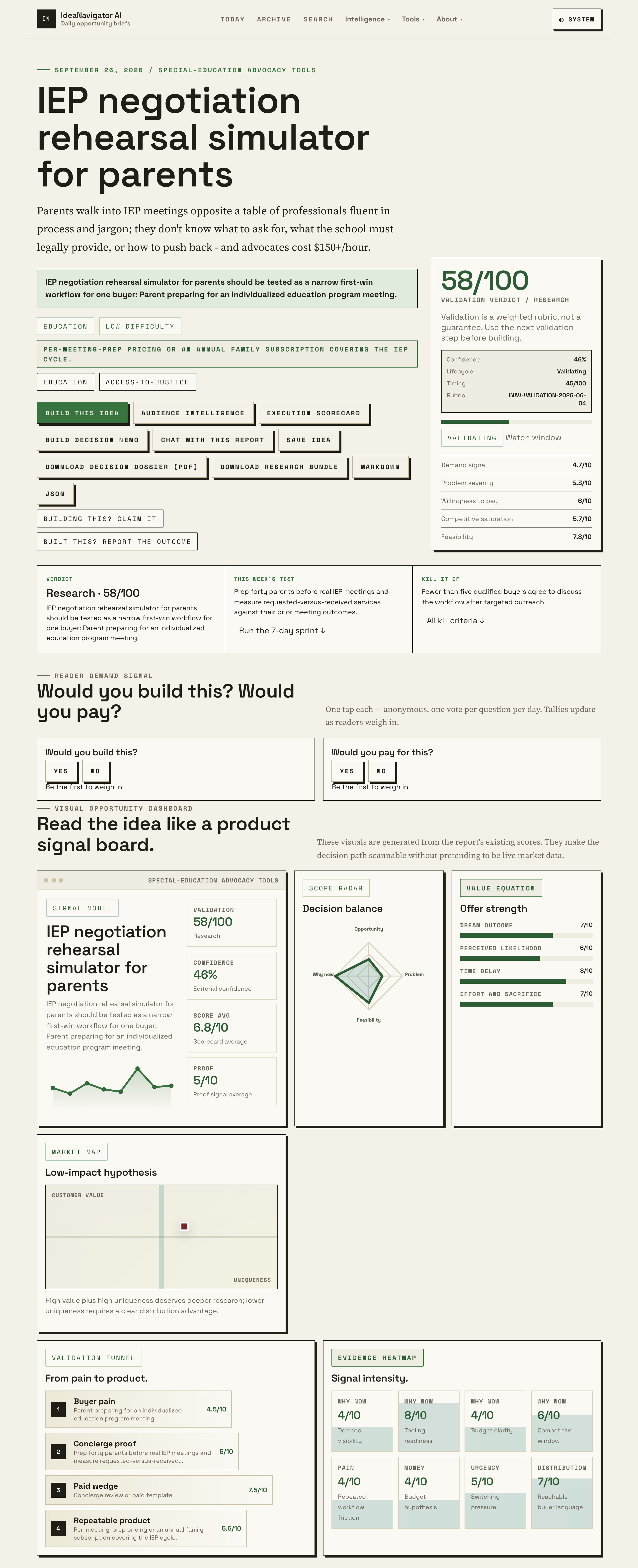
IdeaNavigator AI has outlined a proposed simulator to help parents prepare for individualized education program meetings by reviewing documents, explaining terms and rehearsing conversations. The concept has not been reported as a launched or tested product, and its effect on meeting outcomes remains unknown.
IdeaNavigator AI has outlined a proposed IEP meeting rehearsal simulator for parents preparing for individualized education program meetings, a planning document that sets out special education services for eligible students. The concept would review a family’s existing IEP and evaluation reports, explain information in plain language and let parents practice responding to simulated school staff; no launch, trial results or measured effect on services are reported.
The proposed first version is aimed at one user: a parent preparing for an IEP meeting. Families would upload a current IEP and evaluation reports. The tool would then explain the documents and relevant entitlements in accessible language, generate a list of possible requests with legal grounding, and simulate a meeting with realistic pushback.
The stated purpose is to help parents prepare to present their positions during a meeting. The proposal describes families as facing professionals familiar with the process and terminology, while paid advocates can cost $150 or more per hour. That price is presented as part of the product rationale; no independent pricing survey or comparison is provided.
Possible revenue models include charging per meeting preparation or offering an annual family subscription covering the IEP cycle. To test demand and outcomes, the proposal recommends preparing 40 parents before real meetings and comparing requested and received services with those families’ prior meeting outcomes. It does not provide results from such a study.
A Practice Tool for IEP Meetings
If developed and shown to work, the simulator could give parents a way to rehearse a school meeting before it takes place. Document explanations and practice conversations could help families identify questions and communicate their requests, including families without access to a paid advocate.
That potential is not evidence of improved educational services. The proposed test would compare services requested with services received and prior meeting outcomes, but the proposal gives no method for accounting for differences among students, schools or meeting circumstances. Until a product is tested, its practical value and any effect on outcomes remain unestablished.
The Proposed Preparation Workflow
The idea is framed as a narrow initial use case rather than a general special education platform: prepare a parent for one upcoming IEP meeting. Its sequence combines document review, plain-language explanations, a request list and role-play. The simulator would include school-side objections or pushback so parents could practice answering them.
IdeaNavigator AI says the opportunity is timely because language models can now support realistic role-play and because special education identification rates are rising while district resources are tightening. Those points are part of the proposal’s rationale; it supplies no data series, date range or independent evidence to establish the trends or connect them to more adversarial meetings.
Testing and Legal Accuracy Remain Open
The proposal does not say whether a working simulator exists, when it might become available, who would operate it, or how much it would cost. It also provides no evidence that simulated school responses would reflect actual meeting practice or that the tool would affect the services students receive.
Its proposed legal grounding raises further unanswered questions: the material does not specify how the simulator would account for differences in applicable law, jurisdiction or a student’s individual circumstances, or how legal explanations would be reviewed and updated. The suggested 40-parent exercise has no reported participants or results, and its comparison with past outcomes could not by itself show that the simulator caused any change.
A Forty-Parent Pilot Is Proposed
The next step described is a pilot preparing 40 parents for upcoming IEP meetings, followed by a comparison of requested and received services with each family’s prior meeting outcomes. No timeline, recruitment plan, measurement details or pilot results are provided. Until those details or a product release are reported, the simulator remains a proposed tool rather than a demonstrated service.
Source: IdeaNavigator AI
Key Questions
Is the IEP simulator available now?
The proposal does not say that a product has launched or provide availability details.
What would the proposed simulator do?
It would review a parent’s current IEP and evaluation reports, explain them in plain language, suggest meeting requests with legal grounding and provide role-play practice.
Has it been shown to improve services?
No outcome data are provided. A comparison involving 40 parents is proposed as a way to test the idea.
How would the service charge families?
The suggested options are a fee for each meeting preparation or an annual subscription covering the IEP cycle. No prices are specified.
Source: IdeaNavigator AI
Fall Picks
fall essentials
As an affiliate, we earn on qualifying purchases.