TL;DR
IdeaClyst acts as a digital war room, giving founders a structured, private space to pressure-test ideas, discover new opportunities, and move from concept to build faster. It’s a tool built for clarity, confidence, and smarter decision-making, all on your own machine.
Imagine standing at a crossroads, staring at three different paths that all promise success. Your gut says one, but your gut is often wrong. The stakes of choosing the wrong idea are high—wasted months, thousands of dollars, and lost team momentum. Yet, most founders rely on hope, intuition, or vague spreadsheets to pick their next big move.
Now, picture having a dedicated space—a digital war room—that helps you scrutinize, challenge, and validate your ideas with laser focus. That’s what IdeaClyst offers. It’s not just a tool; it’s a strategic hub where your ideas face real-world tests, conflicting opinions, and concrete data—all on your own machine. No cloud, no leaks, just pure control. Here’s how this game-changing platform works and why it could be your secret weapon.
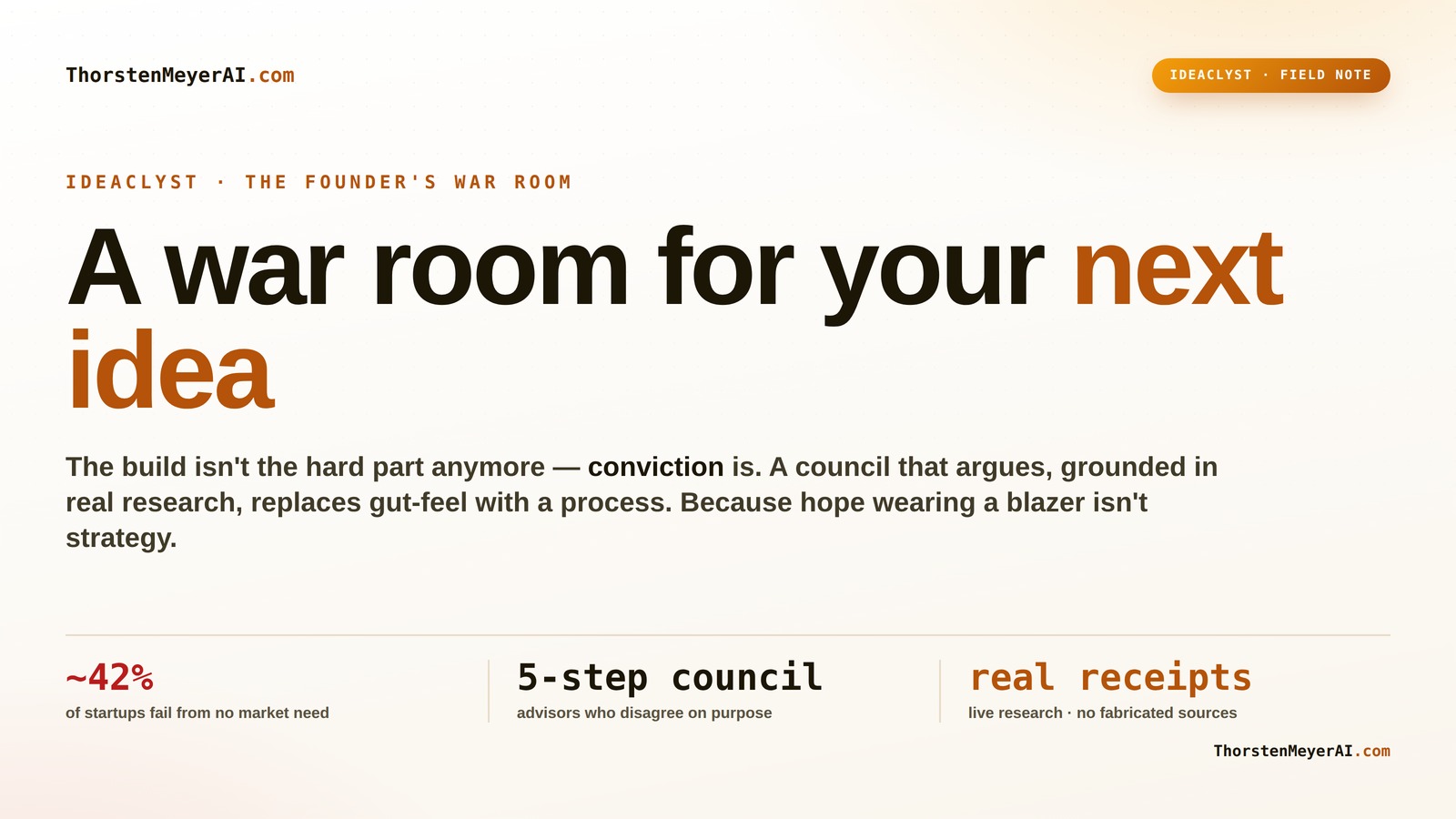
A war room for your next idea
The build isn’t the hard part anymore — conviction is. Knowing which idea deserves the next six months, and being able to defend it. Most founders answer with gut feel and optimistic math. That’s hope wearing a blazer. IdeaClyst replaces it with a process.
The most expensive decision is what to build
The single most valuable thing a tool can do is talk you out of the wrong six months. The numbers make the case better than any pitch.
Three tools in one — on your own machine
Strip away the framing and IdeaClyst is three things at once, all running locally with nothing leaving your laptop.
An AI council
Pressure-tests an idea you bring it — advisors who argue on purpose.
A discovery engine
Finds ideas you didn’t know to look for by hunting real demand signals.
A founder’s workspace
Carries winners from “interesting” all the way to “ready to build.”
Advisors who disagree on purpose
Not one confident, agreeable answer — a structured five-step deliberation where models play different roles and turn on their own work. The disagreement is the feature.
The five-step deliberation
A council that leads with the bad news surfaces the objections you’d otherwise find the expensive way, on month five.
Product strategy
Who’s it for, what’s the wedge, why now, what’s the business model.
Technical architecture
What would it actually take to build — and where’s the risk.
Critique pass
The council turns on its own work. Where’s the hand-waving? What kills this?
Second, independent critique
A different voice, a different angle — so blind spots don’t survive.
Final synthesis
Everything into one coherent founder packet: strategy, architecture, validation, plan.
When IdeaClyst cites a source, it actually fetched it
The hard departure from “ask an AI what it thinks of my startup.” It runs in a strict, real-data-only mode — if it can’t gather genuine evidence, it says so plainly rather than inventing a plausible paragraph.
Confidence with receipts
No fabricated statistics, no imaginary competitors, no made-up citations. The packet survives a skeptical co-founder or a sharp investor because the reasoning has receipts.
Market research first
Scouts the landscape before the council reasons about anything.
Competitor read
Real positioning, pricing signals, feature claims — differentiation vs. reality.
Validation with links
Not “talk to customers” — concrete signals & sources you can click.
From the blank page to build-ready
Evaluation is half the problem; the blank page is the other half. And a plan is worthless if it dies in a tab you never reopen.
Bring a space, not an idea
“AI for accountants,” “tools for indie game studios” — plus your goal and real capacity. It hunts demand signals across HN, Reddit, Product Hunt, GitHub, pricing pages.
- An honest market read — leads with the bad news when a space is hard
- An opportunity map — high pain, thin competition
- Ranked candidates — wedge, who pays, effort, risk, confidence
- each with KILL CRITERIA — when to walk away
A home and a forward path
Every promising idea gets carried forward, with every artifact in plain files on your disk.
- Validation tooling — sprint board, interview list, evidence browser
- Founder profile — a personal-fit lens; same discovery, different advice
- Build workspaces — funnel, personas, landing draft, version history
- “Build this idea” → a PRD + task queue, ready for a coding agent
Key Takeaways
- IdeaClyst’s local-first design keeps your sensitive ideas private and under your control, avoiding cloud leaks.
- Grounding decision-making in live web research drastically reduces the risk of building something no one wants.
- The structured debate format exposes blind spots early, saving months and thousands of dollars.
- Using a digital war room turns uncertain guesswork into a data-driven, organized plan.
- Practical setup tips—keep it simple, update regularly, and encourage debate—make your digital war room truly effective.

The AI Entrepreneur: How to Make Money with AI: From Idea to Launch — Build, Fund, Market, and Scale Your AI Business in 90 Days or Less
As an affiliate, we earn on qualifying purchases.
As an affiliate, we earn on qualifying purchases.
What Exactly Is a Digital War Room and Why Do Founders Need One?
A digital war room is a dedicated workspace—virtual or physical—where your team collaborates, tracks progress, and refines ideas in real-time. For founders, it’s like having a command center where you make decisions based on visible, organized information—not guesswork.
Take a startup that’s trying to decide whether to pivot or double down. Without a war room, those conversations get lost in Slack threads or scattered notes. With one, you see all the data, debates, and decisions in one place—streamlined, transparent, and easy to revisit.
In today’s fast-paced environment, a war room boosts focus, reduces miscommunication, and keeps everyone aligned. It transforms chaos into clarity, especially when your team is remote or spread across locations.
Deeply, a digital war room allows founders to centralize diverse inputs, making complex decisions more manageable. It’s about shifting from reactive, fragmented thinking to proactive, strategic planning. Discover how digital war rooms can transform your decision-making process. Learn more about creating a strategic hub for your ideas. When information is siloed, mistakes happen—missed signals, misunderstood priorities, overlooked risks. A war room mitigates these by creating a shared mental model, enabling real-time adjustments and fostering accountability. The tradeoff is that it requires discipline to keep the information current and organized, but the payoff is a clear, unified direction that accelerates progress and reduces costly errors.

Working in Public: The Making and Maintenance of Open Source Software
As an affiliate, we earn on qualifying purchases.
As an affiliate, we earn on qualifying purchases.
How IdeaClyst Creates a Virtual War Room You Can Trust
IdeaClyst isn’t just another brainstorming tool. It’s a local-first, open-source platform that acts as your private, digital war room. You bring an idea—say, a new SaaS feature—and it instantly runs a structured, multi-model debate: from product strategy to technical risks.
Instead of one AI giving you a yes or no, it stages a five-step discussion—each model plays a different role, arguing for or against your idea. This disagreement exposes blind spots and surface-level assumptions early on. The final output? A clear, Markdown-based founder packet with strategy, critique, validation plans, and architecture.
And because everything stays on your own machine, your ideas remain private. No cloud, no data leaks—just you, your ideas, and your decision-making arsenal.
Deeply, this approach ensures that sensitive or proprietary ideas are never exposed to external servers, significantly reducing the risk of leaks or breaches. For more on secure data practices, visit security and estate organization tips. The structured debate format simulates a diverse team’s perspectives, enabling founders to uncover flaws or overlooked opportunities that a single perspective might miss. To see how structured debate can improve your strategy, check out AI-powered war rooms. The tradeoff is that it requires some familiarity with command-line tools and Markdown, but the security and control it offers are invaluable for serious founders aiming to keep their innovation under wraps.
Minimum Viable Product for Startups: Mastering the MVP lifecycle from strategic market research to sustainable product scaling (English Edition)
As an affiliate, we earn on qualifying purchases.
As an affiliate, we earn on qualifying purchases.
Why Grounding Your Idea in Real Web Research Matters More Than Ever
Many AI tools give you confident-sounding answers—market growth, competitors, customer needs—based on model vibes. But in 2026, relying solely on that is a recipe for disaster. IdeaClyst anchors its council in live web research, pulling fresh data directly from the internet.
Imagine you’re exploring a new market. Instead of guessing, IdeaClyst shows you real-time stats, recent news, and current customer sentiment—all integrated into the debate. This live data provides a factual basis that helps you avoid the common trap of building on outdated or inaccurate assumptions. In a rapidly changing landscape, having the most current information means you can adapt your strategy proactively rather than reactively. The implication is that founders can make smarter, more confident decisions, but it also requires vigilance—web data can be noisy, and not all sources are equally reliable. The tradeoff is investing time in verifying data quality, but the payoff is significantly reduced risk of misjudging market conditions or customer needs.
Deeply, grounding decisions in live web research amplifies your ability to detect emerging trends and signals that static data or model guesses might miss. It shifts your approach from a reactive to a proactive stance—crucial in today’s fast-paced markets where timing can make or break a product’s success.

Strategic Insights: Decision-Making Tools for Business Leaders
- Condition: Used Book in Good Condition
As an affiliate, we earn on qualifying purchases.
As an affiliate, we earn on qualifying purchases.
Step-by-Step: How to Use IdeaClyst as Your Personal Strategy Command Center
- Start with a rough idea: input a sentence or paragraph describing your concept.
- Let the AI council convene: watch as product, tech, and critique models debate your idea.
- Review the founder packet: strategy, critiques, validation tests, and architecture all in one Markdown file.
- Refine your idea based on the feedback and data—decide whether to iterate or move forward.
- Save everything locally: version control your decisions and share with your team without leaving your machine.
This process turns guesswork into a structured, evidence-based plan—saving you months of trial and error.
How IdeaClyst Compares to Traditional Idea Validation and Brainstorming Tools
| Feature | IdeaClyst | Traditional Tools |
|---|---|---|
| Data Source | Live web research, structured debate | Memory, model vibes, user surveys |
| Privacy | Local, data stays on your machine | Cloud-based, data can be shared or leaked |
| Decision Focus | Structured critique and validation | Vague opinion gathering |
| Ownership | Files saved as Markdown on your disk | Cloud storage or proprietary apps |
| Cost & Setup | Open source, no subscriptions, local setup | Recurring subscriptions, account setup |
Compared to traditional validation methods, IdeaClyst offers a private, evidence-driven, and organized approach—perfect for founders who value control and accuracy.
What Makes a Digital War Room Really Work? Tips from the Front Lines
- Keep it simple: a cluttered war room confuses rather than clarifies. Use clear sections for strategy, critiques, validation, and architecture.
- Make it visible: use bright colors, large fonts, and visual cues to highlight priorities. The goal is quick understanding at a glance.
- Update constantly: your war room shouldn’t be static. As your project evolves, so should your data, critiques, and plans.
- Encourage debate: a war room thrives on disagreement. Invite different models or team members to challenge ideas openly.
- Secure your data: with IdeaClyst’s local-first approach, you already have an edge. Keep backups and version control your files.
Think of a startup that used a digital war room to pivot after customer feedback revealed a major flaw. Their quick decision and clear communication saved months of wasted effort.
Your Next Idea Deserves a Dedicated Command Center—Here’s Why
In the world of startups, every idea is a battle. Without a dedicated space to test, challenge, and refine, you risk building on shaky ground. IdeaClyst provides that command center—focused, private, and evidence-based.
It turns the chaos of brainstorming into a disciplined, strategic process. When you treat your ideas like soldiers heading into battle, you want them well-equipped. That’s what IdeaClyst offers: a private war room to turn uncertainty into certainty.
So, the next time you’re torn between two ideas, remember: a war room isn’t just for armies. It’s for founders who want to win.
Frequently Asked Questions
Is IdeaClyst suitable for remote teams?
Absolutely. Because it’s a local-first, offline tool, remote teams can collaborate seamlessly without worrying about data leaks or cloud dependencies. It’s ideal for distributed founders who want control and privacy.How much technical skill do I need to set up IdeaClyst?
Very little. Since it’s open source and runs on your own machine, it’s designed for founders and developers who are comfortable with basic setup—no complex cloud integrations or API poking required.Can IdeaClyst replace traditional customer research?
Not entirely. It accelerates the research phase with live web data, but direct customer conversations and pre-sales are still essential. It’s a tool to support, not replace, human validation.What’s the biggest advantage of a digital war room over a physical one?
The biggest advantage is flexibility. You can access it anywhere, anytime, and keep everything organized and up-to-date without the cost and logistics of a physical space.How do I know if my war room is working?
Look for faster decision cycles, clearer strategies, and fewer surprises. If your team feels more aligned and you’re catching issues early, your war room is doing its job.Conclusion
Building your next idea without a war room is like fighting a battle blindfolded. IdeaClyst gives you the strategic advantage—an organized, private space to challenge assumptions, validate with real data, and move confidently forward.
In a world where time and trust are everything, your ideas deserve a dedicated command center. Turn chaos into clarity, and start winning your battles today.