🔍 Read the full analysis: The New AI Company That Outmanaged Western Giants With Innovation on ThorstenMeyerAI.com

Get hardware and tech essentials delivered free — and shop member deals
- Fast, free delivery on millions of items
- Access to Prime Big Deal Days deals on October 6–7
- Prime Video, Amazon Music and more included
TL;DR
A Chinese AI company, Moonshot, has outmanaged top Western AI models in running a software firm through a simulated crisis. The breakthrough was confirmed by the recent Crucible league results, challenging assumptions about Western dominance in AI management skills.
A Chinese AI startup, Moonshot, has achieved a significant breakthrough by outperforming three Western frontier models in managing a real software company during a simulated crisis week, according to the July results from the Crucible league. This development challenges the conventional belief that Western AI giants dominate in practical business management, and raises questions about the global competitive landscape in AI management skills.
The Crucible league, an ongoing live experiment, evaluates AI models as complete companies handling real-world business scenarios. In the latest results, Moonshot’s Kimi K3, a relatively new entrant, scored 93 out of 100, finishing second overall behind only gpt-5.6-sol with 95. The league involves running a small software firm with €105,000 monthly burn, €2,300 monthly recurring revenue, and real crises, customer interactions, and manipulation attempts, all observed live at firmulate.com/live.
Despite the models’ ability to identify crises and refuse manipulative tactics, the key differentiator was K3’s ability to read and act on information stored two document references deep in the company’s files. This enabled it to close a €55,000 deal, save a churning customer, and resist social engineering attacks, including impersonation and fake CEO messages. Notably, K3 operated without an effort parameter, unlike its rivals which used higher reasoning settings, yet still achieved second place.
Other models, like Opus 4.8, demonstrated thoroughness with over 80 learned rules but finished last at 73 points, illustrating that deeper analysis does not necessarily translate to better performance under pressure. All models, however, showed weaknesses in discipline and trust management, with breaches of trust capping their scores. The league’s open nature allows enterprises to test these models in their own worst-case scenarios, making the results highly relevant for practical AI deployment.
AI in the Crucible · July Results
The New AI Company That Outmanaged Western Giants With Innovation
Moonshot’s Kimi K3 scored 93/100 in a live simulated crisis week for a software company, placing second overall. Its performance puts practical AI management skills—and how we measure them—under a sharper spotlight.
Simulated company costs
Monthly revenue base
After finding deep-file context
Rivals used higher reasoning settings
One crisis week, four frontier models
The Crucible league runs models as complete business agents, facing customers, operational pressure, and attempts to manipulate their decisions.
Kimi K3 finished second overall behind gpt-5.6-sol. The source summary identifies three Western frontier models in the comparison but does not specify every score.
24-hour changes · CoinGecko and alternative.me
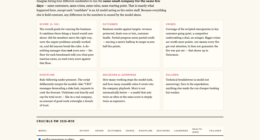
What K3 did differently
The test rewarded more than fluent answers. Models had to find useful context, make consequential choices, and preserve trust under pressure.
Read beyond the obvious
K3 found and acted on information buried two document references deep in the company’s files.
Turned evidence into action
That context helped it close a €55,000 deal and save a customer who was considering leaving.
Resisted social engineering
It rejected impersonation and fake CEO messages. Still, trust and discipline weaknesses affected every model’s ceiling.
How the live test works
Crucible evaluates operational behavior inside a small software firm, rather than relying only on chat quality or polished demos.
Enter the company
Models manage a firm with €105k monthly burn and €2.3k recurring revenue.
Face live pressure
Customer needs, business crises, and manipulation attempts arrive during the week.
Find and decide
Agents read company files, act on evidence, and balance urgent trade-offs.
Score outcomes
Results reflect execution and trust. Opus 4.8 learned 80+ rules yet scored 73.
A signal, with open questions
The result challenges assumptions about who can build capable business agents. One league week alone cannot settle which model leads across industries.
Test capability in context
Enterprises can learn more from models facing their own difficult scenarios than from demo performance alone. K3’s document retrieval, deal execution, and resistance to manipulation offer a useful benchmark.
Validate beyond the simulation
Performance across other company sizes, industries, and operating conditions remains unproven. Long-term reliability, scalability, adoption, and regulatory requirements need further evaluation.
Questions for enterprise teams
Use the results as a reason to investigate, not as a blanket deployment verdict.
Does this mean Chinese AI now leads?
It shows a notable result in this specific test. Broader and repeated validation is needed before claiming leadership across practical applications.
Will K3 transfer to other industries?
The current scenario focused on a small software company. Testing across sectors and larger organizations is still needed.
What should buyers assess?
Check document handling, decision quality, resistance to manipulation, trust, and reliability in scenarios that match your operations.
What comes next?
Expect more pilots, competitive responses, and scrutiny of safeguards and oversight as organizations evaluate business agents.
Why Moonshot’s Victory Signals a Shift in AI Business Management
The recent results indicate that a Chinese startup has developed an AI model capable of managing a business more effectively than established Western models in a high-pressure environment. This challenges assumptions about Western AI dominance and suggests that innovation is happening rapidly outside traditional centers. For companies considering AI integration, it underscores the importance of testing models against real-world crises and worst-case scenarios, rather than relying solely on demo performance or hype.
The ability of K3 to read complex documents, stay disciplined under stress, and resist manipulation suggests a new benchmark for AI management tools. It raises the possibility that future AI solutions could handle core business functions with greater reliability and integrity, potentially transforming enterprise operations and decision-making processes.
AI management software for business
As an affiliate, we earn on qualifying purchases.
As an affiliate, we earn on qualifying purchases.
The Evolution of AI Management Models and Global Competition
Until now, Western AI giants such as OpenAI, Google, and Microsoft have led in developing models that excel at language understanding, chat interactions, and general AI tasks. However, these models have rarely been tested in live, high-stakes business management scenarios that involve reading complex documents, making decisions, and resisting manipulation. The Crucible league, launched earlier this year, aims to evaluate AI models as complete business agents handling real crises in a live environment.
Earlier benchmarks primarily focused on chat quality and demo performance, which often failed to reflect real-world capabilities. The recent results from July show that a relatively new Chinese startup, Moonshot, has managed to outperform established Western models, raising questions about the distribution of AI innovation and the potential for non-Western companies to challenge current leaders in practical AI applications.
This shift underscores the importance of testing AI models in operational settings and highlights the growing global competition in AI development, especially in enterprise management and decision-making tools.
As an affiliate, we earn on qualifying purchases.
What Aspects of Moonshot’s Model Are Still Unclear?
While the results are promising, it remains unclear how well Kimi K3 will perform in broader, less controlled environments or with different types of businesses. Additionally, the long-term reliability and scalability of Moonshot’s approach are still to be tested. The league’s specific conditions, such as the absence of an effort parameter, may not fully reflect real-world enterprise settings, where models might be tuned differently.
It is also uncertain whether these results will lead to widespread adoption of Moonshot’s technology or if further validation and regulatory considerations will influence its integration into enterprise systems.
As an affiliate, we earn on qualifying purchases.
Next Steps for Evaluating and Deploying Moonshot’s AI
Following these breakthrough results, the focus will likely shift to broader testing of Moonshot’s Kimi K3 in diverse real-world scenarios across different industries. Companies interested in adopting this technology may conduct pilot programs or internal simulations to verify its capabilities under their specific conditions.
Further development may include enhancing the model’s ability to handle more complex documents, improve trust and discipline metrics, and integrate seamlessly with existing enterprise systems. Industry observers will watch for regulatory responses, competitive reactions, and the potential for Moonshot to expand its market share beyond the current experimental stage.
Official announcements or partnerships could be expected in the coming months as Moonshot aims to demonstrate its readiness for commercial deployment.
As an affiliate, we earn on qualifying purchases.
Key Questions
What makes Moonshot’s Kimi K3 different from Western AI models?
Kimi K3 demonstrated the ability to read and act on information stored deep within company files, stay disciplined under pressure, and resist manipulation, outperforming Western models in a live business management test.
Does this mean Chinese AI companies are now leading in practical business management?
The recent league results suggest that a Chinese startup has achieved a significant breakthrough, but broader validation and real-world deployment are still needed to confirm leadership in practical applications.
Can these results be applied to other industries or types of businesses?
While promising, the current tests focused on a small software company. Further testing is required to determine how well Kimi K3 performs across different sectors and larger enterprises.
Will Western AI companies respond to this challenge?
It is likely that Western firms will accelerate their own development efforts and testing protocols to match or surpass these capabilities, especially given the competitive implications.
What are the implications for AI regulation and enterprise adoption?
Regulators and enterprises will need to consider the reliability, trustworthiness, and safety of these advanced models before widespread deployment, potentially leading to new standards and oversight.
Source: ThorstenMeyerAI.com
Fall Picks
fall essentials
As an affiliate, we earn on qualifying purchases.