
📊 Full opportunity report: Understanding Anthropic’s $965B Series H: The Compute Revolution on ThorstenMeyerAI.com — validation score, market gap, and execution plan.

Get hardware and tech essentials delivered free — and shop member deals
- Fast, free delivery on millions of items
- Access to Prime Big Deal Days deals on October 6–7
- Prime Video, Amazon Music and more included
TL;DR
Anthropic’s $965 billion valuation is primarily a strategic move to fund massive compute infrastructure for scaling AI models like Claude. The round emphasizes hardware capacity, with commitments from chipmakers and hyperscalers, marking a shift toward infrastructure-driven AI growth.
Anthropic’s $65 billion Series H funding round has been announced, valuing the company at $965 billion. This move is centered on securing the physical infrastructure—chips, memory, and power—needed to scale AI models like Claude, rather than solely increasing valuation metrics.
Anthropic’s latest funding round, totaling $65 billion, is driven by a strategic focus on building the hardware backbone for AI scalability. Major investors include hyperscalers such as Amazon, which committed over $15 billion toward cloud infrastructure, chips, and data centers. The round emphasizes hardware capacity as the key bottleneck for advancing AI capabilities, with commitments from chipmakers like Micron, Samsung, and SK hynix to supply high-speed memory and storage components.
Revenue growth has been rapid, jumping from approximately $1 billion in late 2024 to a reported $47 billion run rate in early May 2026, a 5.4× increase in four months. Despite this, the valuation multiple has decreased from 27× to about 20.5×, indicating investor confidence is shifting toward tangible revenue and infrastructure scaling rather than speculative future potential. The focus on physical hardware underscores a strategic move to prevent bottlenecks that could limit AI development, with significant investments planned for chips, memory, and power capacity.
$965B and climbing — it’s really a compute bet
The viral headline is the valuation. The interesting story is in the press release’s middle paragraphs — and in three chipmakers Anthropic just named as strategic partners. This is a capacity round dressed as a funding round.
The numbers nobody can quite parse in sequence
Read together they describe a trajectory with no precedent in enterprise software. Read individually, each looks like a typo.
From $61.5B to $965B in fourteen months
Salesforce took roughly two decades to reach revenue numbers Anthropic just blew past. The sequence below is the part most coverage skips — it’s not the size, it’s the shape.
Anthropic’s valuation ladder · Mar 2025 → May 2026
Five rounds, fourteen months. Bar height is the valuation; the climb itself is the story. Tap any milestone for context.
The multiple actually got cheaper
Bubbles look like multiples expanding while revenue lags. Anthropic’s pattern is the inverse — the valuation tripled, but revenue grew faster, and the multiple compressed.
Revenue-to-valuation multiple · Series G → Series H
Same company, three months apart. The denominator (revenue) is outrunning the numerator (valuation) — exactly the opposite of what a bubble narrative predicts.
10+ gigawatts and three chipmakers
When you name Micron, Samsung & SK hynix alongside your equity backers, you’re saying the binding constraint isn’t demand or model quality — it’s the physical supply of memory chips. The Series H is a capacity round.
Compute commitments backing Anthropic’s capacity bet
$200B+ in announced compute spend across multi-year contracts. The $65B Series H raise has to be read against that bill, not against operating losses.
A genuinely durable bet — or a structural exposure?
Both readings can be true at once. The answer arrives over the next 18–24 months as the gigawatts come online and either fill with paying demand or don’t.
Revenue growth has no precedent in B2B software ($1B → $47B in 17 months). The multiple is compressing, not expanding. Claude is the only frontier model on all 3 major clouds. Enterprise AI spend share went from ~10% to >65% in a year. Compute commitments are tied to specific contracts with capacity dates.
20× revenue is not cheap by any historical software-investing standard. Revenue is reported gross of cloud-reseller pass-throughs, which inflates the top line. Profitability is 2 years out. Amodei’s own warning: a 12-month delay in AI progress “would make him bankrupt” — the compute commitments are a structural exposure to demand persistence.
The valuation race — and the IPO context
Anthropic shipped Opus 4.8 the same morning as Series H — not a coincidence. One week after OpenAI filed confidentially for IPO. The late-2026 frame is set: two frontier AI companies racing to public markets, each pitching durability.
Why Infrastructure Investment Is Key to AI Scaling
This funding round reflects a fundamental shift in AI development: companies are now investing heavily in physical hardware infrastructure—chips, memory, and power—to support the next wave of AI capabilities. This approach aims to eliminate physical bottlenecks that could slow model training and deployment at scale. For readers, this signals that future AI progress will depend more on hardware capacity and supply chain resilience than solely on software advancements. It also indicates a long-term strategic commitment by major players to control the physical infrastructure critical for AI dominance, potentially impacting supply chains, hardware costs, and global technology competition.
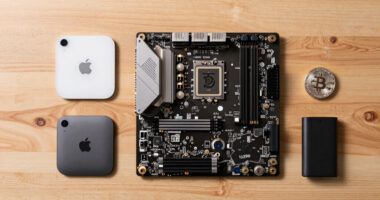
AI hardware infrastructure components
As an affiliate, we earn on qualifying purchases.
As an affiliate, we earn on qualifying purchases.
From Valuation to Infrastructure: The Evolving AI Funding Landscape
Anthropic’s $965 billion valuation surpasses previous tech valuation records, but the focus of the latest round reveals a different story. Unlike traditional funding rounds that prioritize valuation growth based on revenue or user metrics, this round emphasizes infrastructure investments. Major tech giants like Amazon, Microsoft, and Nvidia have committed billions toward hardware capacity, signaling a broader industry trend where physical infrastructure—chips, memory, and data centers—becomes the primary bottleneck for AI advancement. This shift reflects an understanding that hardware limitations are the critical constraint to scaling models like Claude, and that controlling supply chains and hardware capacity is essential for maintaining competitive advantage.
“Our focus is on building the hardware foundation necessary to scale Claude and other models efficiently and reliably.”
— Anthropic spokesperson
high-speed memory modules for servers
As an affiliate, we earn on qualifying purchases.
As an affiliate, we earn on qualifying purchases.
Unresolved Questions on Hardware Supply and Deployment
It remains unclear how supply chain disruptions, hardware obsolescence, or geopolitical factors might impact the planned infrastructure investments. Details about the exact timelines for hardware deployment, the scale of future capacity increases, and how these investments will be operationalized are still emerging. Additionally, the long-term impact of such heavy infrastructure commitments on AI development speed and costs is yet to be fully understood. For a detailed analysis, see the original analysis.
As an affiliate, we earn on qualifying purchases.
Next Steps for Infrastructure Deployment and AI Scaling
Anthropic and its partners are expected to begin large-scale deployment of hardware infrastructure over the coming months, with milestones focused on expanding data center capacity and securing supply chains. Monitoring how these investments translate into real-world AI performance and whether hardware bottlenecks are effectively alleviated will be critical. Additionally, the company and industry analysts will watch for further announcements on supply agreements, hardware innovations, and potential impacts on AI model training timelines.
As an affiliate, we earn on qualifying purchases.
Key Questions
Why is Anthropic raising such a large amount of funding now?
Anthropic’s funding is aimed at securing the physical infrastructure—chips, memory, and power—needed to scale AI models like Claude, rather than just increasing valuation. This reflects a strategic focus on hardware capacity as the key to future AI growth.
How does this funding round differ from typical venture capital raises?
Unlike traditional rounds focused on valuation based on revenue or user metrics, this round emphasizes infrastructure investments—hardware, data centers, and supply chain commitments—to support large-scale AI deployment.
What are the risks associated with this infrastructure-focused approach?
Risks include supply chain disruptions, hardware obsolescence, and geopolitical tensions affecting hardware availability. Long-term success depends on effective deployment and management of these physical assets.
Will this infrastructure investment accelerate AI development?
Yes, by addressing physical bottlenecks, these investments aim to enable faster, more reliable scaling of AI models, potentially leading to more advanced capabilities and broader deployment.
Source: ThorstenMeyerAI.com
Halloween Picks
halloween
As an affiliate, we earn on qualifying purchases.