
📊 Full opportunity report: Parental Consent Management In Privacy-Conscious Youth Services on IdeaNavigator AI — validation score, market gap, and execution plan.

Get hardware and tech essentials delivered free — and shop member deals
- Fast, free delivery on millions of items
- Access to Prime Big Deal Days deals on October 6–7
- Prime Video, Amazon Music and more included
TL;DR
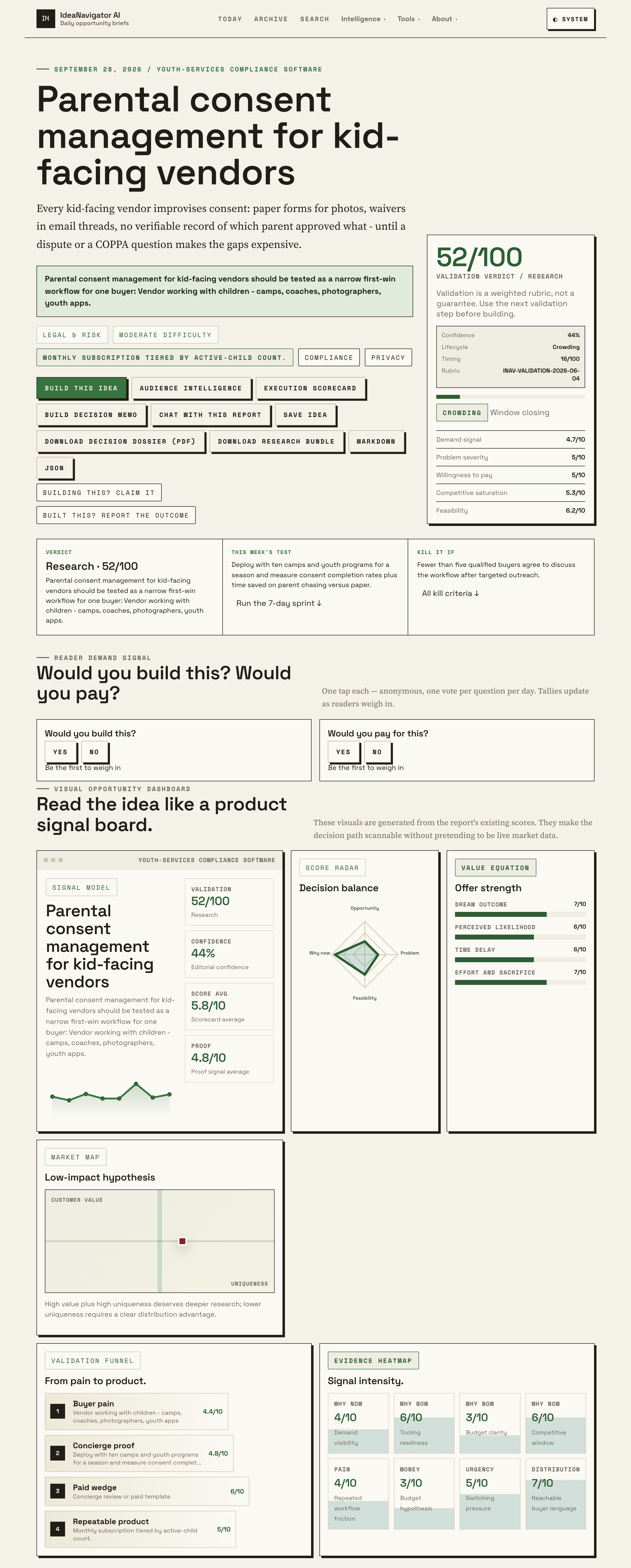
An IdeaNavigator AI proposal describes a consent-management service for camps, coaches, photographers and youth apps. It recommends testing phone-based, vendor-branded forms with ten youth programs for one season; no pilot results or product launch are reported.
IdeaNavigator AI has proposed a parental consent-management service for camps and other businesses working with children, alongside a plan to test it with ten youth programs for one season. The proposal targets vendors that currently handle permissions through paper forms and email, but it does not report that a product has launched or that a pilot has begun.
The proposed service would let parents complete vendor-branded consent forms on a phone. Suggested form categories include photo use, data collection, medical information and liability. The proposal also calls for identity checks matched to the perceived risk, a separate consent record for each child, expiry tracking and an audit export that vendors could produce when needed.
The suggested business model is a monthly subscription tiered by active-child count. The initial customer group is deliberately narrow: camps, coaches, photographers and youth apps that work directly with children. IdeaNavigator AI describes the problem as inconsistent records of which parent approved which activity, leaving vendors to reconstruct decisions when a dispute or privacy question arises.
To assess whether the service solves that problem, the proposal recommends deploying it with ten camps and youth programs for a season. It identifies two measures: how often parents complete consent requests and how much staff time is saved chasing forms compared with paper processes. No results, participating organizations, launch date or pricing figures are provided.
A Record for Each Child
For small youth-service providers, permissions can cover different activities and information, and one broad signature may not make clear what a parent approved or when that approval ends. A searchable, dated record could make it easier for staff to check whether permission exists before using a photograph or collecting information. The proposal’s per-child ledger and expiry tracking are intended to address those recordkeeping gaps.
The practical value remains a question for the proposed pilot. Phone-based forms could reduce follow-up work, but the plan has not established that parents will complete them more often, that staff will save time, or that the records will meet a particular legal requirement. Those outcomes would depend on how the system is implemented and on the needs of each vendor.
Top picks for "parental consent management"
As an affiliate, we earn on qualifying purchases.
From Paper Forms to Phone
The proposal describes a familiar operational problem: youth vendors may collect photo permissions on paper, send waivers through email or use different processes for different activities. It says those approaches can leave no readily verifiable record of which parent consented to which use. This is the problem statement behind the suggested service, not evidence from a published survey or a reported investigation.
IdeaNavigator AI presents the opportunity against a backdrop of changing children’s privacy rules and greater parental scrutiny of photo and data use. It specifically points to COPPA updates and state laws, but does not identify particular provisions, jurisdictions or enforcement actions. The proposal therefore frames regulatory and parental pressure as reasons to explore the product, rather than documenting a specific legal change or case.
Pilot and Legal Fit Unknown
No pilot results or launch details are available in the proposal. It does not name participating camps or programs, give a timetable, provide subscription prices, or state how many parents or children a test would involve. It also does not report whether any vendors have committed to use the service.
The proposed identity checks are described only as appropriate to each risk tier; the verification methods and tier definitions are not specified. Nor does the proposal establish how the service would handle disputed approvals, custody arrangements, data retention, security incidents or withdrawal of consent. Its references to privacy rules do not amount to a legal assessment of whether a particular workflow would satisfy requirements in a given location.
A Season-Long Test
The next step outlined is a seasonal test with ten camps and youth programs. If carried out, it would track consent completion and compare staff time spent following up with parents against the paper process. The proposal does not say when recruitment would begin or when findings would be released.
Further details would be needed to judge the results, including how completion rates are calculated, what counts as time saved and whether the participating programs represent the wider range of youth vendors. Until a pilot is reported, the service remains a product proposal with a suggested validation plan.
Key Questions
Has the parental consent service launched?
The proposal does not report a launch. It describes a possible product and recommends a pilot with ten youth programs.
Who is the proposed service for?
It is aimed at vendors working with children, including camps, coaches, photographers and youth apps.
What would parents be asked to do?
Parents would complete vendor-branded phone forms covering areas such as photo use, data collection, medical information and liability. The specific form design has not been provided.
How would the pilot be evaluated?
The proposed measures are consent completion rates and staff time spent following up with parents compared with paper forms. No pilot results are available.
Does the proposal establish legal compliance?
No. It refers to children’s privacy rules as part of the rationale for exploring the service, but does not provide a legal analysis or confirm compliance in any jurisdiction.
Source: IdeaNavigator AI
Fall Picks
fall essentials
As an affiliate, we earn on qualifying purchases.