
TL;DR

Get hardware and tech essentials delivered free — and shop member deals
- Fast, free delivery on millions of items
- Access to Prime Big Deal Days deals on October 6–7
- Prime Video, Amazon Music and more included
Anthropic’s $65 billion Series H round isn’t only a valuation milestone — it’s a massive investment in AI infrastructure and compute capacity. This move signals that access to chips, cloud power, and data-center hardware now fuels AI growth more than ever before.
When a company announces a $65 billion funding round, you expect numbers — but what really matters is what the money is for. In Anthropic’s case, that ‘what’ is not just about valuation. It’s about building the backbone of the next AI era: massive-scale compute capacity. This isn’t just a funding story; it’s a strategic shift that could redefine how AI giants grow and compete.
Think of it like a sports team investing in a state-of-the-art stadium, not just to host games but to attract top talent, fans, and sponsors. Anthropic’s recent move signals a focus on infrastructure — chips, data centers, and cloud power — to support the towering models and workloads of tomorrow. Here’s what’s really happening behind the headlines, and why it matters for anyone interested in the future of AI.
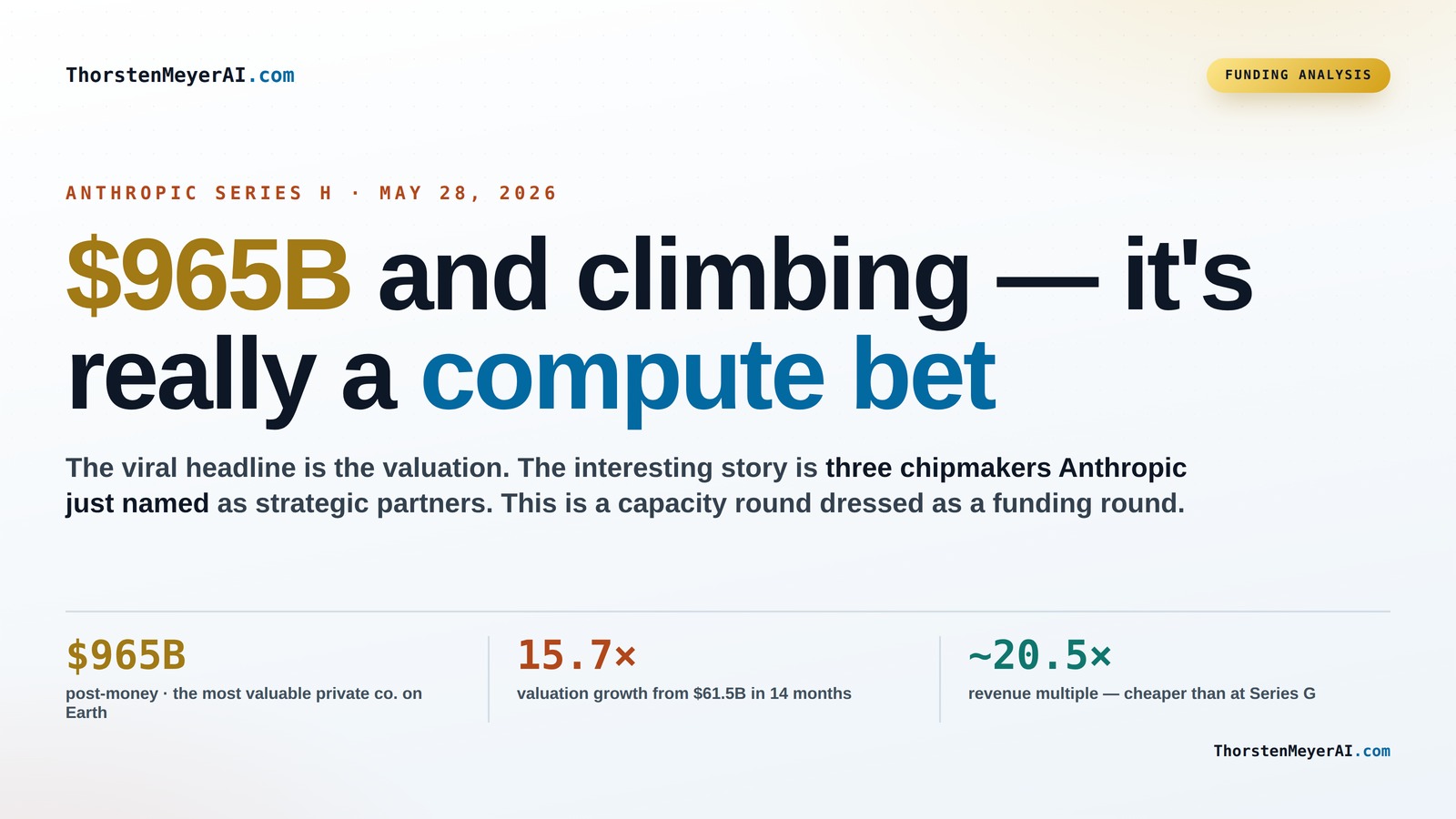
$965B and climbing — it’s really a compute bet
The viral headline is the valuation. The interesting story is in the press release’s middle paragraphs — and in three chipmakers Anthropic just named as strategic partners. This is a capacity round dressed as a funding round.
The numbers nobody can quite parse in sequence
Read together they describe a trajectory with no precedent in enterprise software. Read individually, each looks like a typo.
From $61.5B to $965B in fourteen months
Salesforce took roughly two decades to reach revenue numbers Anthropic just blew past. The sequence below is the part most coverage skips — it’s not the size, it’s the shape.
Anthropic’s valuation ladder · Mar 2025 → May 2026
Five rounds, fourteen months. Bar height is the valuation; the climb itself is the story. Tap any milestone for context.
The multiple actually got cheaper
Bubbles look like multiples expanding while revenue lags. Anthropic’s pattern is the inverse — the valuation tripled, but revenue grew faster, and the multiple compressed.
Revenue-to-valuation multiple · Series G → Series H
Same company, three months apart. The denominator (revenue) is outrunning the numerator (valuation) — exactly the opposite of what a bubble narrative predicts.
10+ gigawatts and three chipmakers
When you name Micron, Samsung & SK hynix alongside your equity backers, you’re saying the binding constraint isn’t demand or model quality — it’s the physical supply of memory chips. The Series H is a capacity round.
Compute commitments backing Anthropic’s capacity bet
$200B+ in announced compute spend across multi-year contracts. The $65B Series H raise has to be read against that bill, not against operating losses.
A genuinely durable bet — or a structural exposure?
Both readings can be true at once. The answer arrives over the next 18–24 months as the gigawatts come online and either fill with paying demand or don’t.
Revenue growth has no precedent in B2B software ($1B → $47B in 17 months). The multiple is compressing, not expanding. Claude is the only frontier model on all 3 major clouds. Enterprise AI spend share went from ~10% to >65% in a year. Compute commitments are tied to specific contracts with capacity dates.
20× revenue is not cheap by any historical software-investing standard. Revenue is reported gross of cloud-reseller pass-throughs, which inflates the top line. Profitability is 2 years out. Amodei’s own warning: a 12-month delay in AI progress “would make him bankrupt” — the compute commitments are a structural exposure to demand persistence.
The valuation race — and the IPO context
Anthropic shipped Opus 4.8 the same morning as Series H — not a coincidence. One week after OpenAI filed confidentially for IPO. The late-2026 frame is set: two frontier AI companies racing to public markets, each pitching durability.
Key Takeaways
- Anthropic’s $65 billion Series H is primarily a strategic investment in AI infrastructure, not just a valuation milestone.
- Over $10 billion of the round is pre-committed from hyperscalers like Amazon, emphasizing infrastructure’s role in AI scaling.
- The company’s revenue growth is fueling a lower valuation multiple, indicating a focus on efficiency and infrastructure leverage.
- Access to chips, data centers, and cloud capacity now acts as a strategic moat for AI leaders.
- Investors are betting on physical infrastructure as much as on AI models, signaling a shift toward hardware-driven AI dominance.
As an affiliate, we earn on qualifying purchases.
Why the $965 Billion valuation isn’t the whole story
The headline of Anthropic’s latest round screams: ‘Most valuable AI startup in the world.’ But the real story is in the details—namely, how the valuation reflects a massive investment in AI’s future infrastructure. The $965 billion figure is a reflection of the company’s anticipated growth, but it’s also a signal of how much AI is now a hardware and compute game.
For example, the valuation leap from $380 billion in February to over $960 billion in May shows investor confidence in Anthropic’s ability to scale compute. Essentially, they’re betting on the capacity to run bigger, smarter models, faster. Think of it as betting on the roads, bridges, and power plants that will support a future city—only here, it’s AI models and data centers.
**Practical takeaway:** If you’re building an AI-focused business or investment, prioritize infrastructure readiness—secure hardware partnerships, cloud capacity, and data-center expansion—since these are now key to scaling AI and attracting investor confidence.

As an affiliate, we earn on qualifying purchases.
The real purpose behind the $65 billion: a massive compute bet
Here’s the punch: most of that $65 billion isn’t just fresh capital pouring into the company’s coffers. It’s a dedicated investment in hardware, chips, and cloud capacity — a ‘capacity round.’ In fact, Anthropic named three memory chip giants—Micron, Samsung, SK hynix—as ‘strategic infrastructure partners’ [1].
Imagine ordering a fleet of super-powerful GPUs, the kind that can crunch trillions of calculations per second. These chips are the heart of AI training and inference. The round is essentially a promise: ‘We’re going all-in on infrastructure. This is about building the physical backbone of AI’s future.’
Practical takeaway: For AI startups or investors, consider how securing hardware and cloud capacity can act as a moat—controlling these resources can provide a competitive edge and scalability advantage in the AI race.
**Why does this matter?** Because in AI, having access to the right hardware isn’t just about speed; it’s about enabling the development of larger, more sophisticated models that can outperform competitors. The tradeoff is that hardware investments are capital-intensive and can create dependencies on specific suppliers or cloud providers, which could influence future flexibility and costs.

As an affiliate, we earn on qualifying purchases.
How hyperscalers and chipmakers shape the AI race
Anthropic’s deal is a clear sign: the AI race now hinges on access to massive compute. Over $10 billion of the round’s funding comes from pre-committed hyperscalers like Amazon, Microsoft, and Google [1].
Plus, the hardware giants—Micron, Samsung, SK hynix—are in the game. Think of this as a relay race, where the baton is high-end chips and cloud capacity. The fastest, most reliable infrastructure wins, and Anthropic is stacking the deck heavily in its favor.
For instance, Amazon’s $5 billion commitment shows how cloud giants are not just hosting AI—they’re fueling it. This infrastructure dependency is shaping how AI companies grow, compete, and plan their next moves.
Practical takeaway: Recognize that partnerships with hyperscalers and chipmakers are critical strategic assets—building strong relationships now can secure vital resources and give your AI initiatives a competitive advantage.
**Implications:** These collaborations often involve long-term commitments and shared infrastructure investments, which can lock in access and influence pricing. While advantageous, they also create dependencies that could limit flexibility, forcing companies to navigate the tradeoffs between control and reliance on external infrastructure providers.
As an affiliate, we earn on qualifying purchases.
What the revenue numbers reveal about AI’s sustainability
Anthropic’s revenue is exploding. From roughly $9 billion at the end of 2025 to over $47 billion in just a few months [1][2], the growth is staggering. But what does it really mean?
It suggests that AI applications are not just a niche anymore. Companies are integrating AI into core operations, and revenue from cloud resellers is skyrocketing. This rapid growth justifies the massive compute investments — it’s like building a highway because the traffic is about to triple.
Practical takeaway: Rapid revenue growth signals that AI adoption is accelerating—investors and companies should prioritize scalable infrastructure to meet surging demand and avoid bottlenecks that could hinder growth.
**Deeper insight:** Sustained revenue growth indicates that AI is becoming a core part of digital transformation strategies across industries. However, rapid growth also presents challenges, such as infrastructure strain, increased costs, and the need for continual hardware upgrades to keep pace with demand. Companies must weigh the tradeoff between aggressive expansion and operational efficiency, ensuring they build flexible, scalable infrastructure that can adapt to evolving AI workloads.

How Anthropic stacks up against OpenAI — and what it means
At a $965 billion valuation, Anthropic has overtaken OpenAI, which was valued at around $852 billion in March 2026 [1]. But the key isn’t just size — it’s the multiple of revenue.
OpenAI is trading at about 30× its annual revenue, while Anthropic now trades at roughly 20.5×. That’s a surprising shift: despite its enormous valuation, Anthropic’s multiple is lower, signaling that investors see it as more efficient or better positioned for scale.
This comparison reveals a market where the value isn’t solely based on current models but on the infrastructure and capacity to build even larger ones. It’s a race to dominate the physical and digital pipelines of AI’s future.
Practical takeaway: When evaluating AI companies, consider not just current revenue but also their infrastructure investments and scalability plans—these are increasingly critical to long-term valuation and market positioning.
**Implications:** A lower revenue multiple can indicate that investors are valuing future potential over current earnings, especially when significant infrastructure investments are involved. It underscores the importance of building scalable, adaptable hardware and software foundations to sustain long-term growth and competitiveness in AI.

What’s really being bought: growth, chips, or both?
Investors are buying more than just company growth — they’re investing in the hardware, chips, and data-center capacity that will power future AI models. The goal is not just to grow faster but to control the essential resources that make AI possible.
Think of it like a real estate developer buying land and building roads, not just building houses. The infrastructure is the foundation for all future revenue.
Practical takeaway: Prioritize securing hardware and infrastructure partnerships—controlling key resources can serve as a significant barrier to entry for competitors and a source of ongoing advantage in AI development.
**Deeper perspective:** As AI models grow larger and more complex, the hardware needed becomes a critical bottleneck. Controlling this infrastructure doesn’t just provide a competitive edge; it can determine the pace and scale of future innovation. Companies that secure exclusive or early access to hardware resources can set industry standards and limit rivals’ progress, effectively creating a hardware moat that’s difficult to breach.
Frequently Asked Questions
How can Anthropic justify a $965B valuation?
The valuation reflects investor confidence in Anthropic’s ability to scale AI compute infrastructure rapidly. It’s based on revenue growth, strategic hardware partnerships, and the massive capacity commitments to chips and data centers that will support future models.
Is the $65 billion raise all new capital, or does it include committed strategic funding?
Most of the funding is pre-committed from hyperscalers like Amazon, Microsoft, and Google, totaling over $10 billion. The round acts as a capacity investment, ensuring access to hardware and cloud resources for future AI growth.
Why is this being described as a compute deal?
The focus is on securing large-scale hardware and cloud capacity. The money is spent on chips, data centers, and infrastructure that are essential to training and running massive models — making it a strategic infrastructure investment.
How much of the money will go to GPUs, chips, and cloud infrastructure?
While exact figures aren’t public, industry estimates suggest billions will be allocated to high-end GPUs and memory chips, plus substantial investments in cloud capacity from hyperscalers. This is the core of the ‘capacity round.’
What does $47 billion run-rate revenue actually mean?
It indicates how much revenue the company is generating annually at the current growth rate. In Anthropic’s case, it signals rapid adoption of their AI services, justifying the enormous infrastructure investments.
Conclusion
Anthropic’s latest round is a sign: the future of AI hinges on infrastructure. Big valuations now reflect not only the models but the physical backbone that makes scaling possible.
As AI giants pour billions into chips and data centers, the race isn’t just about smarter algorithms — it’s about controlling the entire supply chain of compute. The question isn’t if AI will grow, but who will control the hardware that fuels its exponential rise.

Fall Picks
fall essentials
As an affiliate, we earn on qualifying purchases.