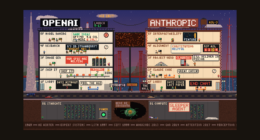

📊 Full opportunity report: Different Game, or Already Lost? Reading Mistral’s Sovereignty Bet on ThorstenMeyerAI.com — validation score, market gap, and execution plan.

Get hardware and tech essentials delivered free — and shop member deals
- Fast, free delivery on millions of items
- Access to Prime Big Deal Days deals on October 6–7
- Prime Video, Amazon Music and more included
TL;DR
Mistral emphasizes sovereignty, open weights, and local infrastructure to compete in Europe’s AI scene. Its success depends on infrastructure development and control over data, but questions remain about its long-term competitiveness.
Mistral has publicly prioritized building a sovereign AI ecosystem, emphasizing control over infrastructure, data, and models, positioning itself as a strategic player in Europe’s AI landscape.
During the AI Now Summit in Paris, Mistral’s CEO, Arthur Mensch, outlined the company’s approach to sovereignty, including ownership of a 40MW data center near Paris and plans for a €1.2 billion facility in Sweden. The company offers open-weight models that can be downloaded, fine-tuned, and operated locally, appealing to enterprises seeking compliance and independence from US cloud giants. Mistral claims that smaller, specialized models outperform larger general-purpose models in enterprise settings due to their speed, cost-efficiency, and targeted performance. The company warns Europe has roughly two years to develop full-stack AI infrastructure before reliance on US and Chinese providers becomes unavoidable. Critics question whether sovereignty-focused strategies can truly compete with the raw power and scale of global giants or if they are merely political posturing.Different game, or already lost?
Mistral now pitches itself as Europe’s full-stack AI provider — compute, models, platform, consultancy — not a frontier-model lab. Is that a real strategic insight, or making the best of a race it can’t win? Both readings fit the same facts.
From model lab to full-stack provider
The clearest signal from the summit wasn’t a model — it was a posture. Heavy on enterprise logos and partnerships (ASML, BNP Paribas, Alexa+), light on new-model announcements. That absence is exactly what skeptics seized on.
Compute
40MW Paris DC + Sweden build · 200MW target by 2027
Models
Open & custom · efficient · you own and run them
Platform
Forge for custom models · Vibe for Work agent
Consultancy
Sales teams, integrators, EU provenance & support
Small & focused, or large & general?
Mistral bets on specialized small models. The claim isn’t that they win a reasoning leaderboard — they don’t. It’s that on the metrics that matter in production agent systems, a purpose-built small model wins. Flip the metric to see the case reverse.
Small specialized vs large general — by what you measure
In token-heavy agentic apps making hundreds of calls, speed/energy/cost compound. Toggle the metric.
Narrow models doing real work
Each is one model doing one thing efficiently — the tangible version of the strategy. Strong on their own terms; the open question is whether the bundle beats a free Chinese open-weight download.
On-prem KYC compliance
Mistral models run inside the bank’s walls for know-your-customer checks. Sensitive financial data never leaves. (BNP was Mistral’s first customer, 2023.)
Voxtral multilingual voice
A focused voice model powering Alexa+ across Europe — speed and efficiency over raw size.
Robostral industrial robotics
Plus a “physics AI” push (via the Emmi acquisition) into aerospace, automotive & semiconductor design and simulation.
Document AI / OCR at scale
Large-scale text extraction — the unglamorous, high-volume enterprise work small models excel at.
The strategy is downstream of the compute gap
Once you see the raw numbers, “why is Mistral behind?” answers itself — and the specialized-small-model strategy starts looking partly like a smart adaptation to a binding constraint, not a pure philosophical choice.
Compute & capital · Mistral vs a frontier leader, this same week
Not a knock — it’s the constraint that forces the efficiency-first, sovereignty-wedge strategy. Adapting intelligently to your position is what good strategy is.
“I want them to win, but I’m worried”
That ambivalence is the most accurate read of where Mistral sits. The enterprise pivot gets read two opposite ways — and both deserve airing.
On-prem, real sales teams, the Koyeb deployment acquisition, EU provenance — exactly what regulated enterprises want, and stickier than consumer mindshare. Targeting €1B revenue in 2026 with 1,000 staff, up from 15 people and one customer in 2023. US closed-API labs structurally can’t match the sovereignty axis.
“Software consultancy with a data center,” not a foundation-model moat. Enterprise B2B is where European startups go when they can’t win consumer or world-scale SaaS. Why pay Mistral on-prem when you could run Qwen free? One paying Le Chat Pro user said the quality gap with frontier labs is now hard to ignore.
Implications of Europe’s Sovereignty-Driven AI Approach
Mistral’s focus on sovereignty could reshape Europe's AI industry by reducing dependence on US and Chinese giants, fostering local innovation, and ensuring regulatory compliance. However, the strategy’s success hinges on rapid infrastructure development and the ability to compete in performance and scale. If Europe cannot mobilize resources quickly enough, the continent risks falling further behind in frontier AI capabilities, potentially limiting economic and strategic independence.enterprise AI data center equipment
As an affiliate, we earn on qualifying purchases.
As an affiliate, we earn on qualifying purchases.
Europe’s AI Ambitions and Infrastructure Race
European policymakers and companies have emphasized sovereignty in AI, investing in local data centers and infrastructure to meet strict regulatory standards, as detailed in the original analysis. Mistral’s announcement aligns with broader efforts to build a self-sufficient AI ecosystem within Europe. However, global giants like OpenAI, Google, and Chinese firms already dominate the infrastructure and model training landscape. The European Union has set ambitious timelines, estimating about two years to develop a viable sovereign AI infrastructure before dependence on external providers becomes critical, highlighting the urgency of Europe’s sovereignty efforts. Previous initiatives, such as the European Chips Act, highlight the continent’s recognition of the need for strategic independence in critical tech sectors. Mistral’s approach reflects these efforts, but the scale and speed required remain significant challenges."Europe has roughly two years to build its AI infrastructure before becoming reliant on US and Chinese giants."
— Arthur Mensch, CEO of Mistral
local AI model deployment hardware
As an affiliate, we earn on qualifying purchases.
As an affiliate, we earn on qualifying purchases.
Unclear Outcomes of Europe’s Sovereignty Push
It is not yet clear whether Europe can mobilize the necessary infrastructure and talent within the two-year window to achieve true AI sovereignty. The effectiveness of Mistral’s approach in competing with established US and Chinese giants remains uncertain, especially regarding model performance, scalability, and ecosystem development. Additionally, the impact of regulatory and political factors on implementation is still developing, and the global AI landscape continues to evolve rapidly.
European sovereign AI infrastructure
As an affiliate, we earn on qualifying purchases.
As an affiliate, we earn on qualifying purchases.
Next Steps for Europe’s Sovereign AI Roadmap
European governments and companies are expected to accelerate investments in local AI infrastructure and talent development over the coming months. Mistral and other local providers will likely announce new models, infrastructure projects, and partnerships aimed at strengthening sovereignty. Monitoring these developments will be key to assessing whether Europe can meet its strategic goals within the proposed timeframe. Meanwhile, global giants continue to expand their dominance, making the race for sovereignty a high-stakes contest.
open weights AI models for enterprise
As an affiliate, we earn on qualifying purchases.
As an affiliate, we earn on qualifying purchases.
Key Questions
Can Mistral’s sovereignty strategy succeed against global giants?
It is uncertain. Success depends on Europe’s ability to rapidly develop infrastructure, talent, and models that match or surpass the scale and power of US and Chinese competitors.
What advantages does local deployment offer for European companies?
Local deployment enhances compliance with strict data privacy regulations, reduces reliance on external providers, and offers greater control over data and models.
Will open weights give Mistral a competitive edge?
Open weights provide flexibility and control, especially for regulated industries, but may not be enough to challenge larger models in raw performance or scale without significant support and infrastructure.
How urgent is Europe’s timeline to achieve AI sovereignty?
According to Mistral’s CEO, Europe has about two years to build a full-stack AI ecosystem before dependence on US and Chinese providers becomes unavoidable.
What risks does Europe face if it fails to develop sovereign AI infrastructure?
Europe could become reliant on foreign AI giants, risking loss of control over data, regulation, and strategic autonomy, potentially limiting economic and technological independence.
Source: ThorstenMeyerAI.com
Fall Picks
fall essentials
As an affiliate, we earn on qualifying purchases.