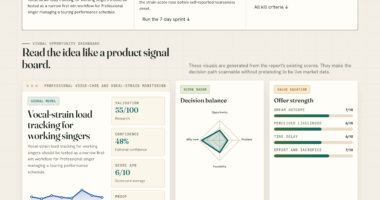

📊 Full opportunity report: Sovereignty Is a Pipe, Not a Passport on ThorstenMeyerAI.com — validation score, market gap, and execution plan.

Get hardware and tech essentials delivered free with Prime
- Fast, free delivery on millions of items
- Prime Video, Amazon Music and more included
- Member-only deals all year
TL;DR
Mistral claims to offer European AI sovereignty by hosting models on European infrastructure. However, when models are delivered via US cloud platforms, jurisdictional risks remain, highlighting sovereignty as a property of data flow, not company origin.
Mistral, a European AI startup valued at $14 billion, emphasizes its sovereignty by hosting models on European infrastructure and avoiding US jurisdiction. However, when its models are distributed through US cloud platforms like Azure or Google Cloud, the legal risks under American law persist, complicating claims of European data sovereignty.
The core of the controversy lies in the US CLOUD Act, which allows American authorities to compel US-based cloud providers to produce data, regardless of where that data physically resides. This means that even if a model is hosted in Europe, using US cloud infrastructure exposes the data to US legal reach.
Mistral’s genuine sovereignty advantage exists when models are self-hosted or run on European-owned data centers—such as its Paris or Swedish facilities—where the jurisdiction is clearly European. European certifications like SecNumCloud and BSI C5 further support this, and European investors have financed these assets with no US involvement.
However, most enterprises consume models via managed services on US hyperscalers, where the pipe—the cloud platform—is governed by US law. This diminishes the sovereignty claim, as the legal jurisdiction is tied to the platform’s headquarters, not the physical location of the data or the company’s origin.
Sovereignty is a pipe, not a passport
Mistral sells European data sovereignty — then distributes its models through Azure, Bedrock & Google Cloud, the American infrastructure it tells customers to flee. A French passport on the lab doesn’t travel down an American wire.
Mistral-direct
hyperscaler
The CLOUD Act lets US authorities compel a US-headquartered provider to hand over data wherever it physically sits. Picking the “EU region” in AWS or Azure doesn’t resolve it — jurisdiction follows the company’s HQ, not the server’s location. Schrems II established the same from the EU side.
Mistral isn’t selling a lie — it’s selling a conditional truth, and the condition is the part the marketing skips. Sovereignty holds on Mistral’s own iron; it leaks the moment convenience routes the model through the American cloud. The deeper lesson cuts at Brussels: sovereignty is an end-to-end property of the whole stack — model, cloud, chips, supply chain — that Europe owns at no layer except the model itself. As Mensch put it: you “cannot regulate your way to computing supremacy.”
Legal Jurisdiction Overrides Company Nationality in Data Sovereignty
This situation demonstrates that ownership of physical infrastructure alone does not determine legal sovereignty if data flows through US-controlled cloud services. For European enterprises and regulators, understanding that jurisdiction follows the data pipe, not the company’s nationality, is important. This influences procurement, compliance, and strategic decisions for AI vendors and users.
As an affiliate, we earn on qualifying purchases.
Legal and Industry Frameworks Shape Data Sovereignty Challenges
The 2018 US CLOUD Act and the 2020 Schrems II ruling established that jurisdiction depends on the location of the service provider, not the data. European regulators remain cautious, especially after controversies like France’s Health Data Hub, which hosts European data on US-controlled infrastructure. European certifications and financing structures increasingly favor local hosting, but reliance on US hardware and subcontractors persists, complicating sovereignty claims.
self-hosted AI model infrastructure
As an affiliate, we earn on qualifying purchases.
As an affiliate, we earn on qualifying purchases.
Extent of Legal Exposure When Using US Cloud Platforms
The practical implications for compliance and data protection when using US hyperscalers are still being clarified by regulators. While legal principles are established, the enforcement and interpretation of jurisdictional risks continue to evolve, especially with new EU controls like Microsoft’s EU Data Boundary.
As an affiliate, we earn on qualifying purchases.
Legal Clarifications and Industry Shifts to Reinforce Sovereignty
European regulators are expected to increase oversight of cloud providers and AI vendors, potentially implementing stricter compliance standards and clearer jurisdictional boundaries. US cloud providers are expanding EU-specific controls, but the effectiveness of these measures in mitigating legal risks remains under assessment. European companies may prioritize local hosting or pursue new legal safeguards in future contracts.
European cybersecurity certification
As an affiliate, we earn on qualifying purchases.
As an affiliate, we earn on qualifying purchases.
Key Questions
Does hosting a model in Europe guarantee data sovereignty?
Hosting in Europe reduces physical and legal risks, but if the model is delivered via US cloud platforms, jurisdictional exposure under US law remains unless additional safeguards are implemented.
What is the main legal risk for European AI companies using US cloud providers?
The primary risk is that US authorities can compel US-based cloud providers to produce data, regardless of where it physically resides, under the CLOUD Act.
Can certifications like SecNumCloud fully protect European data sovereignty?
Certifications improve compliance and trust but do not eliminate jurisdictional risks if the underlying cloud infrastructure is US-based and subject to US law.
Will European regulators enforce stricter controls on US cloud usage?
European regulators are increasingly attentive to jurisdictional issues and may implement tighter rules or oversight to ensure data remains within European legal boundaries.
Is hardware supply chain a sovereignty concern?
Reliance on US-controlled hardware like Nvidia GPUs introduces hardware-related sovereignty issues, as US export laws still apply, even if data is hosted in Europe.
Source: ThorstenMeyerAI.com
Halloween Picks
halloween
As an affiliate, we earn on qualifying purchases.