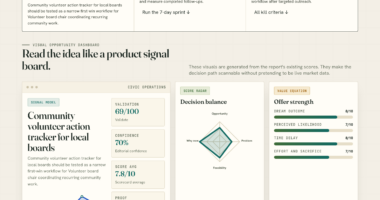

📊 Full opportunity report: The pyramid cracks. What agentic AI does to the consulting leverage model. on ThorstenMeyerAI.com — validation score, market gap, and execution plan.

Get hardware and tech essentials delivered free — and shop member deals
- Fast, free delivery on millions of items
- Access to Prime Big Deal Days deals on October 6–7
- Prime Video, Amazon Music and more included
TL;DR
AI is transforming the consulting industry by undermining the traditional pyramid model. Analysis-heavy firms face margin pressure, while execution-focused firms benefit from new AI deployment opportunities. The industry is splitting, not shrinking, with significant talent and structural implications.
Generative AI is significantly disrupting the traditional consulting leverage model, leading to a structural split in the industry. Firms focused on analysis are experiencing margin compression and headcount reductions, while those specializing in AI deployment are expanding rapidly. This development alters the industry’s economic foundation and talent pipeline, making it a pivotal moment for consulting firms worldwide.
The consulting industry has long operated on a pyramid leverage model, where a broad base of junior analysts performs high-volume, document-heavy work that is billed at a multiple of their cost. Recent advancements in generative AI, such as language models capable of research, synthesis, and initial modeling, threaten to commoditize this analysis work. Major firms like McKinsey, KPMG, and Accenture have already begun to adjust: McKinsey has reduced headcount by approximately 10%, while Accenture reports record bookings and a large team of AI specialists. These changes are not uniform; strategy advisory firms are experiencing margin squeeze, whereas execution-focused firms are thriving by offering large-scale AI deployment and change management services. Industry analysis indicates that the traditional pyramid is breaking apart, with analysis-based revenue shrinking and deployment-based revenue expanding. This creates a split in the industry’s DNA, affecting talent pipelines and the long-term structure of consulting firms.The pyramid cracks.
What agentic AI does
to the consulting
leverage model.
per McKinsey’s own Quantum Black
non-client-facing cuts coming
85,000+ AI & data professionals
growth % — the compression, visible
before AI
for the same output
The compression is a reallocation, not a contraction. The demand for help migrates from analysis — which AI commoditizes — to deployment — which AI creates demand for. The pyramid that monetized analysis-by-juniors compresses. The firm that monetizes deployment-at-scale grows.Thorsten Meyer · The Pyramid Cracks · Enterprise Reorg 02
Implications of AI-Induced Industry Reorganization
This shift signifies a fundamental transformation in consulting economics, talent development, and service offerings. Firms relying on analysis-heavy models face margin pressures and talent pipeline erosion, potentially reducing their future partner pools. Conversely, firms that excel in AI deployment and implementation are capturing new revenue streams, reshaping competitive dynamics. The industry’s core leverage model is under threat, which could lead to long-term structural changes and a redefinition of value creation in consulting.AI-powered consulting analysis software
As an affiliate, we earn on qualifying purchases.
As an affiliate, we earn on qualifying purchases.
Industry Evolution and AI’s Growing Role
For over a century, the consulting industry has depended on a pyramid model where junior analysts perform high-volume, structured work that feeds into senior oversight and billings. Recent advances in generative AI have begun to automate much of this work, threatening the traditional analysis-based revenue stream. Firms like McKinsey have already begun reducing headcount in non-client-facing roles, while Accenture’s focus on AI deployment has led to record bookings. The industry is experiencing a split: analysis-focused firms facing margin compression, and deployment-focused firms expanding rapidly. This evolution is driven by AI’s ability to compress research and synthesis time, shifting demand toward large-scale implementation and change management services.“The leverage pyramid that defined elite consulting is the most exposed structure in professional services, because its economics depend on billing out a large base of juniors doing exactly the work AI now does.”
— Thorsten Meyer
generative AI research and synthesis tools
As an affiliate, we earn on qualifying purchases.
As an affiliate, we earn on qualifying purchases.
Unclear Long-Term Industry Structural Changes
While early signs show a clear industry split, the full long-term impact on firm structures, talent pipelines, and profitability remains uncertain. It is not yet confirmed how deeply the analysis work will be commoditized or how quickly deployment-focused firms will dominate the market.
enterprise AI deployment solutions
As an affiliate, we earn on qualifying purchases.
As an affiliate, we earn on qualifying purchases.
Monitoring Industry Reorganization and Talent Flows
Next steps include tracking firm-by-firm headcount adjustments, shifts in service offerings, and changes in partner pipelines over the coming 12-24 months. Further analysis will clarify whether the industry stabilizes around a new equilibrium or continues to fragment into specialized niches.
AI change management consulting services
As an affiliate, we earn on qualifying purchases.
As an affiliate, we earn on qualifying purchases.
Key Questions
How is AI affecting consulting firm profitability?
AI is compressing analysis-based revenue streams, leading to margin pressures in firms reliant on junior labor for research and synthesis. Meanwhile, deployment-focused firms are expanding, capturing new revenue from large-scale AI implementation.
Will traditional consulting firms survive the AI disruption?
Yes, but their roles and structures are changing. Firms that adapt by shifting toward AI deployment and implementation services are more likely to thrive, while those solely focused on analysis may face long-term decline.
What does this mean for consulting talent pipelines?
The analysis-driven training ground for future partners is shrinking, which could lead to fewer partner-level roles in the future. Firms may need to reorient talent development toward deployment and execution skills.
Is this industry split permanent or temporary?
The current divergence appears structural, reflecting different business models’ resilience to AI. Whether this leads to a stable bifurcation or further consolidation remains uncertain.
Source: ThorstenMeyerAI.com
Fall Picks
fall essentials
As an affiliate, we earn on qualifying purchases.